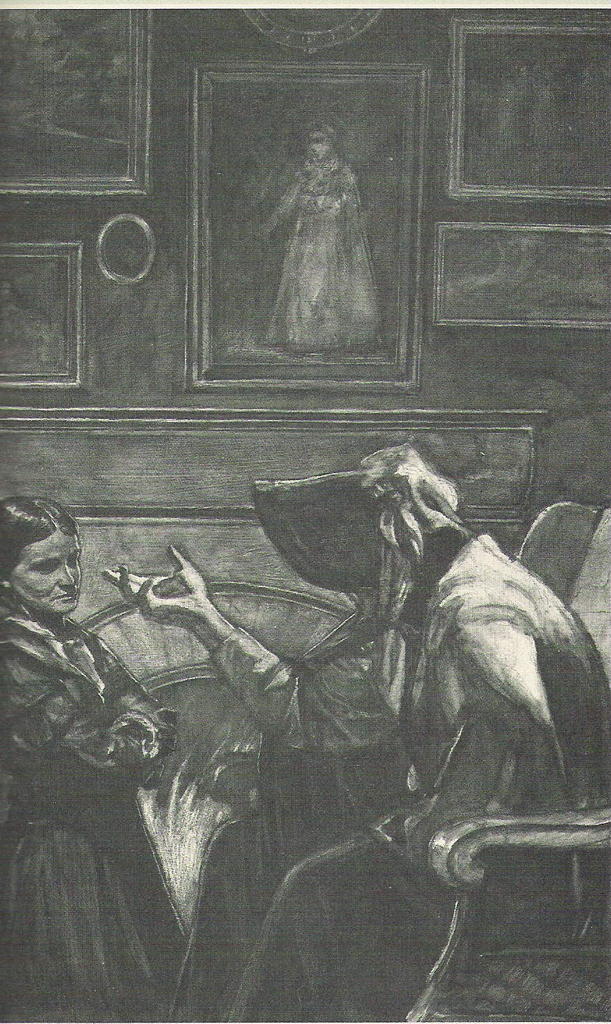
Costuming in Jane Eyre
Again, due to the too too wonderful Kristin!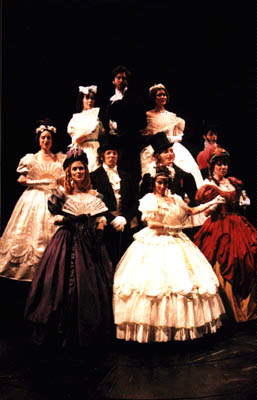
South Bend Tribune (Indiana)May 13, 2001 Sunday Michigan EditionSECTION:
INTERMISSION; Pg. E3HEADLINE: Dressed to thrill; Behind the curtain, costume designer allows work to take center stageBYLINE: By KARIN LIPSON; Newsday
NEW YORK -- Not a beat was lost in the busy backstage rhythm of the Brooks Atkinson Theatre as actor Stephen R. Buntrock [who played St.John Rivers and understudied the role of Rochester] yelled, in mock outrage, "She's got her hands down my pants!"
Andreane Neofitou did indeed have her hands, if not exactly down, at least on the back of Buntrock's trousers. But then, this was the last technical rehearsal for the Broadway musical "Jane Eyre," which recently received a best musical Tony Award nomination.
Neofitou, the show's costume designer, was ready to do some pants adjusting for a cast member if that's what was needed. So, too, with fixing the elegant pale green damask waistcoat of male lead James Barbour, or checking out some wigs, or fretting over an actress's ill-fitting shoe.
What was she looking for, exactly? "I look at everything," she said. "There's nothing I'm looking for, because I don't know what won't be right. If you see something, it means it's wrong."
Uh-oh. She saw something. But what? On stage, it was a beautiful day in the neighborhood, if your neighborhood happened to be the moody English moors. In the garden of mysterious Thornfield Hall, Jane (played by Marla Schaffel) had chanced upon a bevy of bratty aristocrats, led by the flighty Blanche Ingram (Elizabeth DeGrazia). Blanche was all flounces and ruffles and pouffy white silk taffeta, while Jane -- plain Jane, penniless Jane, the lowly governess -- was severely clad in black. A perfect contrast in station and character, it would seem.
But in her seat, Neofitou was not entirely pleased. Those dazzling white dresses of Blanche and company threatened to visually overwhelm the dark gown worn by Jane, upsetting the balance of the scene.
"I could put her gray collar on, so it catches the light a little more," mused Neofitou, as her assistant, Devon Painter, took notes.
Within days, not only was the collar on, but Neofitou was shopping for fabric during previews to create new, more casual and less commanding pastel dresses for the silly gaggle of girls that mocks Jane in the garden.
Dressing down a scene is not what one usually thinks of as a goal of a costume designer. But "for me, it's never a matter of doing pretty costumes," said Neofitou. "I'm trying to bring a world -- with period pieces, specifically, it's an alien world -- to modern audiences, to make that world the present. I don't want to have a barrier between the audience and what's going on onstage. You have to make that costume so familiar, so real to that character, that the audience doesn't see the costumes, it sees the character."
It also, of course, doesn't see the costume designer. With a few striking exceptions costume designers, much like most set designers and lighting directors, are only vaguely known to the public; though she has created the costumes for such megahits as "Miss Saigon" and "Les Miserables" (which won her a Tony nomination), Neofitou is not exactly a household name. Yet her work is part of the glue that holds a show together.
Complementing the director 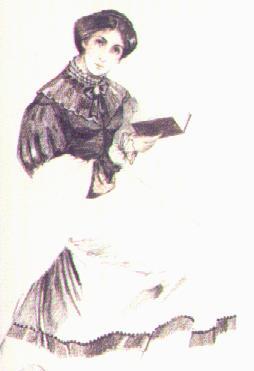
Neofitou previously worked with John Caird, who wrote the book for "Jane Eyre" and is its co-director, and with set designer John Napier (who happens also to be her ex-husband), on "Les Miz" and "Nicholas Nickleby." She also worked with Napier on "Miss Saigon."
"I'm trying to augment what the director is saying or the actor is doing," Neofitou says. When the emphasis of a character changes during rehearsals, which are frequently attended by the costume designer, "You do bend the costumes. The costumes are always fluid."
This sort of continuing involvement with the show and the ability to make adjustments gracefully seem to be keys to successful costume design.
For most good set designers, the entire process starts with research. In "Miss Saigon," for example, an early nightclub scene featuring scantily clad prostitutes was based on documentary photographs of similar young women in Vietnam War-era Saigon.
In the case of "Les Miserables" or, currently, "Jane Eyre," research meant going back to the book that was its source. Charlotte Bronte's famed 1847 novel about the unprepossessing title heroine and her love for her secretive employer Edward Rochester "is very descriptive, in that she has two dresses when she goes to Thornfield -- a black silk and a grey silk." And that is pretty much what she wears in the show, with a few modifications.
From paper to fabric
Born in Cyprus, Neofitou moved with her parents to England at age 7. A graduate of art school, she was a fashion designer in London until her marriage to Napier led her increasingly into theater work. Nowadays, she does her initial sketches in Crete, where she has lived full time for the past four years.
Once her sketches for the show were complete, Neofitou began to turn them into reality with trusted workmen in London and New York. "The most important person is the one who actually cuts the item, that gives it the look you require," she said. A mock-up costume is made, usually in toile ("it's a cheap fabric, and it doesn't matter if it's wrong"); after the inevitable adjustments, it's remade in the actual fabric and tried on the actor, whom Neofitou has had in mind all along. "You can't start until you know who your actors are anyway, because you have to go along with their body."
From this process, Neofitou finally gets to nights like the recent one at the Brooks Atkinson, where she was adjusting men's trousers and deciding on how to rework that garden scene. Eventually, the tinkering on "Jane Eyre" would be done, and she would be able to actively oversee the creation of her costumes for a Metropolitan Opera production of Verdi's "Nabucco."
And then, at some point, it would be home to Crete. "It's wonderful to live in the rarefied atmosphere of theater, but one tends to get terribly caught up in this life, and it's not real," Neofitou says. "I think it's better for me as a person and as a designer to be able to touch reality, and Crete is as far away as you can get from the theater crowd and the theater world socially."
One thing is certain. From her perch in Crete, "I hardly see any other costume designers."
***
The drawing is one of the costume concepts, printed in the liner notes of the Broadway cast recording.
Thursday, October 13, 2005

An American Review of Jane Eyre 1973 (Sorcha Cusack and Michael Jayston)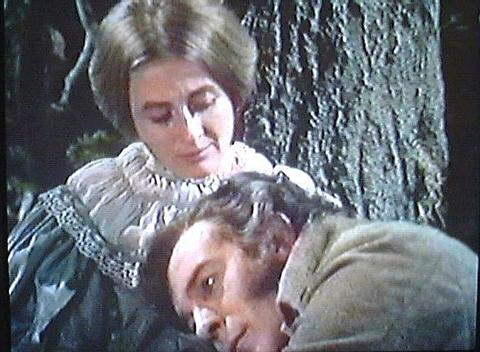 Oh Kristin, you amaze me! You can definately be my research assistant! :D I nearly fell out of my chair reading one line in particular- see if you can guess which one (not to mention hemming in indignation once or twice)!
Copyright 1982 The Washington Post
The Washington Post July 21, 1982, Wednesday, Final Edition
TV Brings 'Jane Eyre' to Life
By Henry Mitchell:
Women, as I understand it, are endlessly impressed by jerks and bounders, especially if called on to be the means of reform and general salvation."I saw it in your eyes," the fellow commonly says, "that you would be the means of my return to something more noble, more innocent, zub, zub, zub."
At this point the lady swoons away, taking care to collapse in the general direction of the cad's arms.
Now whether this is the usual case in real life I hardly know, but it certainly works well enough in Victorian fiction by Charlotte Bronte ,notably in her masterpiece, "Jane Eyre," which came out in 1847 and has been a tremendous favorite of the gentle gender ever since. I well remember hearing girls talk about it when I was in school, and always wondered what or who the hell Jane Eyre was. Then many of us heard it read aloud at one point on public radio, with great effect. Bronte is a gripping writer, always luring the reader along with the promise (adequately fulfilled) of something new going on.
At 8 tonight you may see the story dramatized on Channel 26, the first of four hour-long segments [This is obviously the truncated version. there are 5 episodes but the first one was cut from American airings] produced by the British Broadcasting Corp. in living, as they say, color that allows the hero to sing the praises of a cold gray house (before us in warm tawny Ham stone, I would guess) and a steel sky that looked fairly suitable for bluebirds.
But the audience for which Miss Bronte wrote has never been known to care a fried fandango whether a house is gray or scarlet as long as the love story moves with all deliberate speed; and (allowing for 1847) it certainly does. Jane is played by Sorcha Cusack, a young woman of dandy articulation and considerable beauty. It is an odd sort of beauty, suggesting the Mona Lisa touched with Orphan Annie and this may be the place to say the owner's hound is far too handsome to be left outdoors all the time. Jane is an orphan--though I do not think that is why Orphan Annie came to mind--who for some years has attended a charity school and has wound up as governess for the the young ward of a Mr. Rochester. All this goes on inYorkshire in a grim-looking house with a fine fire place worth admiring.The hero, this Mr. Rochester, frequently drops broad hints of a previously dissolute life, the main feature of which (thus far) was a fling with aParisian opera girl. Perhaps that is the same as an opera singer? No matter, she lured good English gold out of Mr. Rochester's honest English breeches,which the actor, Michael Jayston, calls breaches as in breaches of faith.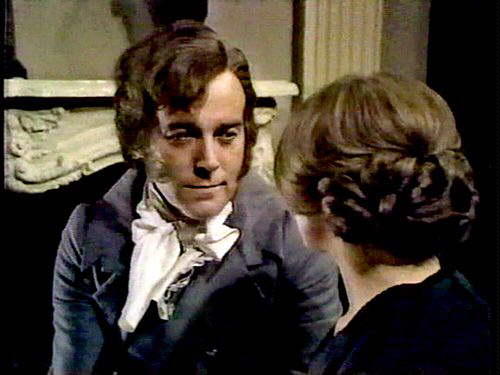
It is known that the Brits, especially in their lower reaches, are impossible to understand; nevertheless, every word of the hour is beautifully delivered and comprehensible, a rare thing on television."Is there a flood?" cries Mr. Rochester, waking suddenly in his bedroom as Miss Eyre throws a bucket of water on him."No, but there is a fire," she cries and sure enough, the bed hangings are ablaze. Rochester notes that Jane has saved him from a horrible death and the hour ends with a beautiful, tender "Jane," spoken softly and with skill by Jayston. Long before this, however, you will have little doubt that things are going to warm up in a most wonderful way between the squire and the governess, and we shall not be disappointed in our surmise as later hours unfold. The intonations of Jayston, by which he virtually makes love while delivering rather cool lines, are notable and effective and and probably are rolling the author about in her grave. But maybe not. The strong current of sex was apparently not only felt but rather carefully channeled by Charlotte Bronte.
The dialogue is not, of course, the sort we are used to in the theater today. It is artificial--it is hardly conceivable an 18-year-old orphan raised any which way should speak rather like Dame Judith Anderson--and is designed to reveal character. It does, I confess, get rather in the way ofthe hot love story people are patiently waiting for, but then art has its price.
At its best, it sounds like Jane Austen through a glass darkly and that isvery good indeed. The hero's ward (identified as the child of the unmarried opera girl, from "the mud and slime of Paris," don't forget that) is fetchingly played by a charming child, Isabelle Rosin, though there are times one joins with her curator, Mr. Rochester, in wishing to pitch her in that handsome fireplace. The point is she is believable, as infant actresses rarely are. Furthermore, old Mrs. Fairfax, the housekeeper, and the other minor characters are agreeable. I suppose the dog is a deerhound. You have surely noticed that novels sometimes have an interior power that is evidently independent of their surface mannerisms and (to us) hilarities."Jane Eyre" has leapt the time barrier far better than most novels. It seems to me girls were about 15 when they had fits about it, and maybe they stilldo."
Wednesday, October 12, 2005
Jane Eyre 1937 by Helen Jerome
I have read the entire play now. Well... It is silly, there's no way around that, but it is also a strange piece of adaptation on many ways. I can appreciate that some of the strange new scenes come about because of staging concerns but others appear to be odd ways of interpreting the text. Some of the necessary evils are that the set can only be one location- an indoor scene. And so for acts one and two there is only the drawingroom of Thornfield, with a downstage right door which leads to an entire wing of the house where 'the madwoman' roams. The room sometimes is transformed into 'the library' quite easily. In act three it becomes the drawingroom of Moor House. Of course, this means no Gateshead, Lowood, or Hay Lane scenes not to mention Jane's wanderings.
So, how do Jane and Rochester meet? He finds her warming her feet and she unknowingly ruffles him by asking what he's doing there. It's sometimes a bit overly dramatic- which I think you could see from my last post on the play. So he indeed informs her that there's something quite horrible behind the door. It's a silly scene also because it introduces a fetish he has for small women. It does include one of my favourite 'new' exchanges, the first words they speak to eachother, in fact:
Much is made of her smallness. In the stage directions he should somehow make it known that he is thinking about how tiny her shawl is when he is rubbing and kissing it.
And as for Lowood, Mr Rochester joins the audience as Jane performs her past for him and us. She impersonates everyone and acts it all out in the drawingroom/library.
We are told a lot that Mr Rochester does not laugh. And then he laughs all the time. He laughs a lot. Too much maybe. But characters still come in later to say you know how Mr Rochester never laughs, and all that. He also has somehow acquired the ability to vacate a room with a single glance. Servants stampede towards the door at one look from him. He goes so far as to tell John that he never even speaks to servants unless he wants something and until then STAY OUT OF MY WAY! Or... something like that. Again, silly. He also has extreme mood swings. Of course he is supposed to be 'changeful' but I'm sure Charlotte didn't mean that he would draw Jane into an embrace only to shout at her and throw her out of the room. Or nearly break down at the saddness of her former life and then yell at her for being so depressing.
Jane is the most enigmatic element of the entire production. She comes in with a superhuman power of some kind, starts off pleasant and at ease. She is often 'demure' around Rochester but only at certain times (times when it seems more like flirtation, to be honest). But then she tells him about how she punched Mr Brocklehurst etc... She has a great speech about women, modelled on Jane's musing on the leads, but then she ends up in the end espousing something like: "love is what makes one endure superiority". Is this a marriage of equals? It appears not. Oh, I forgot to mention that in this play Mr Rochester thinks women are stupid and silly things. This never seems to change. He just thinks Jane is one really amazing woman. I thought she should have "pummelled him with my little fists" at that, but alas...
As for Bertha... she doesn't get to do very much. And all of the mystery is cut out by the revellation in the first act! We all know that Mr Rochester's relative is up there, and all of the significant glances at the door serve no real purpose except perhaps to make us slightly apprehensive that she'll come down and choke someone again. There is also no explaination of how that first marriage came about. He cuts directly to begging her to stay.
The ending was very disappointing. It was the most ineffective part of the entire work. There were really good moments, I must say. And aside from this total insanity there were lovely passages which were more or less lifted from the book (stage directions were also lifted from the novel. For example, Rochester's motivations are transposed from later chapters where he describes how his feelings for Jane developed). The ending uses much of the text, except for a few silly alterations, such as Jane expressing a 'who asked you, anyway?' attitude about staying. But it all ends with something like this:
Jane: And now, dear, show me the spot.
Rochester: The spot? What spot do you mean?
Jane: The spot where you first learned that God really does care.
THE END.
It really deserved far better than that. Other really poor choices are the way Mr.Eyre's intervention comes about. It is glaringly tagged on in an attempt to abridge Mrs. Reed out of the play. Everyone is confused about how Mr Mason knew about the wedding until Jane pipes in saying she wrote to him because she wanted to show Mr Rochester that she had at least one respectable relative! It reads as uncomfortably as it must look on stage. Does she value herself or not? It's so very hard to tell. Speaking on Mr.Eyre and the letter, there is no scene of Jane rejecting Mr Rochester's presents... He just doesn't buy her any in the first place. But there is one very curious inclusion! Here we have dramatised one of my favourite scenes from the novel- the 'carriage scene' when Mr Rochester recasts a meeting with Jane as a fairy tale for Adele. Only here, Mr Rochester and Jane are teasing eachother on their wedding day. It's delightful! It still suffers from some unfortunate lines "I'll lay you down on the rim of a crater- the crater of my heart!" And I really cannot imagine Jane digging around in his pocket for her wedding ring.
Another odd element is that Mr Rochester admits that Adele is his daughter but that "she will never know". A strange choice to make, and one that leaves many unanswered questions as do the comments about women. Taking everything into account, it would definately deserve a second reading.
'Eyre Apparent' exhibit at UVA...
After the absurdity of the last post, it feels good to have something substantive to report on, thanks to Cheshire Cat of the JE Musical forum, and the Brontë Society, would that I could attend!:
"Below is the latest information on the Jane Eyre exhibit. Please contact Barbara Heritage (the co-curator) if you have any questions. It will greatly assist Barbara in planning events if she hears from members who plan to visit.Eyre Apparent: An Exhibition Celebrating Charlotte Brontë's Classic Novel
Brontë enthusiasts are cordially invited to a day-long celebration of Charlotte Brontë's Jane Eyre at the University of Virginia (UVa) on Friday, 9 December. The occasion features special tours of a major exhibition opening this fall and on view in the principal room of the University, the Dome Room of Thomas Jefferson's Rotunda.
The show, which commemorates the 150th anniversary of Brontë's death, is titled "Eyre Apparent" and offers up evidence of the book's ubiquity and enduring popularity. From the 19th century to the present, the exhibit follows Jane Eyre from the bookshop to the stage to the classroom to the dollhouse, from the printed word to household word. Displaying everything from series books to Greek comics, and objects ranging from thimbles to cigarette cards, the show sheds light on how Jane Eyre became a classic text and reveals how shifting cultural contexts have affected and continue to shape its meaning.
Gallery tours led by the show's curators will be offered throughout the day. Other events scheduled for December 9th include:-Morning and afternoon screenings of television and film adaptations of Jane Eyre-Guided tours of the Rare Book School collections led by RBS Founding Director and University Professor Terry Belanger, a 2005 recipient of the MacArthur Fellowship-Adjunct exhibit of the first edition and early printings of Jane Eyre owned by UVa, on display in the University's new Albert and Shirley Small Special Collections Library-Afternoon refreshments and evening reception
All events are free and open to the public. In addition, those who attend the event will receive a 10% discount on purchases made at several of Charlottesville's used and rare bookshops, from 9-11 December. Charlottesville has in recent years become a flourishing center for antiquarian books, with more used and rare bookshops than any other city in Virginia.
A block of hotel rooms has been reserved for Brontë Society at two hotels within walking distance of the Uva campus and all related events taking place that day. Rooms at the Courtyard Marriott will be available at $82 per night (434-977-1700) and at the Best Western Cavalier Inn at $68 per night (434-296-8111). Please mention "Rare Book School at UVa" when you call to make your reservation.
"Eyre Apparent" is co-curated by John Buchtel (Curator of Rare Books, the Sheridan Libraries, Johns Hopkins University) and Barbara Heritage (Curator of Collections, Rare Book School). It is the latest in a continuing series of exhibitions devoted to book history sponsored by Rare Book School, an independent, non-profit and tax-exempt institute supporting the study of the history of books and printing and related subjects.
The show, which is free and open to the public, will remain up through April 2006. UVa's Rotunda is open daily from 9:15 am - 4:45 pm. For directions, complete schedule, or other useful information (including advice on parking), please contact Barbara Heritage at beh7v@virginia.edu. "
Tuesday, October 11, 2005
...*laughs* Sorry, this cannot even pretend to be a serious post.
I've just been reading Helen Jerome's 1930s play of Jane Eyre. I'd have to say... Well, several things. Firstly, I cannot blame Mr Rochester for laughing at Jane as she re-enacts how she punched Mr Brocklehurst "like this, right in his bony chest!" during their first interview. Ah! This play is so many kinds of wonderful silliness... It's terrible, and I love it! The stage directions are pretty fun as well. I'm not sure how exactly Mr Rochester can "look physically" but he does. It's probably something sexual, considering how disturbingly he goes on. And then, you know, smothering Jane's shawl with kisses, before he goes to bed. He does seem a tad more... ornry:
"Here's your damn birthday present!"
And how about this for drama!
(A long, urgent wailing of the wind, like "Jane! Jane! Jane!")
St.John
Where are you going? Jane, Jane...
(She is running up the staircase. her voice come floating down)
Jane's voice
(With a note of exultation)
To pack, to pack.
Reminds me of when a Homerist I study with claimed that Virgil's allusion to Catullus in the Aeneid was like inserting a *pppppppppppppt!*.
Rochester: "So my call reached you"
Jane: "Yes, four days ago"
Good, good! :D A lot of it includes much of the text, don't get me wrong, but these little... 'improvements' are quite frequent. At the end, Jane grabs his face and says how he's such a foolish little darling.
Ah... I must have this for my own, entirely my own! ;D
ETA: I should not have been so brief. But I had to return to purusing this treasure. I got through 2 scenes before I had to stop. At one point I just burst out laughing because it just didn't make any sense. What in the world is Mr Brocklehurst's outfit if it is green rusty black shiney Christian martyr style?! Mr Rochester seems to understand this (probably since he's so sympathetic, you see). He keeps nodding, she keeps acting out her life for him (including scaring him with tales on his pulling their hair, and making him laugh even when everyone has assured us that Mr Rochester never laughs. Maybe he just doesn't like how they run away when he looks at them? John is really awfully Irish... I've never seen such horrid dialect work since I read the Samuel Lover Myths of Ireland. Jane keeps shuddering at the thought of Lowood unless she is expressing her desire to murder Mr Brocklehurst (which 'scares' Mr Rochester while strangely compelling him at the same time).
And then they have a brooding contest and glare at eachother in the library for a bit. ;) It's magnificient. I'm curious to see how this works out since Jane actually sees Bertha strangling him instead of having his bed on fire. He conceeds that she's a member of his family, and she seems satisfied with that. Okay, he keeps his relatives in the attic. So long as she doesn't strangle ME, but then I'm a spunky little thing with my quick fists and 'mind-stuff' (when Jane first appears there is a long paragraph of stage direction which means nothing at all. It says how quaker-like Jane is, or, in other words how sophisticated and 'glamourous'. Or to be more confusing, she seems to be shiney with 'genius' or something they describe as 'a second-born soul' with 'mind-stuff'. Confused? How about that there's also stage direction for the cat?
To conclude, I can barely type for laughing!
Monday, October 10, 2005
Monsieur Heger sighting?
As I updated my blog, looking at the image from the UMaryland production of the Jane Eyre musical, a had a vague sense that I had seen this all somewhere before. It didn't really have time to bother me before I realised what was so familiar about the actor playing Mr Rochester- he looks like Constantin Heger. No really. See?
That's M. Constantin Heger on the left, and James Gardiner on the right (from the photo by Stan Barouh). The image on the left is a detail from a large photocopy a friend sent me of a portrait of the Heger family. M.Heger was Charlotte Brontë's teacher while she was studying abroad in Belgium at the Pensionnat Heger. It's my understanding that she based much of Mr Rochester's character on monsieur. They certainly both have a penchant for cigars and bonbons at any rate ;) And it goes without saying that he is the model for the fabulous Paul Carlos Emmanuel, of Villette. I've always wanted to know more about him, but the books I have on hand have been printed in the 1890s and it looks like there had been some censorship going on. Over and over again it is asserted that Charlotte was never in love with the married Heger, but obviously many believed this was so. What the current evidence for either case is, I don't know not having any more recent works for comparison!
The 1970s Yorkshire TV mini-series The Brontes of Haworth certainly asserts that she was in love with Heger. So my guess is that the letters she wrote to him have been widely published, and I just haven't come in contact with them yet.
A little bit of everything, it seems!
More news on the musical, thanks to the heads-up from BrontëBlog. The University of Maryland's independent student newspaper, Diamondback, has published this article on the university's production of Jane Eyre. BrontëBlog also has this nice post, commenting on the article. Among other things, they point out that Mr Rochester has a fan base. I don't really know the purpose for fanlistings but they are everywhere nowadays, and Brontëdom is no exception! Here are a few:
La Governante (Jane Eyre) [link not working at the moment]
Plain and Passionate (Jane Eyre)
Con Spirito (Mr Rochester)
Bronte Sisters
I used to have links for listings of the other sisters and their works as well but they all seem to have disappeared.
Also mentioned in the commentary is the score of the musical. Clips of the Broadway version of which can be listened to here, and the out of print Toronto cast highlights album can be heard in full here.
Lastly, I finally have an email address for Brontëana! Questions, requests, and contributions may be sent to bronteana.blog@gmail.com
Sunday, October 09, 2005
Actors on playing Mr Rochester...Part Three
James Barbour:
The following quotes are from Horwitz, Simi. "Forget Orson Welles in "Jane Eyre".(James Barbour discusseshis role of Rochester in Jane Eyre musical)(Interview)." Back Stage 42.2(Jan 12, 2001): 19. General Reference Center Gold. Thomson Gale. GraduateSch of Lib & Sci/ Simmons Coll. 09 October 2005. Thanks to Kristin for her free research :)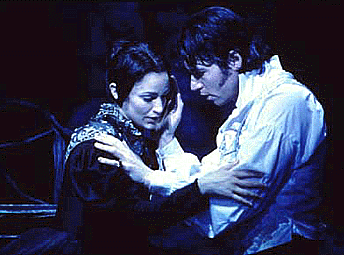
"Some critics think I'm the worst thing to hit the stage. Others see me as the epitome of Rochester. Part of the problem in building this character is that if you go back to the novel ['Jane Eyre' by Charlotte Bronte], you only see him through Jane's eyes.
"The big challenge, however, is that viewers are expecting a performance like one of the many Rochesters who have appeared in the movies. Audiences usually envision Orson Welles [who played the part in 1944]--a 250-pound55-year-old, who is a gruff, dark, tortured soul.
"For starters, I am not that much older than the actress who plays Jane[Maria Schaffel]. I'm 35. More important, I try to bring humor and irony toRochester. If he is all that stoic, and has no sense of lightness, why would Jane fall in love with him? He is not a wall of stone. His biting wit is a form of self-protection. In some ways, he is not unlike the Beast in 'Beautyand the Beast' or Billy in 'Carousel,' two characters I've played."
[He] describes Rochester as "a rebel who doesn't care what others think about him. Yet, he is a highly moral figure. He feels very confined and breaks away in order to feel alive," Barbour asserts. "Rochester is constantly running away--he has no home--and he has a true sense of responsibility."
The problem he faces on a nightly basis in"Jane Eyre," [is] departing from his natural vocal register. "I have a wide vocal range, but I am a bass. This role was written for a tenor, although some of the sections were lowered for me. Still, in the second act, I have four songs [representing a multi-octave stretch] sung practically back toback."
Still, Barbour defines himself as an actor who sings as opposed to a singer who acts and he comes to each role with the actor's sensibility. That is not to say his strategy for each part is the same. "When I played the Beast["Beauty and The Beast"], I approached the character physically--what he moved like, what he looked like. With Rochester, I took a more intellectual tack--his history, his ideals. Then I moved on to what he was about physically--the way he stood and sat. Of course, the period influenced those things as well."
In preparation for the role, Barbour boned up on the era, reading a host of books on Victorian women, aristocracy, social mores, and values. "Victorians of Rochester's class were always aware of what they looked like and the impression they were making. That would be true of Rochester as well. But because he is a rebel in our view, he would deliberately break some of those conventions."
*****
Happy Canadian Thanksgiving everyone!
Actors on playing Mr Rochester...Part Two
Thanks to Thisbeciel again for most of these quotes. I found the second quote for Michael somewhere online, in an interview he did on one of his audio books. The first quote is a caption from a photo in the original Radio Times article on the 1973 Jane Eyre. [These posts on actors has been brought about by some discoveries in the LERO archives, which explains why I'm starting with Mr Rochester rather than Jane, or other great characters from the Brontës' novels].
Michael Jayston:
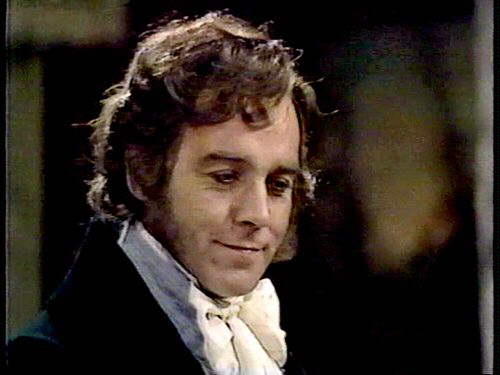
Michael Jayston, who plays Rochester, in front of Norton Conyers, near Ripon; it may have been the model for Thornfield Hall.'I'd love to live in a place like this. It's much easier to imagine a fire burning in Renishaw, which we actually used for the filming. There there would be no escape; here you could jump out of even the top windows. Rochester is all women's ideal of a man; arrogant yet strangely vulnerable.'
Thanks to his acclaimed ABC recordings, Michael Jayston is often associated with the Cold War spy thrillers of John Le Carre, yet at heart the man is a romantic. Ask him to name his favourite TV role and he harks back to Mr Rochester in an early version of Jane Eyre because ‘the character had wit, brooding sensitivity, and a romantic quality’.
Ciaran Hinds:

QUESTION: Uh, how did you feel about being offered the role? Rochester was one of the most romantic men of all fiction. How did you feel about being offered the role?
CIARAN HINDS: Well, I don't know if I was delighted or not... because when you're offered one of these parts and because they are very well-known from literature, then you have the responsibility of doing it. And, I thought, because I'm Irish, I wondered why they were offering an Irishman a job to play a quintessential sort of arrogant, chauvinistic Englishman. But obviously, I have some of that quality in me. (Laughs) No, because he's quite a complex character as well apart from that and somewhere inside his psyche his soul has been deeply hurt, but it manifests itself in different ways, like moodiness and different mood swings. Well, I thought, "Yeah, I'll give it a lash."
QUESTION: You play this ... the character is this gruff, robust person that is kind of soul searching, restless. What do you think he's looking for?
CIARAN HINDS: I don't think he quite knows himself because this marriage that he had, that he was tricked into without being told by the family that the woman that he married had a history of insanity, and indeed the family did, and he hasn't abandoned her, but he's taken her and he's hired doctors for her and all kinds of alternative methods of trying to ... and he brings her all the way from Jamaica back to England and keeps her in the room with somebody to look after her, but he's hurt and very, very angry, very, very angry that he's been tricked like this. But he also then traveled to Europe and had affairs, and then he'd fallen in love again and that's been thwarted. That's where Adele, the ward that he looks after, comes into the story. But the reason that he's prepared to commit bigamy, as he says, he's prepared to go to jail, only for the fact that he is suddenly deeply involved and in love with Jane, is to make her happy.
ETA: Also, thanks to M from BrontëBlog for providing me with a link to more information on Richard Lebensen, whose illustrations can be found in yesterday's post.
Saturday, October 08, 2005
Actors on playing Mr Rochester...Part One.
Thanks are due to thisbeciel, and biedroneczka!
William Hurt: 
“I had read the book a long time ago, and when the project was first mooted, I went back to the book and was blown away by it. The more I delved, the more inspired I became by it. It is a great work of art and it has been a privilege to spend time with it,” says William Hurt.
“Rochester is a wonderful character; he rises out a great romantic figure with tremendous energy and power. Of course I have to throw away everything that is not useful in realizing the work – other people’s reputations, their vision, don’t have to be mine. I can’t think of him as a hero, I have to let the structure of the work do that. I can only think of him as a human being or I give myself added pressure if I see him as a famous role with a lot of expectations riding on the piece. As an actor I have to put those expectations aside and look at him freshly: he is very much at the centre of many conflicting loyalties; he is compelled and repelled, and he is really at the crossroads of many different forces. The fact that other actors have played him is not important: roles are made to be played by different actors. What frightens me is what Charlotte Brontë might think of me as Rochester!”
Timothy Dalton: 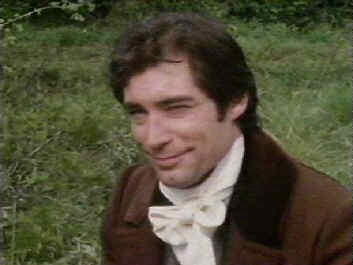
"I think why it worked so well was because, in truth, it's such a good part. What a blow to the image! Rochester is tough and hard, short-tempered and curt on the one hand, and concealing a soul that's been hurt and made sensitive. So you have a lot of the qualities that really appeal to women in Rochester, and I was simply lucky enough to be playing him.
"When I play another kind of character that is not so pleasant I get just a trickle of letters. Some women who've seen several things I've done write in to tell me when I've done something right, and when I've done something wrong, along the lines of 'I wish you wouldn't do this kind of thing. I much preferred you as Heathcliff. Why don't you do more things like that?'
"The fact is, we've all got to work; we have all got to do the parts that are offered to us, whether they turn out ultimately to be good or bad. In America they would largely agree with my correspondents: if you find an image that works, then stick with it. So there's some sense in that; maybe I should play Rochester for the rest of my life!
"There's got to be a bit of yourself in it. I don't think you can be a good actor unless you reveal something of yourself. You're revealing a character through the knowledge you have of yourself and the life around you. Yes, I can see certain elements of myself in Rochester... Of course, Rochester was no fisherman, while fishing is my obsession."
Next time... Michael Jayston and Ciaran Hinds.
At the request of thisbeciel I am posting a few of the illustrations from my copy of Jane Eyre from 1980, Reader's Digest. They're by Richard Lebensen and are quite lovely.
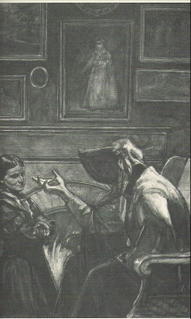
The gypsy.
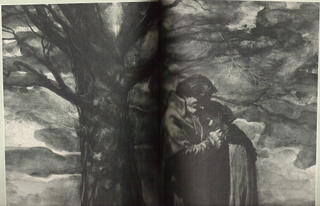
The proposal.
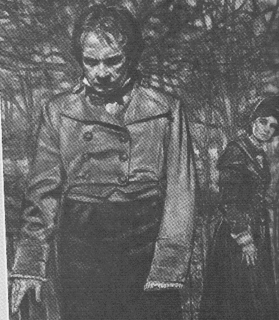
Ferndean.
Please don't repost these images without crediting the artist (and a nod to me would be nice, but mostly don't forget Mr. Lebensen!).
ETA: In addition, I've found an old blog entry from a blog called 'literary death match' where people vote on which author or character in a pair is the best. Alas, poor Mr Darcy... Mr Rochester completely annihilated him 11-4. A very shocking loss for Emily, Charlotte won 7-2 with one undecided and one angry Anne supporter abstaining (pun not intended). To be fair to Emily, quite a few people were torn (metaphorically speaking...).
Friday, October 07, 2005
Jane Eyre the Musical "busts out".
I don't normally post twice in one day but I should help spead the word on all of the upcoming performances of JE. Info is courtesy of "Mrs.Dionysius O'Gall" and the Jane Eyre: The Musical Forum.
"From the MTI site: :
Highlights of some forthcoming productions: : :
ABILENE CHRISTIAN UNIVERSITY
: ABILENE, TX US From 2/16/2006
: Until 3/4/2006
: : BREBEUF JESUIT HIGH SCHOOL
: INDIANAPOLIS, IN US From 3/2/2006
: Until 3/4/2006
: : CAIR PARAVEL-LATIN SCHOOL
: TOPEKA, KS US From 11/10/2005
: Until 11/19/2005
: : CREATIVE MINISTRIES INC
: OAKDALE, NY US From 10/7/2005
: Until 10/23/2005
: : MALONE COLLEGE
: CANTON, OH US From 11/8/2005
: Until 11/19/2005
: : NARBERTH COMMUNITY THEATRE
: MEDIA, PA US From 11/4/2005
: Until 11/19/2005
: : PULASKI COUNTY HIGH SCHOOL
: DUBLIN, VA US From 2/24/2006
: Until 3/4/2006
: : QUINCY MUSIC THEATRE
: QUINCY, FL US From 2/24/2006
: Until 3/5/2006
: : RIVERVIEW HIGH SCHOOL
: RIVERVIEW, FL US From 12/8/2005
: Until 12/17/2005
: : UNIV OF MARYLAND - DEPARTMENT OF THEATRE
: COLLEGE PARK, MD US From 10/13/2005
: Until 10/22/2005"
Links to where to buy tickets for the U of Maryland performances are available at the bottom on the previous post.
The quest for grad programs continues...
I have spoken to 4 professors about grad school programs. So far, the consensus is that I should apply to Toronto. Other schools include McGill, Concordia, and Queen's. Finding the right one for Bronte studies in particular is very difficult. It is very encouraging for them to recomend me to these top schools but I don't feel that they would be right for me. One of my advisors has told me that my project of studying the Jane Eyre musical as an intertext would not be appreciated at Toronto and that I should come up with something else. This bothers me for a few reasons. I've read criticism which points out that there are gaps in the criticism of adaptations of Jane Eyre--in particular there are none which take visuals, and music into account (in the case of film). With my background in all of the arts, and with my enthusiasm for this story and for the theatre I know that I could really take control of this issue and run with it. I have the proof too. I sat down one day to see just how far I could push it, and I came up with 8 pages of notes just on Bertha. Only last week BronteBlog reported that a new book of Jane Eyre stage adaptations from the Victorian period is being published soon. Surely music theatre is fair game for study as well?
But, what to do? I don't want to abandon the work I've already done, and choosing something else might lead to less satisfactory results but would increase my chances of getting to grad school in the first place--in theory. It's all so confusing.
This explains my relative silence over the last few days. I've been trying to sort this all out!But I do have a little announcement to make, thanks to a friend I have Stateside. The musical that is the source of my woes is opening next week at UMCP! I will be posting a link as soon as I can find one (I also hope someone will be able to see it and report back to me in full! *hint*).
ETA: The theatre department. Where to get tickets. Thanks to my secret informant, "Shrew." By the way, I think the poster is adorable.
Monday, October 03, 2005
This is a pun.
Next she bore the Kyklopes with over-proud heart,
Brontes and Steropes and hard-hearted Arges,
who gave Zeus thunder and made the lightning-bolt.
They were like the gods in everything else,
but a single eye was in the middle of their foreheads;
they were given the name Kyklopes because
one round eye was in their foreheads;
strength, force, and skill were in their works. (Theog. 139-146)
This is a distracting bit of Hesiod. But note: strength, force, and skill were in their works. Apt, yes? ;)
As usual, very interesting stuff on the wire and at BronteBlog including another DVD release of Wuthering Heights! I'm not sure how widely known this is, but in my circle it has been much talked of... We expect that the BBC production of Jane Eyre, the beloved version with Sorcha Cusack and Michael Jayston, will be released sometime next year. Alisa from L.E.R.O. first got wind of this after emailing Eureka Video. However, there has been much confusion on this. Even though the news has been verified independently, Eureka and the BBC can't seem to decide who is actuallying releasing it--the BBC say Eureka, Eureka says the BBC. So long as it can be in my hands sometime in the near future, I really do not care. I'm one of the lucky ones. I didn't know about it until this year and I was able to get a recording made from someone's 30 year old copies (thank God for PBS and the CBC!). I have not had to wait 30 years like quite a few fans I know.
I know that from the news on BronteBlog it looks like new adaptations are not forthcoming but I can't say that I agree. The trend seems to be that a Bronte film is made at least once a decade. I believe there has only been one decade or so when this didn't hold true, and in many cases there are a lot of films made in that space of time. Our last one was 1997 I think... I someone has written a screenplay of Villette! Ah! Now wouldn't that be tremendous?! [apparently it had been done by the BBC but I haven't yet been able to find out if copies of it still exist or if it has been lost].
ETA:
I also have an idea. I'm considering posting some of illustrations I've been hoarding over the past year. I collect antique books, and illustrated copies of Jane Eyre. I have quite a few, but friends have simply... piled them on me. I cannot keep up! I have books still to scan (I'm an obsessive compiler, I think ;). I had intended this to be an illustrated blog (see Mr. Bulwer-Lytton in Petticoats below) but I don't often have the energy to make a sketch a day on top of everything else. Anyone horrified at the idea? Here's a random picture--the cover of the 1857 play.

Sunday, October 02, 2005
CBS RADIO MYSTERY THEATRE
presents... *raaaaaaaawr!* DA DA DA DUMMMMMM! Jane Eyre.
Well, well... I've listened to the 'Radio Mystery Theatre' version of Jane Eyre twice now. Very very interesting stuff. It's funny, true... Bertha sounds just like a dinosaur and Mr Rochester is a minx but there's a commentary! It would be best if I go through things point by point...
-The introduction frames the story as 'a real chiller' and says it is 'incredible' because Charlotte Brontë 'seldom left her house'. He comments on how 'the day of the governess' is over, and characterises the Victorian period as one when people lived in grand houses filled with servants and a housekeeper 'who sometimes shared dark secrets'. He also says Charlotte is the most famous of the sisters, and that 'their strange brother Branwell' was the 'prototype' for some of the men in their novels.
-The narrative is interrupted again when Jane gets her first clue that the 'laugh' (which truly sounds like a cross between a t-rex and an elephant sometimes) is not coming from Grace Poole. Now, in the past I've always taken that moment to mean just that- there's a laugh coming from upstairs, Grace is not up stairs. Therefore Grace is not laughing. But the narrator jumps in here to suggest that this is odd- the voice is disembodied! And there are demons in the house 'not the least of which is Grace Poole'.
-After Bertha is revealled there is another commentary made. The action goes really quickly so the narrator revisits the scene placing the listener in the place of Jane and describing the scene of going up the stairs and seeing Bertha.
-The most surprising thing of all came at the end. They actually acknowledged that parts were left out of the story! The 'happily ever after' music has barely ebbed away when the narrator says something like: "sounds unbelievable that everything should work out so well, doesn't it? Well, that's how Charlotte Brontë wrote it." And then goes on to complain about the coincidences in the novel!

Arnold Moss (above left) played Rochester. Patricia Elliot (above right) played Jane Eyre.
And now, for some funny additions...
Considering that it sounds like there's a t-rex in the attic Jane is remarkably calm throughout so she actually has to stop and say to her diary how she doesn't scare easily to explain her complete lack of concern. She scares easily enough when Mr Rochester tells her that children annoy him, and she then starts hoping that he'll leave soon! Mrs. Fairfax... can't seem to decide what she knows exactly. At the start she says some nonsense about her dead husband 'rising from the grave' to warn her that no good will come to Thornfield. And every now and then she warns Jane to get out before its too late. And yet, when Blanche arrives she is all a titter and hopes that the rumors of the impending wedding are true. Yet at the end, she says that she tried to warn Jane about Mr Rochester's marriage--and Mason berates her for not telling Jane about it. And then she goes on with her work 'as though nothing had happened'.
Mr Rochester is a minx, I said. During the proposal Jane has to tell him to watch his mouth. Probably my favourite part of his minxery is:
Jane: Oh sir, please, don't talk about--
Mr Rochester: Who? Who?
Jane: ...Edward.
Mr Rochester: Mmm hum!
But the minxiest is...
Jane: Then, sir, I will marry you.
Mr Rochester: *pause* Now, that's no way to accept my offer...
I know that some people have been puzzled about Mr Rochester asking Jane to help him treat Mr Mason. Well, CBS has the answer for us-- Mr Rochester is afraid of the dark (well, no, but it sounds an awful lot like it!).
ETA: I completely forgot to mention this interesting addition:
Rochester: In spite of my infirmities I don't need a nurse; I want a wife.
Jane: Ask me one more time, Mr Rochester.
Rochester: Ah-ah... Edward, Jane, Edward... Our roles have changed, and you are now my master.
Jane: We are two sides of the same coin, Mr Rochester, and no one can split us in two.
Saturday, October 01, 2005
Limited time offer!
Firstly, I would like to draw your attention to the addition to our links list of http://bronteblog.blogspot.com which is always posting astonishing news about everything from new publications to moon craters! Check it out.
Since this is a student blog, part academic enquiry, part personal testament, I should note that yesterday I took the first step towards my dream of Brontë studies. The professor I studied the Brontës with has agreed to help edit my program of study. I have a comprehensive project already laid out, and this I sent to her yesterday while I put together something which will adequately show my range of interests without seeming diffuse… I’m interested in an awful lot of areas: religion, intertexts, construction of gender, folklore, classics, arts (as in painting, needlework, singing etc in literary texts)--and a lot more… Blindness and poetic creation, and prophecy as well… One small step for me, speaking of moon craters ;) I hope this will lead to something ‘Brontëful’ as a friend of mine says.
The ‘limited time offer’ is two radio adaptations of Jane Eyre which have turned up amongst my friends at L.E.R.O. (League of the Extraordinarily Rochester Obsessed). They can be found here, for a very short time (less than a week now). There’s Loretta Young and Orson Welles:http://s18.yousendit.com/d.aspx?id=3U3VY42CB2Y2A3O2UG1ELMBVF1 and Patricia Elliot and Arnold Moss (a CBS Radio Mystery Theatre production)http://s5.yousendit.com/d.aspx?id=1Z0WE2ABKWXFG2L3UYX4S530CZ
I have only heard the beginning of the second one so far. It sounds very interesting--the introduction claims that the story is interesting because Charlotte ‘hardly ever left her house’ and goes on to mention Branwell being the model for characters in his sisters’ novels! Thisbeciel, who shared this with me after biedroneczka was kind enough to post them for us, says that there’s a lot of “excessive scary dramatic music.
Jane: "I am going to go for a walk" (DA DA DUM!!!!)
Mr. Rochester: "Let's go into the garden" (DA DA DUM!!!!!)”
And apparently Bertha sounds exactly like a dinosaur. I guess that explains the strange noise at the start. It sounded very like a tyrannosaurus rex. Poor Mr Rochester, things just get worse for that man.
Speaking of adaptations of Jane Eyre, Bronteblog informs us that a new version of the 1970 film with Susannah York and George C. Scott is due for release. This is a good thing, in my opinion, only because it probably will fix that gap which appears in one of the scenes between Jane and Rochester. There’s obviously a scene missing in the current release. And yet, this is the only version that I loathe… And I’ve tried to overcome this, but I can hardly bear watching it. Jane really seems to be a broken down woman with no self-respect, to want to be with a man like Scott’s Mr Rochester. I managed to get my Brontëphobic mom to see it, and she and I ended up laughing through the second half (after the infamous: “Have you ever been to an asylum, Jane?… Jane?” *everyone has left*) He’s about as witty as something that isn’t witty at all, with such gems as “life’s an idiot” which even confuses Blanche. So there you go… And St. John is more moved by Jane’s piano playing than Mr Rochester is in the entire film.
More news! (I’m trying to catch up on some things I’ve simply not had the time to report on here). A few months ago, now, I participated in a “literary role playing game”. The idea sounded absolutely awful, so of course I gave it a try. The concept is all of the famous authors of history born before 1900 are reincarnated in the present and are all going to same high school! It’s a lot more fun than it sounds. Reading the different journals had me laughing for hours. Chaucer does rap now, and doesn’t seem to get on well with Marlowe… Anyway, I created a journal for Anne. And it has gone well, although by a cruel twist of fate the people playing Charlotte and Emily have been too busy to keep up theirs. Emily exited in style by, uhm, …going on a trip with T.E. Lawrence on his time machine. Charlotte just slipped away while no one was paying attention (I hear Jane Austen had been trying to get her to go out with Alexander Pope). Anne is doing well, made a few friends including Wordsworth and P.G. Wodehouse. I’m glad to say that there was a lot of joy when she turned up, and that people not in the game have been following her (limited) adventures so far.
As an aside, has anyone else noted how common ‘huzzah!’ is nowadays? How in the world did that happen?… Or is it just me?
Tuesday, September 27, 2005
Emma Brown and the morality of editing.
I forgot to mention yesterday that I brought up a Brontë adaptation, Emma Brown, in a course I am taking on editing practices. We had just finished collating two volumes of poetry by an obscure Canadian poet. The first edition of his works had been seriously tampered with. The editor chose to delete lines from the poems, and--worst of all-- add an entire stanza. She didn't bother mentioning that she had 'improved' these poems and the edition stood as the canonical text for about 50 years as I understand! Most of us were outraged, a few took the view that writing is a 'transition' and had no problem with it. To lead us on in the discussion, our teacher put forward the scenario of finishing a novel. Would it be right for someone to finish a novel? I suppose, in a sense, this is what 'Emma Brown' is supposed to be.
Emma Brown is a novel by Clare Boyland. It begins with the two chapter fragment 'Emma' written by Charlotte Brontë. I have no read anything about the author's purpose or plan for writing 'Emma Brown' and have looked at it in different ways. In short, and what I told my classmates, was that I find the idea of 'finishing' a novel interesting provided that the novel is seen as a new work (It might seem silly, but the editor of the Canadian poems clearly did not put these poems forward as new pieces). At home I have an antique volume which includes the Emma fragment and I also have 'Emma Brown'. I can read the fragment as Charlotte's work, and Emma Brown as Boyland's, and this is only fair.
Most of the reviews--if not all the reviews... okay ALL the reviews of Emma Brown comment on how 'like' a 'Brontë novel' it is, or is not. I am unsure how I feel about this. For one, it is uncharitable to Boyland that her work succeeds or fails only when matched with one of the greatest authors in English literature. Also, this is not a Brontë novel. However, in choosing to make use of Charlotte's fragment Boyland has to take responsibility for it in some way. It seems that she has tried to do so. The novel includes some underpinnings which include quotes from Charlotte's letters, and backstories culled from her juvenilia.
Is it right for someone to 'complete' Charlotte's 'Emma'? I believe it is. I think there could be a dozen attempts to work with it, and they could all be as individual as the author's writing them but they should not be so tightly bound to Charlotte's name and reputation. Of 'Emma Brown' itself, I will say that I found it to be a page-turner and a good mystery but found little statisfying in it beyond this.
Wierd Circle Wuthering Heights, and a Musical
As promised, here is my discussion of Wuthering Heights produced by 'Wierd Circle'. It was quite a few notched better and more mature than their version of Jane Eyre. I know that compressing most books, and great books down to a half-hour radio program is nearly impossible but this one shows that with careful editing it doesn't have to be disasterous. It still isn't good, but it's good enough--I suppose. The story is compressed mainly by cutting out the entire revenge plot from beginning to end, except for Hindley treating Heathcliff poorly (but there's no mention of anything other than ostracism going on). Heathcliff cries a little, thinking of getting revenge but this revenge never happens. It seems more like an immature thought which passes after he sobers up. He does return to the Heights but all that we learn of that is that Hindley invited him. He still marries Isabella 'for spite' but all that we know about the marriage is that Isabella 'isn't happy'. All of the past and present action takes place through the device of Cathy's diary and the explication of Nelly at the end. Lockwood remains at Wuthering Heights until he has heard the whole story. When he has told Heathcliff about Cathy's ghost, Heathcliff rushes into the snow to 'bring her back' and they find him frozen on her grave the next morning. I suppose what really keeps this version from the brink of the kind of absurdity of their version of Jane Eyre is the dialogue. There is only one line, said by Cathy, which seems silly and this is only in its delivery.
I don't remember mentioning this before, but a few months ago I also was introduced to the Wuthering Heights musical. Clips from the CD can be found here: http://www.amazon.com/exec/obidos/ASIN/B00009Y3OJ/qid%3D1123810368/sr%3D2-3/ref%3Dpd%5Fbbs%5Fb%5F2%5F3/103-1399124-4423806 My general impression was that it didn't work. I haven't heard the music for a while now, but while I liked the idea of an operatic attempt I don't feel that this one really did the job at all.
Saturday, August 27, 2005
Jane Eyre the Musical to make its UK Premiere, and the Wierd Circle.
Finally there is news about my favourite musical! Details can be found here: Jane Eyre the Musical's UK Premiere.
I've been very busy lately, preparing to return to school, but I have also been at a loss to decide exactly what to post about- there's so much to choose from. Firstly, just as July was our impromptu Villette month, August is Jane Eyre month. I usually read the novel all at once in a day, or two at most. I picked up on a lot of things that I usually gloss over while reading it slowly over the month. Probably my most interesting 'discovery' was that Helen Burns doesn't have a grave marker for a certain number of years. It seemed very odd that this time frame would be given. After thinking about it, and tallying the passage of time based on the events in the novel I believe that it's plausible to assume that Jane returned to Lowood with her son and Mr Rochester- because it would have to have been when her child was 3 years old. There might be another explaination, but I found this one intriguing!
I love to do inter-textual analysis, and so I also made a list of each and every book mentioned in the novel. :) That will keep me busy f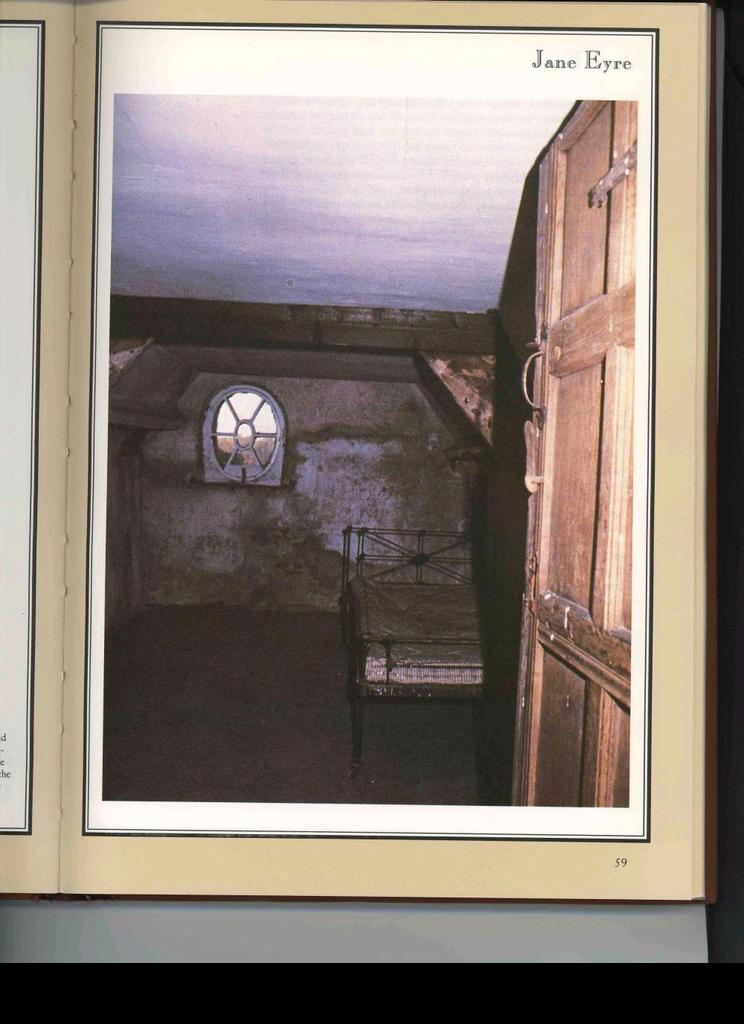 or quite some time in the distant future. My wonderful friend Thisbeciel has also overwhelmed me with her Brontean bounty! I now have full texts of The Cottage Poems by Patrick Bronte! And many terrific images, and illustrations such as... This picture of the madwoman's room at Norton Conyers! I think that if I was shown such a room I'd probably write a novel as well ;)
I ALSO got to hear a strange little adaptations of Jane Eyre and of Wuthering Heights. I believe these date to the 1950s- which is even more interesting to me because I haven't been able to see any of the films of Jane Eyre from that decade (yet). The group was called Wierd Circle. Imagine, if you will, Jane Eyre or Wuthering Heights performed in half an hour. Does it make you smile? Yes, it was awful- but awfully funny. Jane Eyre was especially terrible and has now become the source of many jokes among my friends.
Wierd Circle Jane Eyre included such interesting elements as:
-The landscape being terrifying in and of itself.
-No Mrs. Fairfax. The housekeeper is now a Mrs. Campbell who has a really creepy voice and is always saying things like: "You think you'll be happy here? ha ha ha Really, Miss Eyre? Happy? ha ha. You'll see... yes, you'll see. Ha ha ha". That isn't a direct quote, but this is: "We've had other governesses come before but they never stayed. No. Never..." And she tells poor Adele that she's "a child of the devil".
-Mr Rochester is really not that bad. But he's a few leaves short of a chestnut tree sometimes. During his first chat with Jane he says that he has learned a lot about Jane: that she's an orphan, likes children, and that he loves her: "You're an orphan, like children, and I love you." They sort of pretend that didn't happen, because she is still surprised by his proposal! When Jane asks him why no one is allowed upstairs he replies glibly that "it saves fuel." When Jane points out how this doesn't make sense he says: "Let's say it saves fuel and go with that." When asked about the articulate voice shouting threats in the distance he says: "It's the wind". When Jane objects he replies: "Let's say it's the wind and leave it at that."
-Mrs. Campbell: "You won't be married for another three days, and there's a lot I can do in three days!"
-I will now spoil the ending. Bertha is revealled- and this part really was creepy, I must say. But it still suceeded in ruining the effect of Bertha's demonic cries and laughter. While she laughs and cries out that she likes to see death, Mr Rochester informs us that he adopted Adele because he was lonely and needed something to love- which, you know, inevitably makes me think that a cat would have probably been a better idea. And so that really ruined the moment. But it was very funny. Bertha's death is also comically undermined. Mr Rochester tells her to not jump, and we hear her do a "la la la- whoop!" and hear Jane inform us that Bertha has slipped off of the roof (Jane witnesses the fire- I forgot to say... Thornfield bursts into flames as soon as she leaves). And lastly, the framing device of Jane's diary is reintroduced. Jane is at Mr Rochester's bedside in the hospital. He's alive but IN A COMA. He's been in a coma for the last few months. And since Jane has begun to speak in a slow creepy Mrs. Campbell sort of way, we are left with the knowledge that he won't ever wake up- probably.
I know how much you must have enjoyed that- and so, next time I'll have Wierd Circle Wuthering Heights to discuss!
Tuesday, August 02, 2005
Far too much time on my hands...
From Charlotte Brontë and her Circle by Clement K. Shorter (1896).
'I have read "Madeline." It is a fine pearl in simple setting. Julia Kavanagh has my esteem; I would rather know her than many far more brilliant personages. Somehow my heart leans more to her than to Eliza Lynn, for instance. Not that I have read either "Amymone" or "azeth," but I have seen extracts from them which I found it literally impossible to digest. They presented to my imagination Lytton Bulwer in petticaosts -- an overwhelming vision.' CURRER BELL (Charlotte Brontë)