Home Resources Livejournal Feed Wordpress

Showing posts with label patrick bronte. Show all posts

Tuesday, March 20, 2007

Old Bear Brewery honours the Brontës and Nelson

Yorkshire brewer’s experiment pays off

Brewers at the Old Bear Brewery in Keighley, West Yorkshire, UK, have taken the wraps of their latest creation – a 12.5% ale that lends more than a nod or two to both the Brontës and Admiral Nelson.

The Duke of Brontë ale was created by Head Brewer Ian Cowling who put together a new brew which was fermented to nine per cent before racking and adding champagne/wine yeast.

The ale was initially brewed as a one off for a beer and music festival at the Flowerpot pub in Derby, but word has spread and it is now set to make an appearance at the Leeds Beer Festival between 15 and 17 March, and the Darlington Beer Festival which falls on the same weekend.

A batch of the special brew will also be bottled and sold at selected off-licences.

The beer’s name comes from Lord Nelson who was given the title of Duke of Brontë by the King of Naples, as a thank you for helping restoring him to his throne in 1799.

It is also the name of an Italian estate in eastern Sicily, close to Mount Etna, which was granted to Nelson by the King.

Old Bear’s Head Brewer Ian Cowling, said: “Patrick Brontë, or Brunty as he was originally called, was a huge fan of Nelson who at the time was this great national hero.

“So when he arrived in England from his native Ireland in the early 1800s, he opted to change his surname to Brontë in honour of him.

“We racked our brains for ages, looking for a name for our special beer that on one hand would have a good Yorkshire connection, but on the other would be relevant in other parts of the country, and Duke of Brontë fitted the bill perfectly.”

From Blue Sky PR. You can also visit the Old Bear Brewery homepage, here.

Thursday, December 07, 2006

Newly Published Letter from Patrick Bronte

The loving side of 'stern' Bronte father
By Clive White

A previously unpublished letter has thrown new light on the character of the clergyman father of the famous Bronte authors.

It now appears the Reverend Patrick Bronte was not the "cassocked savage" as branded by Elizabeth Gaskell, his daughter Charlotte's biographer.

It shows him to be, in fact, a loving and courageous dad.

The letter is among the archives at Lambeth Palace, London, and was written to Charles Thomas Longley, former Archbishop of Canterbury, who was a friend of Patrick.

In the letter Patrick says: "I have lived long enough to bury a beloved wife and six children - all that I had, I greatly enjoyed their conversation and company.."

"Now they are all gone - their image and memory remain and meet me at every turn - but they themselves have left me."

The significance of the four pages has been revealed by Bronte scholar and author Brian Wilks, of the Bronte Society.

It was written ten days after the death of Charlotte, the author of Jane Eyre and the sixth of Patrick's children to die before him.

The 78-year-old was left to grieve at Haworth Parsonage, and the letter gives a deeply moving account of the tragedies that struck his gifted family, said Mr Wilks.

The vicar lost his son Branwell, aged 31, in September 1848, Emily, who wrote Wuthering Heights, three months later, aged 30, his daughter Anne, aged 29, in May 1849, having already suffered the grief of losing his wife and two elder daughters some years earlier.

Mr Wilks, who intends to publish the letter in the Bronte Society Journal next autumn, said: "I have always supported the idea that Patrick was a compassionate man.

"It was fashionable to think of him as a bad tempered man and there may have been some of that, but overall he was very compassionate.

"The best thing about the letter is what he says about missing the company and companionship of his family.

"The letter is a missing piece of the jigsaw and will startle and delight Bronte enthusiasts."

It was sent to Longley in 1855 while he was Bishop of Ripon, thanking him for his words of comfort, but also reveals how Patrick's faith had been challenged by the devastation.

He says: "The Lord gave and the Lord took early awaybut I have often found and find in this last sad trial that it is often frequently extremely difficult to walk entirely by faith and sincerely to pray They will be done on earth as it is in heaven.'"

The sentiments in the letter contradict comments made by Mrs Gaskell in a magazine article. She said Patrick was a "cassocked savage who ought to be have been taken out into the garden and shot."

Ann Dinsdale, the Bronte Parsonage librarian, said the letter revealed Patrick as a loving father.

"Elizabeth Gaskell had an axe to grind. The Bronte novels at the time were perceived as brutal and shocking and she was trying to protect Charlotte.

"The way she did it was to make the case that what else could they write about when they were living in this backward place with a half-mad father and alcoholic brother?"

In reality Patrick was a compassionate father who suffered and missed his children, she added.


With a new biopic of the Brontes in the works, I can only hope that we will no longer see Patrick Bronte depicted as an abusive father. It is surprisingly difficult to escape from Gaskell's malicious portrait. So many editions of the Bronte novels state in their tiny penny paperback bios how their father was brutal, or severe. This letter does not surprise me in the least. Some of the well-known letters from Patrick are very warm, and sometimes even silly (as when he wrote a letter to Charlotte under the guise of one of the family dogs. Charlotte was so amused that she forwarded it to her friend). Needless to say, I have little love for Gaskell. Who, incidentally, didn't just say that Patrick ought to have been 'taken into the garden and shot' in a magazine article- she villified him in the biography she wrote for Charlotte at Patrick's request. It is well known today that she relied on the testamony of servants who had been dismissed and had their own 'axes to grind' as well as her own prejudices (she seems at a loss to understand how an Irishman could be so calm- he must have irrational 'volcanic' outbursts of rage while in private- such as shredding his wife's dress or throwing his children's boots into the fire). My point is, then that this letter is not so 'startling' as the article suggests...

Saturday, August 26, 2006

Janian Media Presentations

I am overwhelmed by the amount of media handed to me this week, mostly thanks to Thisbeciel. Since my earlier post about the Doyle/Harris musical I have been offered a DVD of the production- so watch out for a review of that sometime later. Off the top of my head, there are the two television films from 1957 and 1949 with Patrick McNee and Joan Ilan, and Charleton Heston and Mary Sinclair. There's the renown Bloom/Quayle audiobook, an opera, a Romanian audiobook (perfect for a family friend...), perhaps a dozen radio adaptations? One of these features Ingrid Bergman as Jane, another has Michael York as Mr. Rochester. On top of this, there's the BBC radio adaptations of Wuthering Heights, Villette, The Professor, Shirley, and Jane Eyre (with Sophie Thompson and Ciaran Hinds).

Phew.

And that's just what is relevant to Bronte studies. In addition, there's this Multimedia Presentation for the BBC's 1973 mini-series. It is described as a 'teaser' of sorts. I have not seen it yet, since I am still on the old dial-up connection but others have complimented it. From the same site there are also three video clips from the 1944 Jane Eyre with Joan Fontaine and Orson Welles here.

Thursday, August 10, 2006

Campaigners save Bronte farmhouse

BY NEIL HUDSON AN HISTORIC farm building with Bronte connections, which formed part of a Leeds murder investigation, has been saved from demolition after local campaigners succeeded in getting it listed.

Bronte enthusiasts applied to have Thornbush Farm, on Miry Lane, Hightown, Liversedge - formerly known as Lousy Farm - listed after it was put up for auction twice last year. It was feared that the farm would be sold and demolished and the land used for housing. The building was home to Patrick Bronte, the father of the famous Bronte sisters, for up to four years from around 1811.

The 12-acre smallholding was raided by police in 2004 during the inquiry into the murder of wealthy Leeds businessman John Luper. Mr Luper, 57, died after robbers broke into his house and held him hostage. The thieves stole cash and jewellery. Police dug up land at the farm in the hunt for clues.

Last year, the farm was put up for auction but attracted no buyers. That prompted enthusiasts to campaign for it to be listed. Immelda Marsden, from Mirfield, who led the campaign, said: "We've got it listed as a Grade II structure. I am very pleased. "I had letters asking about it from people all over the world. This means that it cannot now be pulled down, or that it would be an offence to do so. "Hopefully now someone will do something with it. When I wrote my letters to English Heritage, I mentioned about its history and the connections with Patrick Bronte and the Luddites.

"I think it's good in terms of attracting more people to the area who are interested in the Brontes and local history in general. It would have been a shame to lose the building." Patrick Bronte lived at the farm after arriving from Ireland and before he took up a position at Hartshead Church. He later moved back to Clough House, on the same road as the farm. A spokeswoman for English Heritage said: "Thornbush Farm has architectural interest as an unmodernised set of rural cottages, altered to form a single dwelling at the centre of a farmstead, probably in the 19th century. The major part of the fabric and original features are intact. "However, it is its historical significance that gives it a high degree of special interest. "As the former home of Patrick Bronte, the building has strong historic allure which contributes towards its merit for listed status."

Wednesday, August 02, 2006

Strong Irish Connection For Bronte

Firstly, I must apologise for a brief absence. My computer died a horrible death on Sunday and I have been trying to revive it ever since. I am currently pounding away *click* at a very stiff library computer which is hurting my thumbs *click*. I hope to resurrect my computer presently. In the meantime, I have only time for one post today.

From the Evening Echo, we are reminded about the Brontes' Irish background:

Jonathan Bronte

There’s a strong double Irish connection to be found in the upcoming film about the famous Bronte sisters: Charlotte, Emily and Anne.

People usually associate the talented literary trio with the wuthering heights of the Yorkshire Moors, but their father, Irish-born Patrick, was a preacher and teacher near Rathfriland in Co Down before moving to England. He actually out-lived all his off-spring. You can visit the Bronte Homeland Interpretative Centre in Drumballyroney.

The other connection is that Dubliner Jonathan Rhys Meyers will play the sisters’ black sheep brother, Bramwell.


There is more information on the Irish connection in the Bronteana archives.

Saturday, July 29, 2006

More News on Biopic 'Bronte'

Photobucket - Video and Image Hosting


At last we have some idea of what this long- very, very long-awaited biopic of the Bronte Sisters will look like thanks to this article from the Observer:

Among the Morris dancers and Bronte tea towels, there is little today in the Yorkshire village of Haworth to dispel romantic images of Charlotte, Emily and Anne strolling on sunlit moors, gaining inspiration for tales that would one day busy the costume drama industry.
It is harder to imagine dungheaps and foul drains, the open sewer in the street and the cholera and typhoid that killed most children before their sixth birthday. It is this dark vision of Bronte country that will be evoked in the first major British biopic of the literary household.
Bronte, likely to be filmed from October in a Yorkshire village that has yet to be chosen, will not replace chocolate-box images with black clouds and tragedy. The £6 million movie will argue that what the sisters achieved in spite of the death and disease was a miracle of imagination and nothing short of heroic.


Charlotte, best known for Jane Eyre, will be played by Michelle Williams, the American actress who starred alongside her partner, Heath Ledger, in Brokeback Mountain. The role of Emily, author of Wuthering Heights, has gone to Nathalie Press, who appeared in the recent BBC adaptation of Bleak House and the critically acclaimed film My Summer of Love. Anne, who with The Tenant of Wildfell Hall never matched the literary reputation of her siblings, will be portrayed by New Zealander Emily Barclay, who was in the film In My Father's Den.

Jonathan Rhys Meyers, seen opposite Scarlett Johansson in Woody Allen's Match Point, plays Branwell, a failed artist who turned to alcohol and opium, while Ben Chaplin plays the Rev Arthur Bell Nicholls, who married Charlotte nine months before her death. Brian Cox, the veteran film actor currently appearing in Tom Stoppard's Rock 'N' Roll on the London stage, plays the family patriarch, the Irish-born Rev Patrick Bronte, who outlived all his offspring.
The film seems to be a safe bet for producer AMC Pictures because of the world's seemingly insatiable appetite for all things Bronte.

'There was terrible disease in the town and burials in the ground around the Brontes every day,' said Angela Workman, the film's writer and director. 'Yet within this trauma they created and turned it into a heat and a life force.'

[...]

'There's a fear of telling this story because there's a fear it will be too depressing,' added Workman. 'There was great tragedy in their lives and they died young, but the lifespan for women in that region at that time was 25, and it occurred to me that the Brontes lived beyond that. For me, the story is about the way they defied death and created.'

From the suppressed emotion between Jane and Mr Rochester to the wild passion of Heathcliff and Cathy, many readers have speculated on the Victorian writers' sexual lives. Workman, a Canadian of British descent who spent four months researching at Haworth, said: 'Everyone talks about how passionate the books are. I think writing became an outlet for them. That will be in the film: a sexuality that emerges out of them in the way it does for people who can't express it, who are physical and temperamental. It comes out in their fantasies as they're playing, in the dirt, wind, rain, cold.'

Brian Cox said of his character, Patrick: 'He lived until his eighties and saw them all off - he was an extraordinary man. Haworth was one of the wettest places in the world: they were living in a permanent state of damp and were doomed from the start.'

ETA: The imdb.com page for 'Bronte' .

Thursday, June 29, 2006

Bronte News and Update on BBC Search
Last Sunday Kenneth Griffith, Mr Mason in the 1970 production of Jane Eyre with Susannah York and George C. Scott, died at the age of 84. Thanks to peridramnews for the notice.

Well, now we have this article from the Guardian about the limited re-release of Daphne duMaurier's Rebecca. In passing this painfully psychoanalytic article suggests that all romances are paedophilic.

Whether it's Pride and Prejudice, Jane Eyre, Bridget Jones's Diary or any old Mills and Boon novel, the grist that feeds the fantasy mill is the same.

Several Bronteana readers have sent in some info which should be helpful in tracking down some of these remaining adaptations which are not currently available. Liz, who wrote to the BBC about the Villette mini series sends the whole text of their email reply which certainly suggests that the series exists but that copyright arrangements prevent distribution of copies- thus, the letter writing compaign mentioned earlier.

Also, Biedroneczka sends along a list she found of BBC productions of Jane Eyre from a site connected to the BBC archives. This is the list (programmes denote episodes):

6 programmes in 1956
6 programmes in 1963
5 programmes in 1972 (radio)
5 programmes in 1973
11 programmes in 1983
3 programmes in 1990 (radio)
4 programmes in 1994 (radio)
15 programmes in 2004 (radio)

In my travels I came across one source claiming there had been productions in the 1940s as well. It is possible that they were mistaken, or perhaps this list is of those versions extant. The 1972 radio adaptation must be the Megwynn Owen/Patrick Allen series. And possibly the 1994 version is the one with Sophie Thompson and Ciaran Hinds. I have not heard the 1990 and 2004 versions yet (15 episodes?!).

Wednesday, June 28, 2006

Charlotte Bronte's Descendents to Attend Premiere of Jane Eyre

Oh, good grief.

Bronteana reader Agnes points us to this 'interesting' article about the Blackpool production of Jane Eyre: The Musical- which I think has certainly taken the prize for most error-ridden publicity as far as the musical is concerned. Our last post about the production highlighted some of these errors including its claim of being the UK premiere, and a claim that the show is 'new' and 'direct from Broadway.' But, this really beats all:

Premier Theatre Company, who are to staging Jane Eyre The Musical at Blackpool Grand Theatre next week have revealed that two descendants of the writer Charlotte Bronte are to attend the opening night gala performance on Tuesday, June 27
Out of the three known surviving descendants of Charlotte Bronte, Carol Bronte and Dr Patrick Bronte-Hearne have accepted the company's invitation to attend the opening of this premiere.


Just so everyone is clear on this: the Bronte sisters left no descendents. No descendents. None. Not a one. They don't exist. Carol Bronte does exist. Her picture is on this earlier Bronteana post when the family got together to fete the publication of a book about Patrick Bronte earlier this year. But perhaps more annoying is that there are relatives of the Brontes- and quite more than three! One of them is Kate Bower, a regular reader of this blog. She wrote a special guest post for us concerning the present extended Bronte family here.

All Bronteana posts about the family should be indexed here (but the archives are still not completely indexed so there are probably more posts).

Sunday, May 14, 2006

Feb. 16th, 1850, writing to one of her friends, Charlotte Bronte wrote:

'A few days since, a little incident happened which curiously touched me. Papa put into my hands a little packet of letters and papers, telling me that they were mamma's, and that I might read them. I did read them, in a frame of mind I cannot describe. The papers were yellow with time, all having been written before I was born. It was strange now to peruse, for the first time, the records of a mind whence my own sprang; and most strange, and at once sad and sweet, to find that mind of a truly fine, pure, and elevated order. They were written to papa before they were married. There is a rectitude, a refinement, a constancy, a modesty, a sense, a gentleness about them indescribable. I wish she had lived, and that I had known her.'

Here is one of them:

TO REV. PATRICK BRONTE, A.B. HARTSHEAD.
'Wood House GROVE, September 18, 1812.

'How readily do I comply with my dear Mr. B's request! You see, you have only to express your wishes and as far as my power extends I hesitate not to fulfil them. My heart tells me that it will always be my pride and pleasure to contribute to your happiness, nor do I fear that this will ever be inconsistent with my duty as a Christian. My esteem for you and my confidence in you is so great, that I firmly believe you will never exact anything from me which I could not conscientiously perform. I shall in future look to you for assistance and instruction whenever I may need them, and hope you will never withhold from me any advice or caution you may see necessary.
'For some years I have been perfectly my own mistress, subject to no control whatever-- so far from it, that my sisters who are many years older than myself, and even my dear mother, used to consult me in every case of importance, and scarcely ever doubted the propriety of my opinions and actions. Perhaps you will be ready to accuse me of vanity in mentioning this, but you must consider that I do not boast of it, I have many times felt it a disadvantage; and although, I thank God, it never led me into error, yet in circumstances of perplexity and doubt, I have deeply felt the want of a guide and instructor.
'At such times I have seen and felt the necessity of supernatural aid, and by fervent applications to the throne of grace I have experienced that my heavenly Father is able and willing to supply the place of every earthly friend. I shall now no longer feel this want, this sense of helpless weakness, for I believe a kind Providence has intended that I shall find in you ever earthly friend united; nor do I fear to trust myself under your protection, or shrink from your control. It is pleasant to be subject to those we love, especially when they never exert their authority but for the good of the subject. How few would write in this way! But I do not fear that you will make a bad use of it. You tell me to write my thoughts, and thus as they occur I freely let my pen run away with them.
'Sat. Morn. -- I do not know whether you dare show your face here again or not after the blunder you have committed. When we got to the house on Thursday evening, even before we were within doors, we found that Mr. and Mrs. Bedford had been there, and that they had requested you to mention their intention of coming-- a single hint of which you never gave! Poor I too came in for a share in the had words which were bestowed upon you, for they all agreed that I was the cause of it. Mr. Fennell said you were certainly mazed, and talked of sending you to York, etc. And even I begin to think that this, together with the note, bears some marks of insanity! However, I shall suspend my judgement until I hear what excuse you can make for yourself, I suppose you will be quite ready to make one of some kind or another.
'Yesterday I performed a difficult and yet pleasing task in writing to my sisters. I thought I never should accomplish the end for which the letter was designed; but after a good deal of perambulation I gave them to understand the nature of my engagement with you, with the motives and inducements which led me to form such an engagement, and that in consequence of it I should not see them again so soon as I had intended. I concluded by expressing a hope that they would not be less pleased with the information than wew my friends here. I think they will not suspect me to have made a wrong step, their partiality for me is so great. And their affection for me will lead them to rejoice in my welfare, even though it should diminish somewhat of their own. I shall think the time tedious till I hear from you, and must beg you will write as soon as possible. Pardon me, my dear friend, if I again caution you against giving way to a weakness of which I have heard you complain. When you find your heart oppressed and your thoughts too much engrossed by one subject, let prayer be your refuge-- this you no doubt know by experience to be a sure remedy, and a relief from every care and error. Oh, that we had more of the spirit in prayer! I feel that I need it much.
'Breakfast time is near, I must bid you farewell for the time, but rest assured you will always share in the prayers and heart of your own
MARIA.
'Mr. Fennell has crossed my letter to my sisters. With his usual goodness he has supplied my deficiencies and spoken of me in terms of commendation of which I wish I were more worthy. Your character he has likewise displayed in the most favourable light; and I am sure they will not fail to love and esteem you though unknown.
'All here unite in kind regards. Adieu.'

Thursday, May 11, 2006

Orson Welles and some Housekeeping

I was stranded at the university today. So after the committee meeting I fixed many of the index links on the side bar. All of the links will now, hopefully, take you to pages in the archives. There is a big 'however', however. I still have not made considerable progress in indexing all of the posts so many of the pages still only contain a handful of posts. Give it some time and I'll be up to date... but it will take a considerable amount of time to tag hundreds of posts. If anyone notices a broken link please inform me as soon as possible.

And, now for something familiar. As thisbeciel says, 'Orson Welles will play Mr Rochester at the drop of a hat' for, indeed, we now have at least four versions of Jane Eyre starring Mr. Welles: one film, and three radio adaptations. Here are two of them:

Campbell Playhouse
Mercury Summer Theater

Campbell Playhouse is an hour long production of Jane Eyre, the Mercury Summer Theater production is half an hour. At the beginning of the first one he has some sorry comments on Patrick Bronte, alas. These are both courtesy of Thisbeciel.

ETA: AppleJax writes that there is another, lost, radio adaptation of Jane Eyre with Orson Welles: Mercury Theatre on the Air, which aired September 18, 1938.

Tuesday, May 09, 2006

Bronte family helps launch book

Thank you, if you're still reading along, Kate Bower, for sending us the news about this book last year! Kate, a descendent of Alice McClory, mother of Patrick Bronte and grandmother of the Bronte sisters, had first tipped us off that Imelda Marsden was writing this book. Kate also shared her story and thoughts on Rose Ann Heslip, cousin of the Bronte sisters in a special Brontëana post here.

From dewsbury today:

DESCENDANTS of the Bronte family helped launch a book about the literary sisters' father written by a former Dewsbury Reporter editor.

The Father of the Brontes was written by WW Yates in 1897, and has been out of print for decades. But Mirfield Bronte enthusiast and Spen Valley Civic Society member Imelda Marsden has resurrected the book, complete with new material from her own research.

The book was launched at the Healds Hall Hotel in Liversedge – a suitable venue for the occasion as it featured in Charlotte's novel Shirley as the home of the Rev Matthew Helstone.Among the guests were Carol Bronte and Margaret Thompson – both Bronte descendants who travelled from their home in Northern Ireland for the occasion. Carol brought along an array of crafts which are being produced by Brontes in the 21st century. Imelda said the launch had gone really well with copies now gracing the shelves of universities in Japan and America.

"We've even got one at Harvard!" she said.

"We're really pleased with it and it all helps put North Kirklees on the Bronte map. So much of the Bronte story is naturally about Haworth, but this area is steeped in Bronte history as well and we want to shout about it."

Imelda said that during the launch event, the idea of twinning North Kirklees with the Emdale and Newry area of Northern Ireland, where the Brontes came from, had been mooted.

Copies of The Father of the Brontes are available from the Spenborough Guardian office at 1 Market Street, Cleckheaton, the Dewsbury Reporter office in Wellington Road, Red House Museum in Gomersal and Oakwell Hall in Birstall. They cost £14.99 with profits going to Holly Bank School, Mirfield.Do you think a twinning scheme would be beneficial to North Kirklees? Contact the Spenborough Guardian at margaret.heward@ywng.co.uk and we will pass your views on to Imelda.

Monday, May 08, 2006

Today's Brontë News

The following items really don't seem to naturally be on the same page with one another, I think you will agree...

Wuthering Heights gets a mention in an article on why people should read the Kama Sutra:

The pundit Vatsyayana, who wrote the Kama Sutra, is blessedly free of physical disgust, but he isn't naïve. He understands lust; he depicts the stages of erotic obsession in great detail. For example, he gives the stages of romance: making eye contact, exchanging longing glances, having erotic images come to mind that won't go away, followed by thinking of the beloved all the time, losing sleep, making excuses to meet, and finally culminating - if sexual contact is denied - with falling sick and dying.

The whole history of the romantic novel is written in those few observations. If you smile at the notion that sexual desire can make someone grow sick and die, you may be correct medically, but millions have wept over the death of Catherine Earnshaw pining for Heathcliff in Wuthering Heights, not to mention a thousand knights languishing for love in medieval romances.


From the Kama Sutra to...

The hometown of the Rev. Patrick Brontë is one of the stops on musican Eliza Gilkyson's tour of the UK and Ireland:

Tue 9. Bronte Centre Churchill Road Drumballyroney Near Rathfriland, N Ireland. BT32 5IX Box Office 02406 23322 TP £12.00 DO 8.30 p.m.

There's more information on the Centre and the town's Brontë-related sites here.

Bronte Homeland Picnic Site, Knockiveagh:The picnic site at Knockiveagh is an ideal place to stop and see the rolling hills where Patrick Bronte grew up and the mountains of Mourne in the background. The picnic area occupies the ruins of a former shebeen - an illicit drinking house.

Alice McClory's Cottage:This cottage was the childhood home of Patrick's mother, Alice McClory. Alice and Hugh used to court secretly and some say they eloped to their wedding in Magherally Church, near Banbridge.

The Birthplace Cottage:Little now remains of the family's two-roomed cottage in the fairy glen at Emdale. The remains have been in the care of the Bronte Homeland Trust since 1956.

Glascar School:Patrick taught here in the 1790's, although the original schoolhouse was replaced by this more modern building in 1844. He is said to have used enlightened teaching methods to bring out the best in his pupils. He was later dismissed for forming a romantic attachment with one of them.

Lastly, tulips and Brontë fan art at the Yorkshire Sculpture Park.

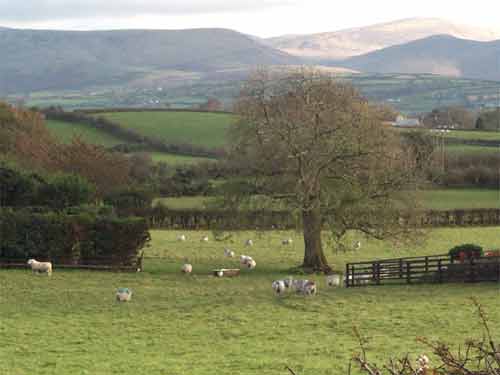
Image is of the Mourne Mountains as seen from near Rathfriland.

Friday, May 05, 2006

Brontë News

Jane Eyre is playing London: "Jane Eyre'' plays from May 9 through July 9 at Trafalgar Studios. Tel. (44) (870) 060-6632 or click http://www.theambassadors.com.

'Bookslut' has another review of The Brontë Project: A Novel of Passion, Desire, and Good PR.

This is probably a better idea than encouraging your children to write fictional thank you letters for fictional gifts of Jane Eyre: a mother-daughter book club!

The Chocolate War, The Outsiders, and The Secret Life of Bees are novels written by contemporary writers, but the group has tackled classics that include A Tree Grows in Brooklyn and Jane Eyre, as well.

"It's not hard to read a book each month," said Katie [aged 11], "but Jane Eyre was so long."

Author Sara Paretsky talks about her attraction to a certain breed of heroine: Women like Jo March of "Little Women" by Louisa May Alcott and the title characters of "Anne of Green Gables" by Lucy Maud Montgomery and Charlotte Bronte's "Jane Eyre"
"Heroines who engage me had to suffer before they succeeded," said Paretsky.

And lastly, Yorkshire has the dubious destinction of being #4 on a list of places to avoid visiting...
Lovely scenery, but there are people in the West Riding who have lived there since 1106 but are still not accepted as true Yorkshiremen because rumour has it that their mother bought clogs from a pedlar who had a cousin in Prestbury, thereby blighting the bloodline forever. They make Londoners look like Hawaiian greeter girls. Plus you can't stray within 50 miles of Haworth sodding Parsonage without being assailed on all sides by Bronte bilge. The Branwell Tea Shoppe. The Helen Burns Sunbed Centre. Mr Rochester Opticians. Grace Moon Loft Conversions. What a load of Wuthering Shite.

I cannot but laugh at the thought: who the deuce is 'Grace Moon'? They... did at least inadvertently promote two other places associated with the Brontës: The Peak District, home to at least one of the halls said to have inspired Charlotte's description of Thornfield, not to mention the location for now two version of Jane Eyre. Also, the Mourne Mountains, in Northern Ireland. Visible from Patrick Brontë's birthplace. So, it's not all so bad? ...

ETA: These this a better link for the London Jane Eyre production: http://www.theambassadors.com/trafalgarstudios/sp_p2702.html

Adapted and Directed by Polly Tealefrom the novel by Charlotte Bronte. Jane Eyre is poor, plain and unloved. But locked up in the attic of her imagination lives a woman so passionate and so full of longing she must be guarded night and day for fear of the havoc she would wreck. Who is this woman who threatens to destroy Janes's orderly world? A world where Jane has, for the first time, fallen in love.

Last seen in the West End with its award winning play After Mrs Rochester, Shared Experience is one of the country's most successful and inventive theatre companies, making a long awaited return to London with its heartbreaking, utterly compelling and unique interpretation of a great novel.

'You feel you are looking into the heart of Bronte herself' The Times
'Brilliant. A big, stormy play' Sunday Times
'Keeps making me cry in the street. Startling intelligence, passion and humour.' Daily Telegraph

Tuesday, May 02, 2006

Today's Brontë News


Today we have, thanks to Austenblog, some news about a very creative blog called Knit the Classics, where members read a classic novel for the month and make needlework (of any variety- crochet, knitting, embroidery etc...) inspired by the work! this month's novel is Pride and Prejudice, and for June the novel will be Wuthering Heights. I think this is a marvellous idea, and not just because embroidery is one of my hobbies.

Here's another article about those Bed Books- books designed for reading in bed. Their assortment includes Brontë titles, such as Wuthering Heights.

There's a wrestling racoon named Jane Eyre...

Emily Brontë is a 'spinner who did Yorkshire a good turn.'

Emily Brontë's poetry is also a challenge for a poetry recital contest.

I'm not sure what to make of this: For $1.50, there is Madeleine L'Engle's "Circle of Quiet," a biography in which she tells of days when she feels like Emily Bronte or Jane Austen or Elizabeth Barrett Browning. On those days, she signs her checks with their names, and never once has the bank returned one as fraudulent.

And an article on Justine Picardie's My Mother's Wedding Dress: The Life and Afterlife of Clothes, a book which features a discussion of Jane Eyre's 'shades of grey.'

And lastly, communities in Northern Ireland are hoping that Patrick Brontë can help to bring people together, and hope there may eventually be 'a Bronte Day.' This movement is being promoted by relatives of the Brontes. In a previous post, such a relative of the Brontes wrote in to Brontëana and posted her story here.

Saturday, November 26, 2005

Rose Ann Heslip and the Living Cousins of the Brontës

Today we have a very special guest post here at Brontëana. Without further ado, here is an article written by Kate Bower, to give us all more information on Rose Ann Heslip and the modern descendants of the Irish Brontës- who are not quite so scarce as it seems. (It probably suits the mystique of the Brontes to think of their extended family fading away but such is hardly ever the case). Thank you, Kate, for taking the time to write this for Bronteana.

The commemorative event for Rose Ann was held on 6th October and the sun shone, it turned out to be a glorious day. There was a dinner held at Healds Hall Hotel attended by family members including Rose Anns’ 89 year old great grand daughter Olive Emily, members of the Bronte society and SpenValley Civic Society, and the Deputy Mayor & Mayoress and the Deputy Sheriff of Yorkshire.

“Healds Hall was one of the most fashionable residences in the district when built in 1764. It was the largest house in Spen Valley. The Hall first became famous through links with the Bronte family when it was owned by the Reverend Hammond Roberson, immortalised as the Reverend Matthew Helstone in Charlotte Bronte's novel "Shirley".”

www.healdshall.co.uk

After a very good meal and a ‘photo opportunity’ session, the party (slowly!) made its way to Dewsbury to the church of St Luke with Whitechapel. Flowers were laid on the grave and the local press were there in force – we all felt like minor celebrities for the day! Then into the lovely church for a memorial service (forgive me for saying so, but it has to rate as one of the dullest services I have ever attended). This was followed by a reading of some of Emily Bronte’s poems and a posy was presented to Olive.

Rose Ann was a very special lady I think. She was the kind of indomitable woman beset by tragedy and hardship you often find in a certain kind offiction. She was born in 1821 in Ireland and therefore lived through the famine - she must have seen some terrible things in her life.

Her parents were Sarah (nee Bronte) and Simon Collins and she was the only one of their ten children to marry. She had five (perhaps six) children only to watch them succumb one by one to consumption. Only one daughter, Emily, lived to marry. Emily, and her husband Hugh Bingham emigrated to Scotland where all their five children were born. Then Hugh moved down toYorkshire to take up work as a foreman at a gas works. By this time Emily was sick with consumption herself and her widowed mother aged over 70 came over to nurse her dying daughter.

Together the elderly lady, the sick daughter and five small children made the long and arduous journey by road from Scotland to Yorkshire. Aged just 33 Emily died and was buried at St Lukes with Whitechapel. Rose Ann stayed to look after her son-in-law Hugh and her grandchildren. What a sense of love and duty she must have had to stay in late Victorian industrial Yorkshire after the open spaces and close knit network of family and friends she had left behind in Ireland. It must have been a very grim place indeed.

“Salthorn was a deserted, forlorn place, surrounded by black pit-hills and standing amidst swamps and pools on the rough uncultivated common – at night lighted up by the lurid flames which belch from the furnaces at Low Moor and Bowling.”

Heckmondwike Herald, 24th August 1893

Eventually Rose Ann seems to have developed some kind of dementia and was admitted to the infirmary at the local work house. Full of character to the end, she climbed over the wall and made her way back home on the back of a cart on at least two occasions, according to family tradition. She lived to94. I would have loved to have known her.

Her eldest grand daughter, Mary Jane – my great grandma also died in her thirties of breast cancer, leaving three children – Leonard, Ernest andOlive Emily. But the younger grand daughter Elizabeth Anne lived to a grand old age, and I can just about remember her as a very old lady who smoked imaginary cigarettes (having been banned them by the doctor) and who frightened me very much when she once threw the ‘stub’ into the grate and asked me “Did it go in?”. I wasn’t used to grown ups behaving like this and I had absolutely no idea what to say to her! This aside, my mother and aunt tell me that she was a lovely lady, and ‘Aunty Annies’ sponge cake’ is a recipe which is still used in the family.

I have known that we had a Bronte connection for as long as I can remember. When I was around 16 I wrote to the Bronte Society to try and confirm this particular family tradition. Sadly, they were not really very helpful. They confirmed that Emily Heslip had married Hugh Bingham, but stated that they had no record of any children of the union. It was clear from the tone of their letter that, as far as they were concerned, the matter was closed.

It was only this year, when Imelda Marsden of the present day Bronte Society, ‘found’ us as the present day descendents of Rose Ann. She is researching a book on the relations of the Brontes and she is particularly interested in Rose Ann. This provided the first concrete proof that we did have a blood connection with the Brontes. After the brush off I had previously received, I wondered if Mary Jane and the others were perhaps Hugh’s children from a previous or subsequent marriage.

Because of this I can trace an unbroken maternal line back almost 250 years to Eleanor (Alice) McClory, born around 1759/60, the mother of Patrick and Sarah and the grandmother of the Bronte sisters and Rose Ann. Since I have a particular interest in womens’ history, and tracing a female line is usually quite difficult, this has been a source of special satisfaction to me - even without having famous cousins.

Saturday, November 19, 2005

Brontë Sisters Links

This resource is truly amazing- a labour of love comprising aproximately 3 000 links to websites, articles, etc. all about the Brontës. The list dates all the way back to March 15th, 2005! And I see that there have been 337 links added this week alone. For easy reference here, I've listed them according to their subdivisions but (as soon as I work up the courage to tamper with my links list again- doing so has deleted posts on Brontëana in the past!) the group's main page will recieve its own place of honour on the Brontëana links list.

The Links:

About the Victorian Era (570 links)
About the Brontes (1230 links)
Rev. Patrick Bronte
Maria Branwell
Maria and Elizabeth Bronte
Charlotte Bronte
Branwell Bronte (Patrick Branwell Bronte)
Emily Bronte (Emily Jane Bronte)
Anne Bronte
Elizabeth Branwell
Relations of the Brontes
Rev. Arthur Bell Nicholls
Friends of the Brontes
Bronte places

Photo is of the Bronte waterfall, taken by Martha, the list owner. I've scare seen anything more lovely! Thank you for sharing this treasure with us! :)

Friday, November 18, 2005

'Cottage Poems' by Patrick Brontë

At last! The Cottage Poems have been published by Project Gutenburg! Click here to read the full texts. They were released on november 16th. Could 'Maid of Killarney' be far behind? How very exciting! Other Bronte texts available through the Project include:

A, C, and E Brontë: Poems by Currer, Ellis and, Acton Bell
Anne Brontë: Agnes Grey, Tenant of Wildfell Hall
Charlotte Brontë: Jane Eyre, Villette, The Professor.

Il y a <<Jane Eyre ou Les mémoires d'une institutrice>>, le roman en Francais aussi. Je ne sais pas qu'est le traducteur de cet roman. C'est tres intéressante. Je pense qu'il est comme lire la roman encore- pour le premier fois. Il a un peu plus ...de melodrame. Ou plus de poésie, peut-etre. D'accord. Chacun langue chante son poésie. And, no, there is no text for Shirley! Shame, shame! (Nothing for Branwell either).

Emily Brontë: Wuthering Heights.

Also: Elizabeth Cleghorn Gaskell: The Life of Charlotte Brontë volume one and two.

A friend of mine is responsible for Really Slow productions of Shakespeare. People volunteer to record their lines, and then this is all pasted together with the magic of the internet into... a really slow production of Shakespeare. Some of my other friends and I were then inspired to try a really slow production of Jane Eyre the Musical. The trouble here was that all of my friends are ladies (the ones who sing, at any rate). And so, we had a soprano Rochester and myself who plays St.John Rivers (also a soprano, although I can sing alto as well). I forget how Brocklehurst came out... Our Jane was a certain classicist from Nova Scotia. Alas, before we ever even took our little horrendous productioni seriously, she ran away to a religious order.

And now, she's back! And she's not a nun. She found true love... in the religious order. I am astounded and amazed, and it is beautiful. She is no longer my soon-to be nun friend who despaired of leaving behind her copy of Villette. I now have a deliriously happy non-nun friend who can have as many books as she likes- and the true love thing is rather nice too.

ps. Don't worry, Martha- I got your email! I think this deserves a post of its own :)

Saturday, October 29, 2005

Another limited time offer.

A dear friend of mine has recently bought a CD full of theatrical tidbits that someone had collected over time. In it there are some lovely video clips from the Jane Eyre musical when it was on Broadway. I haven't seen most of these- my computer is still not up to the job, but that's no reason not to share the links! They will be up for less than a week.

Several are promotional trailers from Broadway.com (avid fans will recognise the Proposal clip from James Barbour's website):

"Secret Soul"
"The Pledge"
"The Proposal"
"The Kiss"

These are apparently longer video clips. I haven't viewed them so I cannot comment on where they might have come from:

You examine me Miss Eyre
End of the Gypsy Scene
The Proposal
"Secret Soul" performed in the studio

There are also some audio files and photographs. I haven't listened to these, either, but apparently the lyrics are different from other renditions: Sirens, Secret Soul. I've posted some of the photos throughough this post btw (or I will do when Blogger will allow it...).

I have been silent lately, due to more than one crisis at home, which are now resolved, God willing. Exam week is over, I have survived it with only minor damage and the addition of a new hobby- crochet. All of this has nothing to do with the Brontës and so, I'll move on to something I read this morning which struck me as very odd.

From the Liverpool Daily Press article on Polly Teale's Bronte:

"A fine actor like David Fielder is expected to play the sisters' father, the dull curate who becomes Charlotte's husband, Charlotte's tutor and the fictional Mr Rochester. It's not always easy to know which one he is playing at any moment."

That really must be confusing. I'm thinking especially of the Patrick Bronte and Arthur Nicholls crossover. Just how is that supposed to work? I can't help but think that it would make one of them seem totally nuts. "That soundrel! I don't ever want to see him in this house again!" "Oh please, let me stay-" "No, I say!" Or something more accurate and meaningful but along those same lines. Still, it is a shame I cannot see this. Mr Rochester is easier to work in since he is a composite of imagination and experiences of character like most fictional creations. There could be a little of ..most of them (Mr.Nicholls excepted) in his character. It would probably come across as though there had only ever been one man in Charlotte's life- at least he doesn't also play Messrs. Smith, Williams, Taylor, and Thackeray too.

Saturday, August 27, 2005

Jane Eyre the Musical to make its UK Premiere, and the Wierd Circle.

Finally there is news about my favourite musical! Details can be found here: Jane Eyre the Musical's UK Premiere.

I've been very busy lately, preparing to return to school, but I have also been at a loss to decide exactly what to post about- there's so much to choose from. Firstly, just as July was our impromptu Villette month, August is Jane Eyre month. I usually read the novel all at once in a day, or two at most. I picked up on a lot of things that I usually gloss over while reading it slowly over the month. Probably my most interesting 'discovery' was that Helen Burns doesn't have a grave marker for a certain number of years. It seemed very odd that this time frame would be given. After thinking about it, and tallying the passage of time based on the events in the novel I believe that it's plausible to assume that Jane returned to Lowood with her son and Mr Rochester- because it would have to have been when her child was 3 years old. There might be another explaination, but I found this one intriguing!

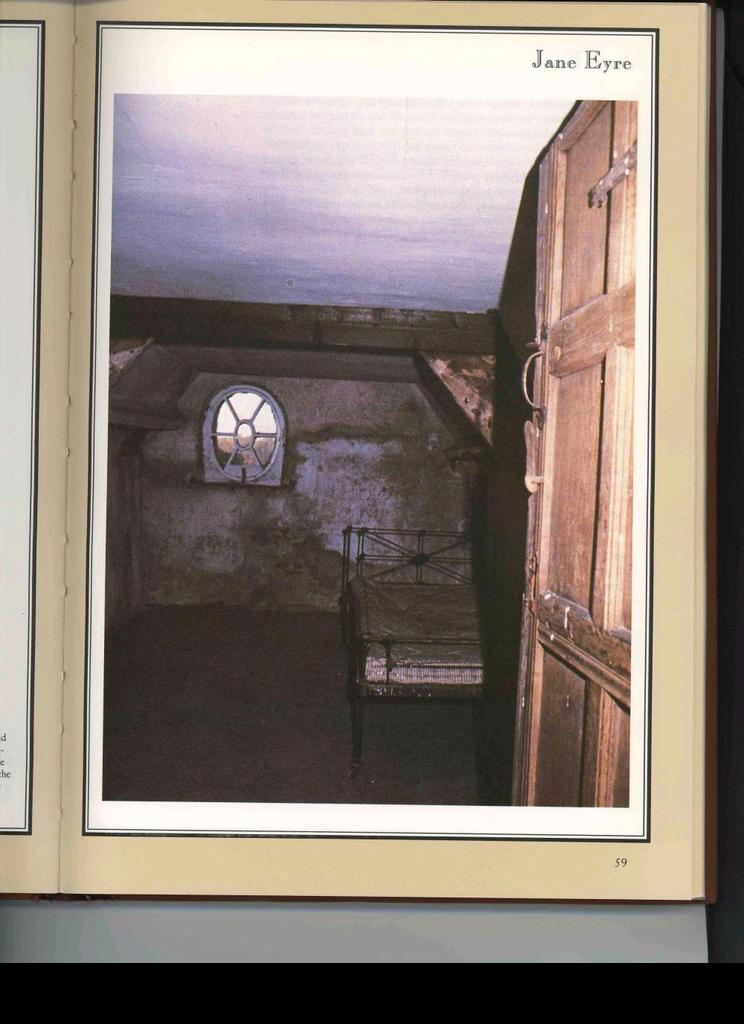
I love to do inter-textual analysis, and so I also made a list of each and every book mentioned in the novel. :) That will keep me busy for quite some time in the distant future. My wonderful friend Thisbeciel has also overwhelmed me with her Brontean bounty! I now have full texts of The Cottage Poems by Patrick Bronte! And many terrific images, and illustrations such as... This picture of the madwoman's room at Norton Conyers! I think that if I was shown such a room I'd probably write a novel as well ;)

I ALSO got to hear a strange little adaptations of Jane Eyre and of Wuthering Heights. I believe these date to the 1950s- which is even more interesting to me because I haven't been able to see any of the films of Jane Eyre from that decade (yet). The group was called Wierd Circle. Imagine, if you will, Jane Eyre or Wuthering Heights performed in half an hour. Does it make you smile? Yes, it was awful- but awfully funny. Jane Eyre was especially terrible and has now become the source of many jokes among my friends.

Wierd Circle Jane Eyre included such interesting elements as:
-The landscape being terrifying in and of itself.
-No Mrs. Fairfax. The housekeeper is now a Mrs. Campbell who has a really creepy voice and is always saying things like: "You think you'll be happy here? ha ha ha Really, Miss Eyre? Happy? ha ha. You'll see... yes, you'll see. Ha ha ha". That isn't a direct quote, but this is: "We've had other governesses come before but they never stayed. No. Never..." And she tells poor Adele that she's "a child of the devil".

-Mr Rochester is really not that bad. But he's a few leaves short of a chestnut tree sometimes. During his first chat with Jane he says that he has learned a lot about Jane: that she's an orphan, likes children, and that he loves her: "You're an orphan, like children, and I love you." They sort of pretend that didn't happen, because she is still surprised by his proposal! When Jane asks him why no one is allowed upstairs he replies glibly that "it saves fuel." When Jane points out how this doesn't make sense he says: "Let's say it saves fuel and go with that." When asked about the articulate voice shouting threats in the distance he says: "It's the wind". When Jane objects he replies: "Let's say it's the wind and leave it at that."

-Mrs. Campbell: "You won't be married for another three days, and there's a lot I can do in three days!"

-I will now spoil the ending. Bertha is revealled- and this part really was creepy, I must say. But it still suceeded in ruining the effect of Bertha's demonic cries and laughter. While she laughs and cries out that she likes to see death, Mr Rochester informs us that he adopted Adele because he was lonely and needed something to love- which, you know, inevitably makes me think that a cat would have probably been a better idea. And so that really ruined the moment. But it was very funny. Bertha's death is also comically undermined. Mr Rochester tells her to not jump, and we hear her do a "la la la- whoop!" and hear Jane inform us that Bertha has slipped off of the roof (Jane witnesses the fire- I forgot to say... Thornfield bursts into flames as soon as she leaves). And lastly, the framing device of Jane's diary is reintroduced. Jane is at Mr Rochester's bedside in the hospital. He's alive but IN A COMA. He's been in a coma for the last few months. And since Jane has begun to speak in a slow creepy Mrs. Campbell sort of way, we are left with the knowledge that he won't ever wake up- probably.

I know how much you must have enjoyed that- and so, next time I'll have Wierd Circle Wuthering Heights to discuss!

Friday, July 29, 2005

Rose Ann's Grave

Grave of first cousin to the Brontes found in Yorkshire.

The umlauts will not work today.

Richard Wilcocks recently shared some very interesting news about a relative of the Brontes that I have not heard very much about at all: Rose Ann Heslip. Mr. Wilcocks's post can be found here: http://groups.yahoo.com/group/BRONTE/message/17727 although you will not be able to view it without a membership at the yahoo group, I believe. He posted some material which will eventually be on the front page of the Bronte Gazette for September. Here are some excerpts:

Rose Ann's mother was Sarah Bronte who was the only sister of Rev Patrick Bronte to marry. Sarah married a Simon Collins and had ten children. Rose Annwas the only one to marry and carry on the line. Rose Ann was the niece ofPatrick Bronte and his children's cousin, yet they never met. CharlotteBronte once mentioned an 'Aunt Collins' to Ellen Nussey of whom she said 'sheknew little to her regret'. That was long before Rose Ann came to live in theSpen Valley, West Yorkshire.

***

The story of how Rose Ann was found by the literary world is one worthy of theBrontes. A Dr William Wright wrote an article entitled The Brontës in Irelandin McClures Magazine, extracts from which were published in the Bradford DailyTelegraph. Rose Ann read them and was very displeased, thinking that certainparts were deeply insulting to her family, so she sent her son-in-law down toLondon to seek out the author. This led to a newspaper interview with Rose Annwho until then was quite unknown. Dr Wright visited her at home, where she toldhim what she thought of his writings about her family in no uncertain terms. Hethen changed what he had written in the second edition of his book.

Rose Ann visited Haworth for the first time on the fourth of November 1893through the kindness of Dr Wright. Haworth church was open for the party tolook around. The church warden commented to the family on the likeness of RoseAnn to Charlotte Bronte, her cousin. She was taken to the Black Bull wherelike so many visitors she sat in the chair in which her cousin Branwell Bronte used to sit. There was no evidence that she visited the Parsonage.

I hope I will be able to read the full article when it comes out in the Gazette! I don't how to get a copy of it, but I would like to know more about the relatives of Patrick Bronte.

Above: Rose Ann's Grave Churchwarden Joan Pinder with grave of Patrick Brontë's niece Rose Ann Heslip in Cleckheaton