


Newly Published Letter from Patrick Bronte
The loving side of 'stern' Bronte father
By Clive White
A previously unpublished letter has thrown new light on the character of the clergyman father of the famous Bronte authors.
It now appears the Reverend Patrick Bronte was not the "cassocked savage" as branded by Elizabeth Gaskell, his daughter Charlotte's biographer.
It shows him to be, in fact, a loving and courageous dad.
The letter is among the archives at Lambeth Palace, London, and was written to Charles Thomas Longley, former Archbishop of Canterbury, who was a friend of Patrick.
In the letter Patrick says: "I have lived long enough to bury a beloved wife and six children - all that I had, I greatly enjoyed their conversation and company.."
"Now they are all gone - their image and memory remain and meet me at every turn - but they themselves have left me."
The significance of the four pages has been revealed by Bronte scholar and author Brian Wilks, of the Bronte Society.
It was written ten days after the death of Charlotte, the author of Jane Eyre and the sixth of Patrick's children to die before him.
The 78-year-old was left to grieve at Haworth Parsonage, and the letter gives a deeply moving account of the tragedies that struck his gifted family, said Mr Wilks.
The vicar lost his son Branwell, aged 31, in September 1848, Emily, who wrote Wuthering Heights, three months later, aged 30, his daughter Anne, aged 29, in May 1849, having already suffered the grief of losing his wife and two elder daughters some years earlier.
Mr Wilks, who intends to publish the letter in the Bronte Society Journal next autumn, said: "I have always supported the idea that Patrick was a compassionate man.
"It was fashionable to think of him as a bad tempered man and there may have been some of that, but overall he was very compassionate.
"The best thing about the letter is what he says about missing the company and companionship of his family.
"The letter is a missing piece of the jigsaw and will startle and delight Bronte enthusiasts."
It was sent to Longley in 1855 while he was Bishop of Ripon, thanking him for his words of comfort, but also reveals how Patrick's faith had been challenged by the devastation.
He says: "The Lord gave and the Lord took early awaybut I have often found and find in this last sad trial that it is often frequently extremely difficult to walk entirely by faith and sincerely to pray They will be done on earth as it is in heaven.'"
The sentiments in the letter contradict comments made by Mrs Gaskell in a magazine article. She said Patrick was a "cassocked savage who ought to be have been taken out into the garden and shot."
Ann Dinsdale, the Bronte Parsonage librarian, said the letter revealed Patrick as a loving father.
"Elizabeth Gaskell had an axe to grind. The Bronte novels at the time were perceived as brutal and shocking and she was trying to protect Charlotte.
"The way she did it was to make the case that what else could they write about when they were living in this backward place with a half-mad father and alcoholic brother?"
In reality Patrick was a compassionate father who suffered and missed his children, she added.
With a new biopic of the Brontes in the works, I can only hope that we will no longer see Patrick Bronte depicted as an abusive father. It is surprisingly difficult to escape from Gaskell's malicious portrait. So many editions of the Bronte novels state in their tiny penny paperback bios how their father was brutal, or severe. This letter does not surprise me in the least. Some of the well-known letters from Patrick are very warm, and sometimes even silly (as when he wrote a letter to Charlotte under the guise of one of the family dogs. Charlotte was so amused that she forwarded it to her friend). Needless to say, I have little love for Gaskell. Who, incidentally, didn't just say that Patrick ought to have been 'taken into the garden and shot' in a magazine article- she villified him in the biography she wrote for Charlotte at Patrick's request. It is well known today that she relied on the testamony of servants who had been dismissed and had their own 'axes to grind' as well as her own prejudices (she seems at a loss to understand how an Irishman could be so calm- he must have irrational 'volcanic' outbursts of rage while in private- such as shredding his wife's dress or throwing his children's boots into the fire). My point is, then that this letter is not so 'startling' as the article suggests...
Thursday, December 07, 2006

Wednesday, November 01, 2006
'You Must Try Now to Forget...'

I realise that I have never posted these letters by Charlotte Bronte before. This is a shame because they are among my favourites. Her letters make wonderfull reading, especially when she's angry and being a snark. Here she wonders what it would be like to see an adaptation of Jane Eyre, and then her reaction to a review of one of the first adaptations (if I remember correctly the first adaptation appeared only months after the novel's publication).
TO W. S. WILLIAMS
‘February 5th, 1848.
‘Dear Sir,—A representation of Jane Eyre at a minor theatre would no doubt be a rather afflicting spectacle to the author of that work. I suppose all would be wofully exaggerated and painfully vulgarised by the actors and actresses on such a stage. What, I cannot help asking myself, would they make of Mr. Rochester? And the picture my fancy conjures up by way of reply is a somewhat humiliating one. What would they make of Jane Eyre? I see something very pert and very affected as an answer to that query.
‘Still, were it in my power, I should certainly make a point of being myself a witness of the exhibition. Could I go quietly and alone, I undoubtedly should go; I should endeavour to endure both rant and whine, strut and grimace, for the sake of the useful observations to be collected in such a scene.
‘As to whether I wish you to go, that is another question. I am afraid I have hardly fortitude enough really to wish it. One can endure being disgusted with one’s own work, but that a friend should share the repugnance is unpleasant. Still, I know it would interest me to hear both your account of the exhibition and any ideas which the effect of the various parts on the spectators might suggest to you. In short, I should like to know what you would think, and to hear what you would say on the subject. But you must not go merely to satisfy my curiosity; you must do as you think proper. Whatever you decide on will content me: if you do not go, you will be spared a vulgarising impression of the book; if you do go, I shall perhaps gain a little information—either alternative has its advantage.'
He did go to the performance. His report does not survive, but this is Charlotte's response to his review:
TO W. S. WILLIAMS
‘February 15th, 1848.
‘Dear Sir,—Your letter, as you may fancy, has given me something to think about. It has presented to my mind a curious picture, for the description you give is so vivid, I seem to realise it all. I wanted information and I have got it. You have raised the veil from a corner of your great world—your London—and have shown me a glimpse of what I might call loathsome, but which I prefer calling strange. Such, then, is a sample of what amuses the metropolitan populace! Such is a view of one of their haunts!
‘Did I not say that I would have gone to this theatre and witnessed this exhibition if it had been in my power? What absurdities people utter when they speak of they know not what!
‘You must try now to forget entirely what you saw.'
Saturday, October 14, 2006
Actors on Playing Jane and Rochester
Another good thing about a new adaptation is that it brings out all of the previous ones! The Daily Mail posts this survey of mini-interviews with Janes and Edwards past (thanks to siansaska!) Also, the images from this post are from the internet and not my archive so this explains why some are tiny while others are huge:
"Unknown actress Ruth Wilson has shot to fame as Jane Eyre in the BBC’s current adaptation of the classic novel. The series, one would assume, would guarantee her a glittering thespian future. Costume dramas are often a springboard to fame and fortune for young actors: Samantha Morton was 20 when she played Jane in 1997 and then went on to star in Minority Report with Tom Cruise and Enduring Love opposite Daniel Craig. But they can also be a one-way ticket to professional oblivion. Here, we find out what happened to previous Janes and Mr Rochesters, and why they now look at the role as a double-edged sword.
SUSANNAH YORK starred with George C. Scott in the 1970 version of the film. Susannah, 64, is starring in a touring production of The Wings Of The Dove next year. As well as acting, she also writes film scripts. She recalls: At the time I was asked to play the role of Jane, I was quite hot, so to speak. Offers were coming fast and furious, so I was delighted when I got the part. I loved the book and it was a part I had always wanted. I was bewildered and upset, however, when people said I was too pretty to play a plain governess. I have always thought of myself as a character actress and I longed to be noted for my acting ability and hated it when people paid attention to my appearance.
I’ve never thought of myself as pretty and truly felt I was Jane. She’s not a showy character, but she is still passionate, and that’s what I liked about her. People are also saying that Ruth Wilson is too pretty. But I think she has just the right qualities and seems to have the same view and feel of, and feeling for, Jane that I did.
My co-star, George, was a big, craggy, gruff creature, and he was great for a chat. But our approach to filming was totally different. I liked to rehearse, but he would do a scene in one take then go back to playing backgammon. I thought he made a pretty good Rochester, though, as he had a real presence — although he was perhaps a bit too old. I must confess that I have yet to see my perfect Mr Rochester. Even Toby Stephens in the current adaptation, while a great actor, is not the Rochester of the book as he’s a bit too young.
I wouldn’t say I was typecast, but people tended to see me as a more serious actor afterwards. As a result, although I refuse to accept it when people put limitations on me, I’ll admit that it hasn’t always been easy to get roles since.
I don’t regret playing Jane, though. It was a brilliant part. Usually I curl up with embarrassment when I watch my performances, but when I watched my version of Jane Eyre, it seemed to me that I had struck the right note.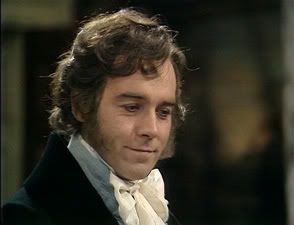
MICHAEL JAYSTON played Mr Rochester to Sorcha Cusack’s Jane in the 1973 BBC miniseries of Jane Eyre. Michael, 70, currently on tour with the play Heroes, says: I landed the role of Rochester as a result of a practical joke. My then wife, Heather, sent a funny letter to the director, Joan Craft, saying, ‘It’s about time Michael played Rochester’, and we used to think that I got the part as a result.Looking back, though, I was on a roll at the time. I’d just come from playing several highprofile roles such as Tsar Nicholas II in Nicholas And Alexandra, and A Bequest To The Nation opposite Glenda Jackson. And here was the ultimate romantic part.
Sorcha was only 23 and I was 37. People said there was an electrifying chemistry between us, which was true. I did find her attractive, but we kept things quite jokey on the set to alleviate the intensity. It’s not that romantic performing love scenes on a cold morning at 8am, with a props guy holding a hot fan right next to you to stop your lips freezing. Professionally, playing Rochester didn’t do me much good. I never played a romantic part on TV after that. I was baffled because when it was shown on TV, I received the biggest fan mail I’ve ever had.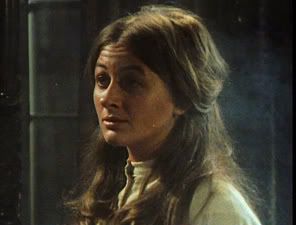
SORCHA CUSACK, 57, never made the big time after playing Jane Eyre, but has had roles in such shows as Morse, Casualty and North And South. She is currently starring in the Royal Shakespeare Company’s Romeo And Juliet. She says: Jane Eyre was my first TV job and, to be honest, I felt I was rather hopeless. With no major roles under my belt, my performance was flat. I was very lucky to get the role in the first place and I think I got the part because I’m plain-looking and, because I was born and bred in Ireland, I was ten years behind other girls in terms of sophistication. Both were key ingredients to the character.
As a child, people were always saying, ‘Isn’t Sinead [her actress sister] gorgeous?’ But my look was perfect for Jane. Rochester, Michael Jayston, said, ‘After this you’ll be huge,’ and, while we were filming, I did go to my bank manager and say, ‘I won’t need the overdraft any more.’ But I did need it as I didn’t get any big breaks afterwards. There was plenty of work, but not a role that changed the course of my career.Lots of theatre work followed, but several years after playing Jane, I put my career on hold for a while to return to Ireland to care for my late mother, who had heart problems. It’s nice looking back on the whole Jane Eyre period, and it’s lovely that I still get letters saying, ‘You’ll always be my Jane.’
ZELAH CLARKE starred in the lavish 1983 BBC adaptation of Jane Eyre opposite Timothy Dalton, who was said to be too handsome to play the brooding Rochester. Zelah, 52, says: Jane Eyre is the ultimate poisoned chalice. Everyone remembers the Rochesters, but no one recalls the Janes. I hoped the role might be a springboard — I never thought it would force me to retire. Before Jane Eyre I had done lots of TV costume dramas, but not a lead role, so I was thrilled when I got the part. Tim Dalton wasn’t a superstar then — in fact, I had more TV experience than him.
It was depressing when things suddenly stopped after Jane Eyre, especially as I had no idea why. But then I got married and my life changed. There is something undignified about old actors scraping around for work. I would never go back into the theatre; it ruins your social life and breaks up families. If I hadn’t done Jane Eyre, perhaps I’d have felt that I hadn’t proved myself. But I did and I have. Now, looking at the series, it seems old-fashioned, but I was pleased with my performance. Between roles I became interested in art, so perhaps I didn’t have such a desire to be a famous actress after all."
Monday, October 09, 2006
New Spin on the Darcy Moment
Well, we have heard a lot about this being Toby Stephens' 'Darcy Moment.' This article, however has a different approach:
And does this (praise be!) mark an end to the tiresome lionisation of Mr Darcy? I say Mr Darcy, but of course we all know I mean Colin Firth.
[...]
The slow burn ignited, and up in flames went effigies of Rochesters past; William Hurt (impressive sidewhiskers, but a bit bland), Timothy Dalton (rather shifty, but not in a good way), George C Scott (not dishy enough) and of course, Orson Welles (impressive, but I've never forgiven him for Citizen Kane, surely the most over-rated movie ever made).
[...]
All of which brings me back to the disagreeable cult of Mr Darcy, who in recent years has been consistently voted the greatest romantic hero in literature.
Last year a survey of heroes (romantic or otherwise) by the literary website Books.co.uk saw the aloof incumbent of Pemberley Hall triumph over the likes of Romeo Montague, Heathcliff and Rhett Butler, with Mr Rochester languishing very unfairly, I feel, at 15th - just ahead of Mr Pickwick.
It doesn't take a Nostradamus to predict malign forces at work; Mr Darcy's position has rather more to do with Colin Firth than Pride and Prejudice. How else can one account for the fact that Mark Darcy, of Bridget Jones' Diary - also played by Firth - somehow managed to insinuate his way into seventh position.
But why? Charlotte Bronte's Edward Rochester is a passionate, powerful man, by comparison to whom Jane Austen's Fitzwilliam Darcy appears not merely repressed, but sexually continent to the point of constipation. Yes, he's proud and insufferably arrogant, which - shhh! don't tell the feminists - always goes down well with us career girls, but there's something rather unmanly about his prickliness.
Unfortunately for the Darcy camp, last year I witnessed a 'literary death match' between Darcy and Mr Rochester in which Rochester beat Darcy more than two to one. And I'm sorry to say that most of the pro-Darcy aguments were nothing more than 'how could you not like him?' or 'how could you like Rochester? I don't understand.' How can that compare with: "my bride is here because my equal is here," "my second self, and best earthly companion," "I longed for thee with soul and flesh," with his intriguingly complex character? It just wasn't fair.
I think Charlotte Bronte still says it best in this letter where she defends her creation:
Mr. Rochester has a thoughtful nature and a very feeling heart; he is neither selfish nor self-indulgent; he is ill-educated, misguided; errs, when he does err, through rashness and inexperience: he lives for a time as too many other men live, but being radically better than most men, he does not like that degraded life, and is never happy in it. He is taught the severe lessons of experience and has sense to learn wisdom from them. Years improve him; the effervescence of youth foamed away, what is really good in him still remains. His nature is like wine of a good vintage, time cannot sour, but only mellows him.
Sunday, October 01, 2006
Preview Clip for Episode Three of Jane Eyre 2006
The preview clip is now available here. Not much happens in this clip, so I have only made a few screencaps this time. Aunt Reed is ill, Jane reads a letter. I wonder what that's about...


ETA: Link fixed.
Monday, September 18, 2006
Other Voices on the Jane Eyre Preview.
The preview crowd who were present at the screening of the BBC's new mini series are out in force now and the message boards are showing the response to the first two episodes has been very positive so far- no didgruntled Bronte enthusiasts so far. Here's a survey that I hope will be of interest (thanks go to Liz for inadervent the tip):
Most reviews are in harmony with the following, by AnnetteG:
Sandy Welch has done a wonderful job with it - I thought it was an intelligent and imaginative adaptation. It has quite a Gothic feel. With four hours to tell the story, she doesn't have to rush things. The house-party is dealt with at length, and we also have time to see the developing relationship between Jane and Rochester in several conversations. And we're promised quite a bit of screen time devoted to Jane's stay with the Rivers family. Jane's childhood is dealt with fairly quickly, but it's done so well and so atmospherically that we get what it was all about without having too much detail.
In the Q&A afterwards, Sandy said that the first episode was originally too long and had to be cut, so some Lowood scenes were lost. But the producer promised they'd be in the DVD as extras - one of them is the scene where Helen's hair is cut.Ruth Wilson as Jane is superb - she has a very expressive face that shows emotions subtly but effectively. I found the scenes after the fire very touching and then heartbreaking - first as she realises that she is in love with Rochester and thinks he has feelings for her, and then as she finds out he's gone off to the Ingrams' the next day and is likely to marry Blanche. Sandy has included that wonderful scene where she draws a rough, monochrome self-portrait, and then a coloured portrait of what she imagines the beautiful Blanche Ingram to be like. And I liked Toby Stephens more than I thought I would. He's not a favourite of mine but he gives a nicely layered performance and I'm looking forward to seeing how his character develops in the rest of the drama.
The adaptation has also gone over well with those who dislike the book:
There's a wonderfully imaginative opening sequence, and the style of filming is much more active and creative than in many period dramas, with some fast cuts and extreme closeups, and sequences on hand-held camera, like those we saw in 'North and South'.I have nothing but praise for Ruth Wilson and Toby Stephens as Rochester and Jane. I hadn't thought Toby Stephens an obvious choice for Rochester, but I think he's excellent, investing the character (who I've never really taken to in the novel) with a sense of humanity, despite his initial brusqueness. Ruth Wilson gives a wonderfully nuanced and subtle performance as Jane – she reminded me a little of Anna Maxwell Martin in ‘Bleak House’
Thursday, June 29, 2006
Bronte News and Update on BBC Search
Last Sunday Kenneth Griffith, Mr Mason in the 1970 production of Jane Eyre with Susannah York and George C. Scott, died at the age of 84. Thanks to peridramnews for the notice.
Well, now we have this article from the Guardian about the limited re-release of Daphne duMaurier's Rebecca. In passing this painfully psychoanalytic article suggests that all romances are paedophilic.
Whether it's Pride and Prejudice, Jane Eyre, Bridget Jones's Diary or any old Mills and Boon novel, the grist that feeds the fantasy mill is the same.
Several Bronteana readers have sent in some info which should be helpful in tracking down some of these remaining adaptations which are not currently available. Liz, who wrote to the BBC about the Villette mini series sends the whole text of their email reply which certainly suggests that the series exists but that copyright arrangements prevent distribution of copies- thus, the letter writing compaign mentioned earlier.
Also, Biedroneczka sends along a list she found of BBC productions of Jane Eyre from a site connected to the BBC archives. This is the list (programmes denote episodes):
6 programmes in 1956
6 programmes in 1963
5 programmes in 1972 (radio)
5 programmes in 1973
11 programmes in 1983
3 programmes in 1990 (radio)
4 programmes in 1994 (radio)
15 programmes in 2004 (radio)
In my travels I came across one source claiming there had been productions in the 1940s as well. It is possible that they were mistaken, or perhaps this list is of those versions extant. The 1972 radio adaptation must be the Megwynn Owen/Patrick Allen series. And possibly the 1994 version is the one with Sophie Thompson and Ciaran Hinds. I have not heard the 1990 and 2004 versions yet (15 episodes?!).
Sunday, June 25, 2006
Bronte News
So, here's today's news and the backlog as well. I thank you all for your supportive comments. I am feeling more at ease now. The etext is also finished but I would like to check it against the text before posting it to the Resource Site.
Author Sarah Waters claims Jane Eyre and Wuthering Heights influence her work, such as her novel Fingersmith.
Here is another review of Reader, I Married Him by Michele Roberts.
Jane Eyre is not part of this lady's emergency kit. Well, her loss. A friend of mine keeps a small copy of Villette at all times 'in case of emergency!' It would also come in handy for Random Acts of Bronte.
Canadian cities can learn a thing or two about marketting from Haworth.
Forget 'York' and 'Lancaster', this English class has a head-to-head literary death match- or rather a 2 hour quiz- with teams including 'The Bronte Sisters,' in Qatar:
There were six teams of senior students each consisting of six members with shingles commemorating Shakespeare, Wordsworth, Agatha Cristie, Bronte Sisters, Sarojini Naidu and Tagore.
[...]
Sarojini Naidu Bronte Sisters and Tagore were pipped at the post though raced hard.
Religious and literary pilgrimages merge in this article which mentions the venerable home of the Brontes.
And we have some very strong voices of protest against David Brooks' earlier article about gendered education which listed the Brontes as among the favourite books of women. You will have to scroll down to read this letter.
The 'lost classic' of Welsh literature, described as 'the Welsh Wuthering Heights' is to be made into a BBC radio4 production. The novel is called Country Dance:
Country Dance is a story of passion, jealousy and revenge centred around a young girl who grows up in an isolated rural community on the border between England and Wales.
She keeps a diary of everyone she meets but her daily scribblings fall into the wrong hands.
Friday, June 09, 2006
Evolution of Jane Eyre: The Musical Part Two- Wichita
I have to confess that my notes are nowhere to be found. I do wish to move on, so I will simply have to catch up later. Another reason for my silence resently is that I am graduating tomorrow and I have been running about making sure everything is coordinated for the event.
So, this version is probably properly called a demo. The performers are clearly not yet comfirmed in their roles (only the regular leads- Marla Shaffel and Anthony Crivello are featured). It is, however, from a live performance onstage unlike the previous recording we looked at in the previous post. I do know something about the staging at this point- there was a basic sort of scafold stage, and that this design was 'blown up' for the Toronto staging due in part to a lack of time to rework the setting- apparently.
The show has started to look more like what will become the standard set of songs for the remaining versions with a few important exceptions. This version generally features greater hyper-fidelity to the novel than the demo. In this version Jane's parents have a song but Jane's uncle Reed also! The scene illustrates Jane's arrival at Gateshead as an infant. 'How We Pity Her' is titled by myself. It consists entirely of the Reeds heaping abuse on Jane- and was thankfully a song never seen again. The chorus now comes further out of the background. They now feature in 'Jane's Letter' for instance.
The gem of this work is clearly 'Silent Rebellion.' It seems to be the descendant of 'My Hope of Heaven' although the tune is entirely different. This is the 'feminist on the roof' scene once again. The music is lovely, the lyrics also. I suspect, however, that negative reviews in the press led to the song being toned down and reworked into 'Sweet Liberty' (several reviewers claimed, with wild inaccuracy, that the show imposed radical feminist ideas onto the text of Jane Eyre- the offending items being, in fact, direct quotes or paraphrases from the novel). The same charge was levelled at 'Sweet Liberty.' The song survives to Toronto. I prefer these earlier lyrics for their way of capturing the inner imaginative life Jane has for herself on the 3rd floor.
'The Governess' is a delightful song which survives to Toronto and then La Jolla but was cut before the show went to Broadway. Imagine Jane and Rochester's first interview set to music which highlights the teasing banter as well as some of Rochester's changes of mood in that scene. 'Wild Boy' has been shifted to the moment when Rochester has just revealled Bertha to everyone. There and then he tells his story, followed by 'Gypsy Reprise' which is Rochester trying to persuade Jane to stay. It is a good song, except for one troubling bit of incongruity- he keeps referring to her as 'sister' which is stretching things a bit. I would have even preferred 'Janet.' For those familiar with 'The Gypsy', Rochester's pursuasion is sung with this tune but Jane has a separate melody which sometimes jars- appropriately marking a disjunction between their intentions. A sample of the lyrics:
Rochester: I am a scoundrel, we know this to be! The floodgates of tears are now open to me! Now, you intend to fly off- to be free! Oh sister!
Jane: And I could lie there by his side, his little Jane, his little elf. And who would care? Well, I declare 'I care for myself!'
Rochester: My little friend, you're a comfort to me! Dear sister!
Jane: What friendship exists in your lying to me? Dear master.
Lastly, and I know how you have been waiting for this, we get to St.John Rivers. In the demo, he is a remarkably well-rounded character. In fact, his character is far better delineated in the demo than in more than a few films I've seen in my travels. He loses some ground here, but not much. If anything he is a little too loathesome, or more loathesome in this version, but less genuinely pious. The previous 'Standard of the Cross' was clearly not only about his devotion to God, but his inward stuggle against his own nature and inclination. This version is very much about the 'White Man's Burden': "All my hopes and joys, the powers of my race, are held within the light of Jesus shining from space," (at least that's what it sounds like he is saying). We are further encouraged to dislike him when he, quite rightly, is mortified that Jane wants to travel to India unmarried. It is faithful to the novel, yes, but without the softening of knowing his own struggles and his genuine faith it comes across as even more repulsive. His final musical line is rather Satanic in tone. The register is very high, and the words remind this little reader too much of the Temptation of Christ: "Giving your soul to me would be like giving your soul to God! I tell you this to purchase your Heavenly bliss, by yeilding to destiny's holy kiss.' Thankfully Rochester's voice comes in just in time! The characterisation is still far superior to the very benign, cute- even- St.John Riverses of the cinema.
And, look here! I actually uploaded something all by myself! Here, for your listening pleasure is 'Silent Rebellion.'
Songs: Secrets of the House, Parents' Theme, Gateshead, As I Lay Myself Down to Sleep, How We Pity Her, Naughty Girl, Children of God, Forgiveness, My Maker, Jane's Letter, Perfectly Nice, Silent Rebellion, The Governess, As Good As You, Painting Her Portrait, The Gypsy, Secret Soul, Second Self, The Chestnut Tree, Slip of a Girl, Wild Boy, Gypsy Reprise, Farewell Good Angel, The Standard of the Cross/Morton, A Voice Across the Moors, Finale, Brave Enough for Love.
Tuesday, June 06, 2006
Evolution of Jane Eyre: The Musical Part One: The Demo
This is the first in a series of posts I have put together in order to get some more indepth information concerning my research on Jane Eyre The Musical out of my head and onto this blog. There's so little information about the show available, I hope these posts will be of some use. If there are any questions do not hesitate to comment or to send me a line at bronteana.blogATgmailDOTcom. I have to keep these posts relatively brief because, well, I have written 10 pages on ONE element of the show. So, this is all of an intro I can give you, with that in mind except to say that having written about 15 pages of material for these posts I have lost them. So, if I forget anything there will be another post to fill in the gaps. Hopefully I will find my notes before I move onto Wichita, Toronto, La Jolla, and Broadway.
As far as I know, these demo songs date from 1995 (if I remember correctly). Some are from a later period, although I cannot tell much from this recording since they are out of chronological sequence. In general, the songs are performed on synthesizers, and the composer often sings while the regular cast members only appear briefly (in 'Sweet Liberty'). I have a partial cast list which I will have to post later. Most of these songs were cut by the time the show reached Bway while some remain in the underscore and others are refashioned into other pieces.
Paul Gordon, in an interview, once said that he was inspired within the first 10 pages of the novel to write. The first piece he composed for the work was 'The Parent's Theme.' This song is notable for a hyper-fidelity to the novel which characterises the early stages of the work's development. Jane's parents do not appear in the novel, but they are brought into the musical here in a pivotal way. The song introduces many important elements, themes, and symbols of the work including: caste, marriage, wealth, faith, love, and illness. Jane's father reminds me somewhat of Mr. Grey in that he believes his wife must regret marrying below her station.
Several songs are among the most beautiful written for the show and yet they did not progress into the work as it appeared onstage. One of these songs is 'My Hope of Heaven.' It would be equivalent to Jane's 'feminist on the roof' scene. The interesting thing is that the song reappears as Mr Rochester's proposal ('Second Self'). Having the two songs in the work would have made an interesting sensation. In a very late recording (from about a month before the show closed on Bway), a musical cue marking when Jane first recognises the Master as the Hay Lane Rider is taken from this song's line: "when will I meet a soul of my kind?" But since the song was removed, the moment loses that added connection to Jane's earlier longings. I believe this song is refashioned into 'Silent Rebellion' which I will talk about later, and then finally 'Sweet Liberty' which is one of the demos but which did not appear in the show until it appeared at La Jolla.
One song which should have been cut earlier (it does eventually get cut) is 'A Perfect Match.' It reminds me of Gilbert and Sullivan do Handel's Messiah. There's lightning-quick witticisms about society and marriage, overlaid with manly choruses of 'England is glorious! Long live England! Hosannah!' (The lyrics are toned down a bit later, into 'marriage is glorious' but the song is still irritating). The song, by the way, marks when Mr Rochester's engagement to Blanche is announced. Oh, and did I mention, there are also cymbals?
This is all I have the heart to write, without my notes! I also wished to have a few more clips to show but I forgot to request help in uploading the others- I do have 'My Hope of Heaven', kindly uploaded for me by Thisbeciel. I just recall, I have quite a lot to say about St.John Rivers, so perhaps I will have to run this article over two posts when I get the chance. Lastly, though, 'If You Could See the World' is affectionately known by some fans as 'Rockin' Rochester' since Edward has a bit of a 'rock out' moment there. St.John does as well... The songs all tend to have more of a pop/rock edge than their descendants do.
Songs: The Parents' Theme, As I Lay Myself Down to Sleep, I Suppose Miss Temple, Helen's Death, Jane's Letter, Private Moments, Secret Soul, Wild Boy, Dream of a Child, Forgiveness, In the Light of the Virgin Morning, Secret Soul Reprise, Jane and Hannah, The Things That Might Have Been, The Revelation, A Voice Across the Moors, Return to Thornfield, Finale, Sirens, My Hope of Heaven, Sweet Liberty, The Aristocrats, Restless, A Perfect Match, Miss Grey, If You Could See the World
Sunday, May 14, 2006
Feb. 16th, 1850, writing to one of her friends, Charlotte Bronte wrote:
'A few days since, a little incident happened which curiously touched me. Papa put into my hands a little packet of letters and papers, telling me that they were mamma's, and that I might read them. I did read them, in a frame of mind I cannot describe. The papers were yellow with time, all having been written before I was born. It was strange now to peruse, for the first time, the records of a mind whence my own sprang; and most strange, and at once sad and sweet, to find that mind of a truly fine, pure, and elevated order. They were written to papa before they were married. There is a rectitude, a refinement, a constancy, a modesty, a sense, a gentleness about them indescribable. I wish she had lived, and that I had known her.'
Here is one of them: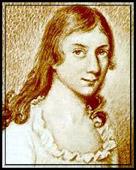
TO REV. PATRICK BRONTE, A.B. HARTSHEAD.
'Wood House GROVE, September 18, 1812.
'How readily do I comply with my dear Mr. B's request! You see, you have only to express your wishes and as far as my power extends I hesitate not to fulfil them. My heart tells me that it will always be my pride and pleasure to contribute to your happiness, nor do I fear that this will ever be inconsistent with my duty as a Christian. My esteem for you and my confidence in you is so great, that I firmly believe you will never exact anything from me which I could not conscientiously perform. I shall in future look to you for assistance and instruction whenever I may need them, and hope you will never withhold from me any advice or caution you may see necessary.
'For some years I have been perfectly my own mistress, subject to no control whatever-- so far from it, that my sisters who are many years older than myself, and even my dear mother, used to consult me in every case of importance, and scarcely ever doubted the propriety of my opinions and actions. Perhaps you will be ready to accuse me of vanity in mentioning this, but you must consider that I do not boast of it, I have many times felt it a disadvantage; and although, I thank God, it never led me into error, yet in circumstances of perplexity and doubt, I have deeply felt the want of a guide and instructor.
'At such times I have seen and felt the necessity of supernatural aid, and by fervent applications to the throne of grace I have experienced that my heavenly Father is able and willing to supply the place of every earthly friend. I shall now no longer feel this want, this sense of helpless weakness, for I believe a kind Providence has intended that I shall find in you ever earthly friend united; nor do I fear to trust myself under your protection, or shrink from your control. It is pleasant to be subject to those we love, especially when they never exert their authority but for the good of the subject. How few would write in this way! But I do not fear that you will make a bad use of it. You tell me to write my thoughts, and thus as they occur I freely let my pen run away with them.
'Sat. Morn. -- I do not know whether you dare show your face here again or not after the blunder you have committed. When we got to the house on Thursday evening, even before we were within doors, we found that Mr. and Mrs. Bedford had been there, and that they had requested you to mention their intention of coming-- a single hint of which you never gave! Poor I too came in for a share in the had words which were bestowed upon you, for they all agreed that I was the cause of it. Mr. Fennell said you were certainly mazed, and talked of sending you to York, etc. And even I begin to think that this, together with the note, bears some marks of insanity! However, I shall suspend my judgement until I hear what excuse you can make for yourself, I suppose you will be quite ready to make one of some kind or another.
'Yesterday I performed a difficult and yet pleasing task in writing to my sisters. I thought I never should accomplish the end for which the letter was designed; but after a good deal of perambulation I gave them to understand the nature of my engagement with you, with the motives and inducements which led me to form such an engagement, and that in consequence of it I should not see them again so soon as I had intended. I concluded by expressing a hope that they would not be less pleased with the information than wew my friends here. I think they will not suspect me to have made a wrong step, their partiality for me is so great. And their affection for me will lead them to rejoice in my welfare, even though it should diminish somewhat of their own. I shall think the time tedious till I hear from you, and must beg you will write as soon as possible. Pardon me, my dear friend, if I again caution you against giving way to a weakness of which I have heard you complain. When you find your heart oppressed and your thoughts too much engrossed by one subject, let prayer be your refuge-- this you no doubt know by experience to be a sure remedy, and a relief from every care and error. Oh, that we had more of the spirit in prayer! I feel that I need it much.
'Breakfast time is near, I must bid you farewell for the time, but rest assured you will always share in the prayers and heart of your own
MARIA.
'Mr. Fennell has crossed my letter to my sisters. With his usual goodness he has supplied my deficiencies and spoken of me in terms of commendation of which I wish I were more worthy. Your character he has likewise displayed in the most favourable light; and I am sure they will not fail to love and esteem you though unknown.
'All here unite in kind regards. Adieu.'
Tuesday, May 02, 2006
Caution: Books Ahead
This article is delightful.
Some books, perhaps, should come equipped with warnings.“Caution: This text could change your life.” “Attention: Reading can be hazardous to entrenched opinions.”Or maybe just a simple, “Warning: Do not try this at home.”
“Dear Mr. Lewis,Closet walls hurt. I'm not sure whether there is any significant difference between the pliability of the back of your wardrobe and the back of my closet, but I can personally attest to the immovability of my closet's walls. I learned this after throwing my 8-year-old body full force against this rigid impediment, hoping that velocity would somehow allow me to break out into Narnia.”
What young Calli Strellnauer failed to appreciate was that she needn't crash into closets to reach Narnia. No, all she had to do was pick up a book and turn the page.It is something the high schooler has done countless times over the decade or so since she first explored that closet full force. But no matter how many pages she's turned, Calli cannot forget the impact author C.S. Lewis had on her young life.
And what does Narnia have to do with the Brontës? Aside from Georgie Henley playing Young Jane Eyre in the new BBC production? Well, that, my friends, will have to wait for another post...
In the five years Montana has been participating in Letters About Literature, they've been responding to J.K. Rowling of Harry Potter fame, to Montana writer Ben Mikaelsen, to Dr. Seuss and to outdoor-adventure writer Gary Paulsen.
But they've also responded to the likes of Charlotte Bronte, who, were she still living, would have received a letter this spring from Kalispell's McKenzie Javorka, a letter that earned her second place among Montana's seventh- and eighth-graders.
Her parents were going through a rough patch when McKenzie found Bronte, she wrote, and her big sister was heading off to college.
“I found myself alone, anxious and unhappy.”
Then along came “Jane Eyre,” and “as I finally closed the (book) and turned out my light, I felt an emotion I had thought was lost to me forever: peacefulness.”
Friday, April 28, 2006
Digest of Brontë News
The forcast for today is wierdness with 10% chance of irrelevancy.
The Guardian has a review of Shanghai Nights by Juan Marsé:
Susana is a capricious girl who spends her time painting her fingernails and indulging in wild cinematic fantasies in which Scheherazade and Quasimodo appear in Wuthering Heights.
Hmn.
Here's a book most of us should be able to sympathise with: A Dead Language by Peter Rushforth.
Its heroine, Alice Pinkerton, is the spinster daughter of wealthy suburban New Yorkers. She reads, as Dickens once said, for life; and her obsession with books (with the Brontës and Shakespeare and Edgar Allan Poe and Tennyson, and so on) comes across, publicly, as a kind of madness, for which her small-minded neighbours hold her up as a curious exhibit.
More news on Emily Brontë the race horse.
Retiring judge Terry Hallenbeck is working through his alphabetised reading list, but somehow missed A... for Anne Brontë.
Lastly, we are told to keep teens occupied this summer by getting them writing:
So, get creative and dream up different ways of engaging that bright spark-propose e-mail, pen-pals, composing a thoughtful letter to Aunt Dorothy for the gift of Jane Eyre last Christmas; maybe even a letter to the editor of the local newspaper about some burning issue dear to your teenager's heart, such as why teens should be allowed to return home at all hours of the night and early morning.
Oh, yes, this will work. M. Heger put Emily to the same task, and the result is not very stimulating (she had to write several fictional letters). I can't imagine she found it enjoyable either. Some of the other advice is sound, though!
Wednesday, April 05, 2006
"I don't remember that"
To quote Charlotte in a letter wherein she remarks that she doesn't remember Mr Rochester being repulsive. I thought of this immediately after reading this recent review of Polly Teale's Jane Eyre:
"A memory unsoiled is an exquisite treasure," muses the intolerable Mr Rochester of his "poor and obscure" Jane Eyre.
I am puzzled by other things in this review:
Unable to escape from the horrors of her own miserable childhood, Bronte's heroine finds herself reliving her nightmares as an adult when she finds herself back living in a house with a secret attic room sullied by tormented cries of madness and drawing rooms dominated by stern men. Clinging to her faith and somewhat limited education, she works tirelessly to bury her innermost desires and elude her she-devil alter ego.
I obviously have not seen this production but I think I am becoming very weary of this treatment of the story. I really do not find the concept innovative. I might say I find it hackneyed, in fact. Scarcely three adaptations of the novel do not turn the story into something far darker and tormented than it reads- with all of its humour and wit. After viewing nearly a century of such adaptations, I'm truly weary of it. And I'm tired of hearing that Jane is emotionally repressed when she is one of the most expressive heroines of literature. She struggles with convention, she does not surrender to it- the poor dear.
Need I add that Jane Eyre has been used as a template for cheap, awful Romance novels for... who knows how many years? And that they tend to follow the same trend of oppressing the young woman, and turning the man into something formidable and stern- even sadistic? In fact, minus mad-woman alter-ego, the template sounds... exactly like this description of the play. (A professor I studied with affirms that there actually is a template which authors of these 'novels' use. A sort of 'quick-e-plot' which is a horridly bastardised version of Jane Eyre).
There is nothing that appears out-dated or immaterial. Who would have thought stiff corsets, ringlets, breeches and proper Queen's English (albeit spoken with a Yorkshire drawl) could sit so comfortably in today's society of iPods and PSPs? Shared Experience proves that they do.
'Stiff corsets, ringlets, breeches and proper Queen's English' are things that I have never thought typified the work. But it's a snappy ending to the article... I also don't know what a PSP is, so who am I to say?
Thursday, March 09, 2006
A Very Random Act of Brontë
I am half-way through my week of trails. There's still the in-class essay and the conference to prepare for. This afternoon I met with several colleagues also presenting at the Classics conference. They were drafting a letter accepting invitations to the conference's luncheon. The three of us are in some way students of English and Classics. We amused ourselves with writing the most grandeloquent prose humanly possible, describing our professors as "most sapient", and beginning with terms such as "Lord Admiral Nelson (Ph.D)," and "*professor's name here*, Duchess of Lambton Tower," and ending with something like "your most obliguing and obedient servants." I think 'conference' was consistently replaced with 'confabulation.' When it came to how I would be mentioned in this letter, the first option proposed was to make me an esquire. But then I explained how ladies can't be esquires...
"Unless you are Shirley, from the novel of the same name by Charlotte Brontë- She is the only one allowed to break this rule!"
And a hush falls, since no one knows what I'm talking about. But it's a start! I just have to keep mentioning it and eventually someone will ask me to explain. I do not remember how they resolved my title. It was troublesome:
"You're not married to a baronet, are you?"
"...Not to my knowledge."
Click here if you do not remember Random Acts of Brontë.
Wednesday, January 18, 2006
Some Reassuring Notes for North American fans of Jane Eyre 1973
I have retraced the news of the release of this production through the Brontëana archives (which need much re-structuring, I see) and I can tell you that it appears that the release dates for the DVD are:
[...]
Back in november, there is this post wherein I quoted a letter from the director of programing at Acorn Media, who stated that the dates at that time were still under discussion but that the production was to be released in North America and the UK. Soon afterwards, in december we have this post wherein I reported the news that the release date was May 8th. Thisbeciel, who recieved the initial notice from the director at Acorn Media, reminded me that the release date was May 8th. It appears now we have dates for the region 1 and 2 editions- although this isn't definate. It seems unlikely that the release date would have been moved up from May to April.
Let me also say, once again, what a great year 2006 will be for Brontë fans! In march Tenant of Wildfell Hall is coming out on DVD, in April and May we have Jane Eyre!
ETA: Somehow I consistently misread the date of the release. There is only one date, and that is MAY 8th, 2006.
Saturday, January 14, 2006
The Moors are A-Callin'!
Someone has sent me another clip from a regional production of Jane Eyre presented as a musical. this is not to be confused with 'Jane Eyre: the Musical' by Paul Gordon and John Caird. This musical is by PatriciaYork and Jerry Williams. I have only heard two songs so far, and it is quite catchy if not entirely atmospherically sound, shall we say. I look forward to hearing the rest of it soon. So far I have heard two songs from the show. The first song is 'She Cannot Charm Him' which is, of course, Jane commenting on Blanche Ingram's failed attempts to woo Mr Rochester. My sources inform me that the show is rather close to the book in plot. All I can say is that it makes me smile in the same way that the 1857 play of Jane Eyre does- and there are a few similarities between that production and this musical. Dancing servants for one. They are featured in this second song, which I will call 'The Moors are A-Callin'' for lack of a better name. The entire production can be purchased on CD from here.
The song is set shortly after Jane has left Thornfield to visit her aunt. Before we get to Gateshead, however, the servants of Thornfield are reacting to some terrible weather by, what else? having a jig and a ol' song 'the Moors are a Callin'. understandibly, Mr Rochester is not impressed. In fact, he's such a wet blanket that they leave him to mope for a bit "what's he on about?" Well, a lot of things. I think the best way to express my first reaction other than "I LOVE IT!" is this little parody I wrote immediately after I listened to it for the first time (I often do this sort of thing. I always parody things I enjoy). I think this also illustrates the dangers of trying to forshadow the voice across the moors:
Servants: ooooooooooh, the moors are a callin'! Callin'! Callin'! Whee-ha! *dance*
Servant: Aye, laddie! Would ye like some dinner?
Mr Rochester: *pout* No. How is dinner going to help with this melancholy? *sniff*
Servants: *get even more cheery* What's wrong with him, eh? La la la!
Mr Rochester: I don't like my house, my soul hurts, my heart cannot trust, and it's raining all the time!
Servants: Wheeha!
Mr Rochester: Can I ever find a heart I can trust? Is there an Eden somewhere? I'm a gonna picket Heaven! That's right, God! I'm gonna sit outside and glower until you come out and feel sad like me! Just because! Rain, rain, rain. That's all we get here. When is the sun coming back? I don't think it ever will, John.
John: Well, sure now-
Mr Rochester: When will it come back? When will she come back? *cries*
Eliza: Mommy's dying! I've done my explication *leaves*
Aunt Reed: I have to EASE MY MIND BEFORE I DIE!
Jane: Hey, letter here, from my uncle, wha?
Aunt Reed: I hated you.
Jane: Oh. ...So, Eliza, how you do miss him. Yes, he is terribly missed.
Eliza: ...'She'. Are you crazy or something?
Jane: Oh?! Heh. No, I um.
Mr Rochester: And my tea is really weak.
Jane: Sorry- where were we?
Mr Rochester: And luke warm. I hate that.
Eliza: You just said my mom was male.
Jane: Oh, I didn't mean to- I
Mr Rochester: Did someone let the fire go out in the next room? I feel a draught.
Jane: It's just that...
Mr Rochester: Aw, Pilot! You've gnawed a hole in this slipper!
Jane: ...He won't ever STOP TALKING IN MY HEART!
Mr Rochester: I could use some soup right about now.
Jane: WHY WON'T HE LEAVE ME ALONE?!!!!!!!!
Mr Rochester: Pity, there isn't any. I live such a wretched life.
Jane: STOP!!!! Why won't you stop?!
Eliza: Okay, I'm out of here...
Jane: I fear I will never escape from his CONSTANT WHINNING!
Mr Rochester: I've worn out my moping chair! It was my favourite one too. Figures. *sigh*
Jane: And he'll always be there muttering complaints in my head. He'll always be there muttering complaints
Both: In my head. Where it Eden? I wish it would stop raining. Rain, rain, rain, all the time.
John: Miss Eyre is back! You make your own rainbows, Mr Rochester. YOU MAKE YOUR OWN RAINBOWS!
Mr Rochester: ...whazubuh?
Very silly, cheesy, but a lot of fun all the same!
Wednesday, January 04, 2006
A Brontë on History Bites
What is History Bites, you ask, and What does it  have to do with the Brontës? History Bites is a brilliant (if I may say so) Canadian skit comedy program which still runs on the History Television channel. This is how they describe themselves- I cannot do better:
History Bites is a skit comedy show that asks, "What if television had been around for the past 5,000 years?"
Each episode explores an important historical event by channel surfing through news, sports, talk shows, commercials, and game shows. The Sports Desk covers Gladiator fights. Martha Stewart plans a Roman orgy. Pharaoh Ramses meets the press. A Mongol barbarian appears on Larry King. The X-Files delves into the latest plague. Cops are Knights.
By viewing ancient events through television parodies, History Bites connects our past to our present. Spoofing popular TV formats makes historical events as urgent as today's news; and it gives today's urgent news stories a historical context. Viewers discover that history does repeat itself and there are lessons to be learned from the past.
Of special interest to us is one episode in particular:
Episode 59
When Irish Eyes Are Starvin'
IRISH POTATO FAMINE 1840'S AD
The great Irish Potato famine that caused a huge wave of immigrants to leave the old world for Canada. It's a story of immigration and economics done as a telethon to raise money for food, or money to ship the Irish off to the new world. There are also on-the-street interviews with apathetic English citizens, and Larry King grills the politicians who did too little, too late. Other parodies include Dennis Miller offering his thoughts, Martha Stewart on how to cook for a famine, and the game show "Who Wants To Have A Wee Bit Of Potato?"
And who has generously decided to sponsor an Irishman but our very own Emily Brontë! Sadly, I don't have any pictures of her from this episode. I have drawn some, however! Not really accurate, since the last time I saw this show was more than 5 years ago... nevertheless, better than nothing! She starts off, in the field reporting for the telethon. It's a bit damp in Ireland. 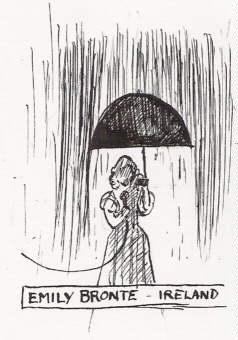
She there interviews a miserable man named 'Murphy.' Emily "Brontie", despite the rain, is inspired on the spot and asks him if nothing does grow "on those hills, surely something... something must flower in that verdant heath?" "Naw, t' hap o' dairt's good fur nothin'," replies 'Murphy'. "..How awful." She will not let her spirits down, for this Emily- this blond ringletted and very sprightly Emily, is as I said 'sprightly' and cheerful. But considering the other people involved in the telethon it's alright- at least she isn't trying to slip in promos for Wuthering Heights. Some of the composers involved in the charity are obviously only there to spin their operas (hmph).
Sometime later we return to Emily. She has sponsored Murphy's immigration to America and she has just recieved a letter from him. After excitedly opening it, she reads. "Alas, the streets here are not paved with gold. They are, in fact, not paved at all. And they seem to expect me to pave them," she smiles weakly before reviving. "I finally got a chance to read your book, Wuthering Heights! While the characters were most intriguing, I felt that the conclusion extends far beyond the natural ending... and the... *mumble* ...contrived..." 
Poor Emily. (As you see only one was inked. I just began applying for grad programs, and I am so anxious/excited that my hand is unsteady a mite- as you can see from the first illustration and my inky fingers which you cannot see. The joys of dip pen sketching!)
The photos in this post are from other History Bites episodes and feature fans of 'The Greekles,' and Ivan the Terrible on Oprah with Dr.Phil.
Monday, January 02, 2006
Some Things to Consider, I hope!
This article formed the preface to the 1988 Penguin edition of Jane Eyre. In many ways insightful, but in places slipping strangely into uncertain territory. As I read along, the first thing to grab my attention was a mention of 'Lord Rochester'. This is not, in fact, Lord Rochester- John Wilmot, but Mr Rochester gratuitiously elevated to the nobility. I have read much Bronte criticism, and it surprises me how often little slips like this occur. I am sure my professors would object to such things as creating entire plot points but I have seen that as well as imagined characters. I do not recall which article it was, but in one article about Mr Rochester (I think it was) I learned that there was damning evidence that Jane had been merely a tool for Mr Rochester (and patriarchy) all along for her first action in their relationship is to mail a letter for him. She is in fact mailing a letter for Mrs Fairfax when she meets Mr Rochester- and she volunteers to take it, in fact.
A wonderful professor of mine insisted that we must not only set up citations but thoroughly explain them to make best use of the evidence. Maybe this is what is lacking in this paragraph which deals with the Byronic 'dangerousness' of Mr Rochester:
Emily Brontë's Wuthering Heights is more clearly an adult's rendering of incestuous childhood obsession than are any of Charlotte Brontë's novels, but the romantically dangerous Rochester is most likely a remnant of the children's sensational world, the poetic antithesis of all that was dull, dreary, routine, and circumscribed in the world of Haworth Parsonage. Here is Jane's first vision of the man she will adore: Something of daylight still lingered, and the moon was waxing bright; I could see him plainly. His figure was enveloped in a riding cloak, fur collared and steel clasped; its details were not apparent, but I traced the general points of middle height, and considerable breadth of chest. He had a dark face, with stern features and a heavy brow; his eyes and gathered eyebrows looked ireful and thwarted . . .; he was past youth, but had nor reached middle age. Like Emily's Heathcliff, that Byronic, doomed hero; yet unlike Heathcliff—who after all starves himself to death in his deranged attachment to the past—since, by the novel's end, after he goes blind, Rochester does become domesticated. The Gothic has become tamed, and redeemed, by ordinary marital love. However unlikely for Brontë's time, or for ours, Jane Eyre ends upon a note of conjugal bliss: I am my husband's life as fully as he is mine. No woman was ever nearer to her mate than I am: ever more absolutely bone of his bone and flesh of his flesh. I know no weariness of my Edward's society: he knows none of mine, any more than we each do of the pulsation of the heart that beats in our separate bosoms; consequently, we are ever together.... We talk, I believe, all day long: to talk to each other is but a more animated and an audible thinking. The orphan Jane is no longer "resisting all the way"; no longer, at this point, required to be Jane. The novel's passionate energies consume themselves as the apocalyptic fire at Thornfield consumes unregenerate Bertha.
Firstly, I have no idea what she means by Emily's 'incestuous Childhood obsession.' If anyone would like to speculate on this, feel free by all means (as always)! But let's look at this quote carefully. This 'first vision' is of a late man in a cloak, average in height, deep of chest, and angry. the cloak can't be important- it's wintertime. The physical description doesn't say much about his character, and his 'ire' and 'thwarted' look should be understandible considering that he just sprained his ankle falling from a horse! I'd like to suggest that it's quite a leap from this to pronouncing him 'byronic and doomed' and 'like Heathcliff'. As for the second quote, I wonder why Jane would have to resist herself? For, as she says elsewhere, she is 'indulging her sweetest desires'. How is she 'not being Jane'? She nowhere says that she has changed her thoughts or conversation to suit Mr Rochester- they happen to harmonise with one another. The image of their heart beats is not one of submission of one to the other- each is separate and yet familiar enough to be inextricable. Also, there are more than a few readers who would say the 'passionate energies' are by no means burned off with Bertha. That is granting far too much symbolism to Bertha- she is not the focus of eroticism that she is often made out to be.
And in a paragraph presumably about the 'increasing melodrama' of the work, after she discusses Mr Mason (who is not at all melodramatic, as the quote she uses illustrates) she moves on to Bertha:
When, later, Jane is brought into Bertha Mason's presence and mockingly introduced to Rochester's wife, she is naturally revulsed—she feels no kinship with this creature. And though Jane charges Rochester with cruelty in so despising and exhibiting his mad wife, claiming that Bertha cannot help her condition, Jane cannot really identify with the woman; and rather too readily forgives Rochester his curious (and ungentlemanly) behavior.
I have read this scene very many times and I have never detected mockery. Rochester speaks ironically, but not mockinging and these are two different things. he does not believe that Bertha is his wife in any other than a nominal sense. Otherwise, I fail to see where this comes from. And why can Jane not identify with Bertha? Why does she reproach Rochester, then- when throughout the novel she has been anxious for him to get rid of her for his own safety (in the figure of Grace Poole)? She has changed her position, apparently but the article does not acknowledge this. She does feel at least enough 'kinship' to refer to her as a 'poor woman' and not a monster or a beast any longer. In addition, she says nothing about Rochester's 'exhibiting' his wife. He has not been 'exhibiting her'- she has been concealed for ten years. He wishes now that his secret is known, to have it known completely.
I write on this article mostly because this following paragraph touches on a nerve I have. It is regarding the 'Whitcross' section of the novel. It begins:
Numerous readers have felt that the long Whitcross section, consisting as it does of nearly one hundred pages, is an awkward digression in Jane Eyre; and one is nudged to recall that the publishing firm of Smith, Elder had rejected Charlotte Brontë's earlier novel, The Professor, as "undersized." (But if Currer Bell would write a full-scale, three-volume novel for them, they would be "most interested.") Still, the carefully transcribed section is required for symmetry's sake. Brontë's authorial strategy is to balance one kind of temptation with its obverse (if Rochester is all romantic passion, urging her to succumb to emotional excess, St. John Rivers is all Christian ambition, urging her to attempt a spiritual asceticism of which she knows herself incapable).
There is a startling tendency to view this part of the book as the artcle describes, and I think it is completely groundless. All I will conceed is that it is evident that Charlotte is playing with the Gothic convention of the two men- one dark and dangerous, one fair and virtuous. It is one of the most vital sections of the work- not an 'awkward digression.' It would take far too long for me to outline my reasons, here but I hope to use one example to at least challenge this perspective. There is a point at which St.John attacks Jane's feelings for Mr Rochester, claiming that the 'tie' she cherishes is unlawful but also that she is being selfish and will live obscure if she persists in it. It is only one brief statement he drops, and yet very profound for at the end of the novel there are two things that I am sure no one would seriously dismiss. Jane is 'living with and for' what she 'best loves on Earth' (Mr Rochester), living 'for' him unselfishly when she could live contentedly and selfishly with someone more conventionally eligible or on her own. But more importantly, instead of dying nameless in India, an anonymous female missionary following the program not her own, she has written her autobiography, claimed her life and sealed her name to it- the very opposite of 'living obscure'!
Saturday, November 26, 2005
Rose Ann Heslip and the Living Cousins of the Brontës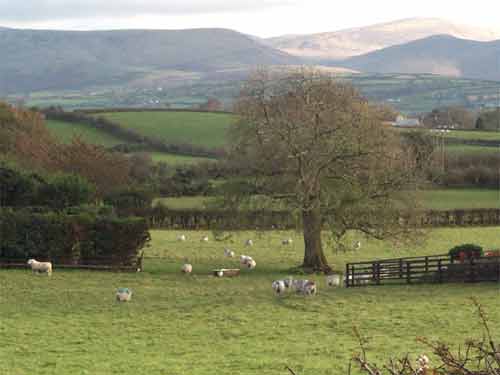
Today we have a very special guest post here at Brontëana. Without further ado, here is an article written by Kate Bower, to give us all more information on Rose Ann Heslip and the modern descendants of the Irish Brontës- who are not quite so scarce as it seems. (It probably suits the mystique of the Brontes to think of their extended family fading away but such is hardly ever the case). Thank you, Kate, for taking the time to write this for Bronteana.
The commemorative event for Rose Ann was held on 6th October and the sun shone, it turned out to be a glorious day. There was a dinner held at Healds Hall Hotel attended by family members including Rose Anns’ 89 year old great grand daughter Olive Emily, members of the Bronte society and SpenValley Civic Society, and the Deputy Mayor & Mayoress and the Deputy Sheriff of Yorkshire.
“Healds Hall was one of the most fashionable residences in the district when built in 1764. It was the largest house in Spen Valley. The Hall first became famous through links with the Bronte family when it was owned by the Reverend Hammond Roberson, immortalised as the Reverend Matthew Helstone in Charlotte Bronte's novel "Shirley".”
www.healdshall.co.uk
After a very good meal and a ‘photo opportunity’ session, the party (slowly!) made its way to Dewsbury to the church of St Luke with Whitechapel. Flowers were laid on the grave and the local press were there in force – we all felt like minor celebrities for the day! Then into the lovely church for a memorial service (forgive me for saying so, but it has to rate as one of the dullest services I have ever attended). This was followed by a reading of some of Emily Bronte’s poems and a posy was presented to Olive.
Rose Ann was a very special lady I think. She was the kind of indomitable woman beset by tragedy and hardship you often find in a certain kind offiction. She was born in 1821 in Ireland and therefore lived through the famine - she must have seen some terrible things in her life.
Her parents were Sarah (nee Bronte) and Simon Collins and she was the only one of their ten children to marry. She had five (perhaps six) children only to watch them succumb one by one to consumption. Only one daughter, Emily, lived to marry. Emily, and her husband Hugh Bingham emigrated to Scotland where all their five children were born. Then Hugh moved down toYorkshire to take up work as a foreman at a gas works. By this time Emily was sick with consumption herself and her widowed mother aged over 70 came over to nurse her dying daughter.
Together the elderly lady, the sick daughter and five small children made the long and arduous journey by road from Scotland to Yorkshire. Aged just 33 Emily died and was buried at St Lukes with Whitechapel. Rose Ann stayed to look after her son-in-law Hugh and her grandchildren. What a sense of love and duty she must have had to stay in late Victorian industrial Yorkshire after the open spaces and close knit network of family and friends she had left behind in Ireland. It must have been a very grim place indeed.
“Salthorn was a deserted, forlorn place, surrounded by black pit-hills and standing amidst swamps and pools on the rough uncultivated common – at night lighted up by the lurid flames which belch from the furnaces at Low Moor and Bowling.”
Heckmondwike Herald, 24th August 1893
Eventually Rose Ann seems to have developed some kind of dementia and was admitted to the infirmary at the local work house. Full of character to the end, she climbed over the wall and made her way back home on the back of a cart on at least two occasions, according to family tradition. She lived to94. I would have loved to have known her.
Her eldest grand daughter, Mary Jane – my great grandma also died in her thirties of breast cancer, leaving three children – Leonard, Ernest andOlive Emily. But the younger grand daughter Elizabeth Anne lived to a grand old age, and I can just about remember her as a very old lady who smoked imaginary cigarettes (having been banned them by the doctor) and who frightened me very much when she once threw the ‘stub’ into the grate and asked me “Did it go in?”. I wasn’t used to grown ups behaving like this and I had absolutely no idea what to say to her! This aside, my mother and aunt tell me that she was a lovely lady, and ‘Aunty Annies’ sponge cake’ is a recipe which is still used in the family.
I have known that we had a Bronte connection for as long as I can remember. When I was around 16 I wrote to the Bronte Society to try and confirm this particular family tradition. Sadly, they were not really very helpful. They confirmed that Emily Heslip had married Hugh Bingham, but stated that they had no record of any children of the union. It was clear from the tone of their letter that, as far as they were concerned, the matter was closed.
It was only this year, when Imelda Marsden of the present day Bronte Society, ‘found’ us as the present day descendents of Rose Ann. She is researching a book on the relations of the Brontes and she is particularly interested in Rose Ann. This provided the first concrete proof that we did have a blood connection with the Brontes. After the brush off I had previously received, I wondered if Mary Jane and the others were perhaps Hugh’s children from a previous or subsequent marriage.
Because of this I can trace an unbroken maternal line back almost 250 years to Eleanor (Alice) McClory, born around 1759/60, the mother of Patrick and Sarah and the grandmother of the Bronte sisters and Rose Ann. Since I have a particular interest in womens’ history, and tracing a female line is usually quite difficult, this has been a source of special satisfaction to me - even without having famous cousins.
