


Jane's Journey Part Six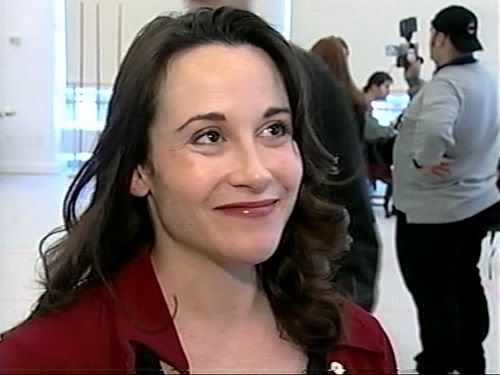
Richard Ridge: Where did you start with Jane Eyre? Give me your history.
Elizabeth DeGrazia: In Toronto and I did the production in La Jolla as well, and now I'm here.
Richard Ridge: So, tell me about the character you play.
Elizabeth DeGrazia: She's extremely over the top and flamboyant. She's the aristocratic Scarlet O'Hara. She really is. Shes got a good heart but she's all about wealth and status and really wants to marry this guy. And she comes to Thornfield for a couple of nights and needs an engagement ring- she's a a bit desperate!
Richard Ridge: That's the number we saw you do today.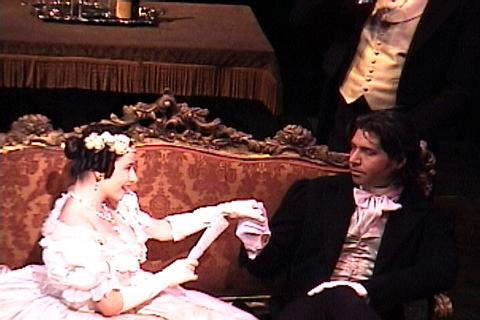
Elizabeth DeGrazia: Yes, she sings really high and tries to be very, very fabulous. And there's a real parallel between Jane Eyre and Blanche. They have a similar size and look- dark eyes, dark hair but very, very different in character. And you see who wins out in the end!
Thursday, January 19, 2006

Tuesday, January 17, 2006
Jane's Journey Part Five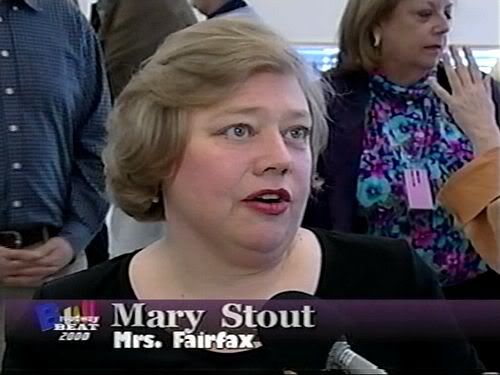
Mary Stout: I believed in this from the moment I did it at the Manhattan Theater Club reading. I love what it says, I love how it uplifts people. And I think it's going to be something people remember for a long time. It's a theatre experience where people get to experience emotions on many levels, on many levels. And I think it's going to be uplifting to people. You know, it's a dark story. And that's a given. She has a lot of things to deal with but hopefully I'll provide some of the comedy and some of the lighter moments.
You know, this character that I play- the housekeeper- she's written fairly... she's not a dark character in the book although she does have a darker edge to her because you never really know what she knows is going on in the house. That's a question I have personally answered. But everyone always wonders about this. Is she involved in some way? Is she a part of this? Home much does she know? And they took this character and made her a little more comedic than the book does and made her sort of a Gilbert and Sullivan sort of character which I think is such a brilliant idea- to give her patter songs that move the score along and have some brightness and some comedy. And it's so great that they've allowed that to happen. I think there are other shows that do that too- I think The Full Monty has a character that does the same sort of thing. Sometimes stories and shows need that to lift them up. And he's been incredibly very true to the book in so many ways; very few changes.
Richard Ridge: Tell me about the number that we saw you do today.
Mary Stout: It's called 'A Slip of a Girl' and it takes place after... after the proposal scene- I don't want to give away too much. After the proposal- and, obviously, she's accepted, then suddenly there''s a big storm that happens which I think will be very visually exciting I think. Then out of the blue I come out with little Adele- the little ward, and proclaim my problems with the whole situation.
I'm quoting someone. When we were in that city outside this country [Toronto] we're not supposed to mention that but when we were there, Terrence McNally came to see the show and he's actually seen the show several times but when he saw the show in that city he said it's the perfect song because it takes you through an entire story and you get to see a character really turn a corner and make a realization. And he said it's the perfect song and I thought it is! It really is a lvoely, lovely little piece to character ladies everywhere. I'm very proud to be playing this character.
Thursday, January 05, 2006
Jane's Journey Part 4, and More News on JE '06?
And now we have James Barbour's interview from the November 6th episode of Broadway Beat 2000. A special thanks to 'English' and Kathey for helping me date this piece.
James Barbour (Mr Rochester): I had read the novel three times- the third time just before I went to do La Jolla, and that time with Rochester in mind. And I just realized at that point that- I mean, I've done roles like Billy Bigalow and The Beast. Billy Bigalow is a multidimentional role and he's always on all the time. The difference is this man has probably thirty more layers than Billy Bigalow does. And once I got in production, once we got in rehearsal I realised how- I mean, he's delicious! And that's what I gravitated to but it's the darkness, the happiness, the torture, the love, the unrequited love, I mean just unbelievable levels. And trying to make them all fit into one character was the challenge- and it still is the challenge. That's what I enjoy about it.
Next time, Mary Stout (Mrs Fairfax)!
For more on James Barbour and Rochester, see the post entitled Actors on Playing Mr Rochester Part 3.
Next, mysticgypsy informs me that she has recieved word from the BBC Drama webteam that there are no plans to produce either 'Jane Eyre' or 'Villette' anytime soon. This is no cause for alarm, I think. My friends discovered that the BBC was planning on releasing the 1973 production after months of hearing that they had no plans to.
Tuesday, January 03, 2006
Jane's Journey Part 3
Another installment of transcripts I've made from an episode of 'Broadway Beat' from December (or Novemeber) 2000 (thanks again to thisbeciel for sending it to me!). This time, an interview with Marla Schaffel who played Jane Eyre in Jane Eyre: The Musical. Marla Schaffel: I'd not read the book when I got it. I read it after I did the reading. And I definately felt some sort of spiritual connection with Jane Eyre. Definately on a very basic level. But, actually, the first version of the show was so complete I really didn't even need to read the novel. It was four hours long, basically, and so thorough that everything in the novel was basically included. And Paul's brilliance is that he also takes a lot of Charlotte's words and sets them to music which is so extraordinary for an actor! To have that kind of language to music that just takes it to another level.
Richard Ridge: What's interesting about this is they're so held back from all of those Victorian images and how they're brought up but you crack the veneer by the time the show ends, don't you?
Marla Schaffel: I think we do, I think why the show touches people as it does is because we all have that veneer to a certain degree, we all put up our walls. And we know that certain experiences finally tear them down and make us understand and forgive ourselves- it's such a large message of the piece. And how they come together and that the walls are knocked down by loving, losing and tearing yourself away from someone you don't want to be apart from but you know that it's the only thing you can do to survive. And then making choices. It's so universal.
Next time: James Barbour's interview.
Monday, December 26, 2005
Jane's Journey Part Two
More transcripts! This time, I bring you the Broadway Beat 2000  interview with Paul Gordon, composer of the Jane Eyre musical. Part one can be read here- Broadway Beat interview with John Caird (lyrics and co-director for Jane Eyre).
Paul Gordon (composer): It began ten years ago for me. An I was looking for a project to musicalise. And I came across the novel in a bookstore and just decided that I was going to read it. And I got into about page twn and I was in tears and I knew that this was the project that I wanted to do. Then it was just the challenge of waiting until I finished the book before I'd start writing because I was so eager to write.
Richard Ridge: What did you love about the book initially when you read it? I'm sure there are millions of things...
Paul Gordon: There are a lot of things but I was initially attracted to Jane's journey-Jane's spiritual journey, the idea of forgiveness- that message. And that, even though it had a lot of darkness to it, and it gets very complicated and very deep in a lot of places, ultimately it is an uplifting journey, an uplifting tale. I was very attracted to that.
Richard Ridge: So, how has the music and lyrics changed since your initial readings at Manhattan Theater Club, to La Jolla, and now to here?
Paul Gordon: It's changed quite a bit. John Caird has come in and done so much work with me and together, since he became the book writer, he's really taken it several levels above where I initially started. And I've learned so much from him. And, you know, our Toronto production was sort of one concept and it was almost composed-through, not sung-through. And when we went to La Jolla we took a lot of the music, of the underscoring out and the songs sort of stood on their own as songs. So the musical's been developing in ways like that as we go about our journey.
Clockwise (from left): James Barbour (Mr Rochester), Paul Goron (composer), John Caird (lyrics), Marla Schaffel (Jane Eyre).
You can sample and check out Paul Gordon's latest work at his website, http://indieclectic.com. His current projects include a musicalisation of Emma, which should be very interesting!
Wednesday, December 07, 2005
Jane's Journey, Part one...
I have begun the laborious task of transcribing several items relavant to the Jane Eyre musical. So far I have finished one interview with John Caird, which I believe has not been made available online before. It is only one segment of a program which covered the pre-Broadway opening rehearsals. The interviews include John Caird (most famous for his work on Les Miserables), Paul Gordon, Marla Schaffel (Jane Eyre), James Barbour (Mr Rochester), Mary Stout (Mrs. Fairfax), and Elizabeth de Grazia (Blanche). (Incidentally, these internet broadway database pages are in serious need of updating!).
Broadway Beat 2000 (sometime in 2000, before December 3rd).
John Caird (Additional lyrics, book, co-director): Well it is a- it is very much a woman's work. It's written by a woman about a woman writing the story of her own life. And so it's- it's a multi layered piece of work. But it is almost entirely seen from the female point of view. And, indeed, our version of it is rare in the respect that it has nine women in the cast and only five men- which is extraordinary for a Broadway musical. Ane, really, there are only two or three important male characters in the work and there are ten or twelve important female characters in the work. And Charlotte Bronte's world is very woman-oriented. You know, she sees the world through a woman's eyes. And as well as Jane you have Mrs Reed, Mrs Fairfax, you have Blanche Ingram the beautiful aristocrat, you have the mad woman in the attic. You know, you've got an extraordinary panoply of female characters to draw from.
Richard Ridge: Why do you think this story is so timeless? I mean, my eleven year old neice just read Jane Eyre. You can ask anybody and they'll say 'Oh yes, I know that book.' Why do you think it has endured so much over the years?
John Caird: I think because Charlotte Bronte was a great literary and philosophical genius. And in Jane Eyre she's written, not the story of one deprived and brutalised little girl and how she grows into a proper human being, but she's told the story of all girls, and how they grow up to be women. It's a quite extreme story, Jane Eyre, but any woman who remembers her childhood- and I suppose all women do- will- has something to associate themselves with Jane Eyre- that's Jane's journey is- Jane's journey from early childhood to maturity as a woman.
