Home Resources Livejournal Feed Wordpress

Showing posts with label wuthering heights. Show all posts

Sunday, July 05, 2009

Fashionable Make-Over for Wuthering Heights


Fashion illustrator Ruben Toledo has designed an expressive cover for the newest penguin deluxe edition of Emily Bronte's Wuthering Heights.

The book is available for pre-ordering from Amazon.com, and will be released August 25th.

Saturday, May 10, 2008

Well, that was interesting...

Apparently Natalie Portman is out of the Wuthering Heights project:

Natalie Portman has walked out of new film ‘Wuthering Heights’.

The Hollywood actress has reportedly left movie bosses fuming after quitting her role as Cathy Earnshaw in the big screen adaptation of Emily Bronte’s classic 1847 novel, despite having “seduced” them into giving her the part.

A movie insider told Britain’s Daily Mail newspaper: “It’s fair to say we were seduced by her and we should have been on our guard.”

Portman is said to have made a concerted effort to convince director John Maybury and producers Ecosse Films and HanWay Films to give her the role of Cathy, even convincing them to allow her casting approval over the choice of actor to portray her character’s lover Heathcliff.

‘Wuthering Heights’ producers refused to comment on Portman’s decision to pull out of the project.

Maybury is now looking for a new lead actress. Sienna Miller and Keira Knightley - who both star in his upcoming film ‘The Edge of Love’ - were both previously linked to the project.

That sounds pretty bizarre. If this is true, and she was so taken with the project, why give it up so soon? As an aside, I continue to find it amusing that Keira Knightley is suggested as the ideal actress- in some circles, mind you- for both Cathy and Jane. Maybe we need to have a few more actresses of substance out there to choose from? I don't know- I am still living under a pile of spiral bound notebooks.

Wednesday, May 07, 2008

A little recap...


Ellen Page will be our new Jane in a big screen adaptation of Jane Eyre.

Alison Owen of Ruby Films, who most recently produced "The Other Boleyn Girl," is working with BBC Films to develop the new adaptation of Bronte's classic 19th century romance. It's the story of a mousy governess who softens the heart of her surly employer Mr. Rochester, only to discover that he's hiding a terrible secret.

Moira Buffini has written the screenplay. No director is yet attached, but the producers are aiming to set the project up to shoot this fall.


Natalie Portman will be our new Cathy in a big screen adaptation of Wuthering Heights.

Natalie Portman is to play heroine Catherine Earnshaw in a new big-screen adaptation of Wuthering Heights.

The Jacket director John Maybury will helm the Ecosse Films production from a script by Olivia Hetreed (Girl With a Pearl Earring), claims The Hollywood Reporter.

Emily Bronte's 1847 novel revolves around the turbulent love affair between headstrong Catherine and her brooding adopted brother Heathcliff.

Keira Knightley and Lindsay Lohan were previously reported to be vying for the role, famously played by Merle Oberon opposite Laurence Olivier in 1939. A 1989 version starring Ralph Fiennes and Juliet Binoche performed poorly at the box office.

-From Digital Spy.

And, of course, we're still waiting on the Bronte biopic, the ITV Wuthering Heights, a touring version of Jane Eyre: The Musical, and an adaptation of Shirley.

Thursday, June 07, 2007

Wuthering Heights at York Theatre Royal

The following article is from The Press.

SUE Dunderdale surveys the task of directing Wuthering Heights, Emily Bronte's windy, wild tale of ill-fated love and vengeance.

"It's a fantastic story and it's a Yorkshire story," says Sue, whose production of Jane Thornton's adaptation opens at York Theatre Royal on June 2.

"All the cast, the stage management and me, we all went up to Haworth, walking up to Top Withens, which they say may be the site of Wuthering Heights, though it's now a ruin.

"It was the first time I'd been there in 20 years; the last time I was there, there was a French film crew making a film about the Brontes. Isabelle Huppert was in it, of course; she seems to be in every French film."

Revived by Yorkshire pudding and onion gravy, Sue returned to the work in hand: staging Thornton's compact adaptation of the tragic story of Catherine Earnshaw and Heathcliff, first performed on the much smaller Hull Truck stage in 2003. "Damian Cruden the Theatre Royal artistic director had already decided on using this version, partly because it has a cast of only five, which has its advantages and disadvantages and we're focusing on the advantages," says Sue.

"I've gone for a young cast because it's very much a teenage love story. They feel that if they don't marry, they will die. Cathy married at an extremely young age; she was 17 when she married Edgar, and once she dies, Heathcliff feels dead too. He may be walking around, but he feels dead inside. Cathy died partly because she stopped eating, and so did Heathcliff."

advertisementRecords show the average age of death in Haworth at the time the Brontes lived at the Parsonage was 26, the same age as the cast's average age. "I think that makes it right that it's a very young company," says Sue.

Among her casting selections is Joel Fry for the mixed-race role of Heathcliff.


Sue Dunderdale
"I think he's an extraordinary actor. I spotted him at RADA three years ago, when I was working on a course on acting on camera.

" I was doing various film scenes, and one was from Neil LaBute's In The Company Of Men, and there was this extraordinary-looking young man, who didn't stop moving before we started, but once he was on camera he had this incredible stillness about him. That was Joel.

"I then saw him playing Abraham Lincoln in The American Play, and again he was remarkable in that."

No doubt she will be looking to bring out the intensity in Joel Fry that she found in the book. "It's the intensity that strikes you. When I read the novel again, it was like reading one of the Russians. It's like reading a Yorkshire version of Dostoevsky. It's not Jane Austen," says Sue.

"It's the expression of her soul. When you read that all Emily Bronte's life was an interior life, where all she did was walk on the moors, you realise her freedom was in her imagination and in her spirit, and that's what draws you in.

"No two people should be more together than Cathy and Heathcliff, but she makes the major mistake of her life and that destroys them as they miss out on each other.

"We may all like to pretend that we've never done that in our lives, but in her writing Emily has no such pretence. Cathy's decision destroys her life and lives around her."

What Emily did was to frame the story in her inner being and in the world she knew, says Sue.

"Edith Wharton wrote about the same subject, so did Henry James, and they were very different from Emily's spirit, which was close to Dostoevsky, but they all deal with missed opportunities - but Wuthering Heights is more cruel than the rest, extremely cruel.

"There's a grimness and a dryness that make it so Yorkshire," Sue says.

"It's all about being thwarted and thwarted is such a Yorkshire word, isn't it!"

Wuthering Heights runs at York Theatre Royal, June 2 to 23. Box office: 01904 623568.

Friday, March 30, 2007

Wuthering Heights on Sale


I made another trek to Bayer's Lake today, lured by the siren song of classic literature (so difficult to find in my hometown, where the shelves are stocked instead with home fondue-kits, coffee books, or trashy novels). I finally surrendered to my desire to read Victor Hugo's Les Miserables, unabridged, in French (yes, after the thesis...).

I still hate Chapters, but they have Wuthering Heights on sale. They have a special offer of three books for $25.00 including Wuthering Heights and several other classics ranging from Jane Austen to James Joyce.

Speaking of Jane Austen, and of worthwhile purchases, I would recomend purchasing this little edition of Wuthering Heights by the Collectors Library. It's only $5.00 but a quality book- well bound and beautiful. The series also has Jane Eyre, however, they are completely sold out of Charlotte's novel. I purchased their edition of Northanger Abbey today, and am very pleased with it. It is also illustrated, but I cannot say whether or not the Bronte novels are as well. They are pocket-sized and very handy for emergencies (such as long bus rides). NA has gold gilding, burgundy cloth binding, and a matching silk ribbon bookmark. These pages are certainly not going to fall out easily!

Sunday, March 25, 2007

More on Textmessaging and the Brontes

From the New York Times Sunday Book Review:

They lived happily ever after, and maybe things would have been easier for Emily Brontë too. You can see her, can’t you, mischievously texting her older sister across the garden at Haworth; scholars guess that, many years after Emily’s tragic early death, her sister Charlotte was raising a literary memorial in the text-messaging lingo that plays so crucial a role in “Jane Eyre” (“Hlp! Im in the attc!”).

O.K. Maybe not. I first read “Wuthering Heights” in ninth grade and loathed it; I would have been glad for a hundred pages less of the stuff. Lately I’ve come around — not only to Emily’s queer, savage novel, but also to the realization that cellphones, while they might have their uses in what we are pleased to call “real life” (though I’m still to come to a final verdict on that), are nothing but an albatross around the neck of any writer who wants to tell a story.


Yes, I can see how cellphones would have obliterated Western Literature! Jane would return from the Morton Schoolroom and find her cell phone full of calls and messages from E.Rochester, Cathy would have fired off a message to Heathcliff preventing him from running off before she could marry Edgar Linton.

Related post: Jane Eyre in textspeakOMG! (Do you think me handsome? No sir. LOL OMG WTF?).

Friday, February 02, 2007

A Brief Note About Emails Etc.

I have only just begun to tackle the emails that have built up inside my inbox (there's only 841 new messages now!). It's slow going. I hope that no one's message gets lots but if you have sent word to me and I have not replied, remind me please. I am also aware that I am behind in replying to comments as well. It is more difficult to keep up with those.

This week is going to be quite hectic. I will be readjusting my Bronte thesis proposal. I've met with my advisor who has advised me to trim it down to two adaptations. The reasoning behind this decision is that I have such a huge amount of new material I could contribute it seems wasteful to retread adaptations which have already been studied. These two adaptations will be the 2006 mini-series and the 1996-2001 musical by Paul Gordon and John Caird. (Which reminds me, Anthony Crivello, if you're reading this, I have been carrying the package I prepared for you in my backpack for months now. I WILL post it! I feel like the world's worst fan...).

To make matters more interesting, I am once again in the middle of marking essays (some of which make my brain feel like bursting and not in a good way), I have a paper of my own due monday, and I will be presenting my first lecture on thursday (it is on Dickens, monomania and class tensions in Victorian England. I only briefly contemplated throwing in a Wuthering Heights reference but I've been good about sticking to Mr. D's work).

Thursday, December 07, 2006

Newly Published Letter from Patrick Bronte

The loving side of 'stern' Bronte father
By Clive White

A previously unpublished letter has thrown new light on the character of the clergyman father of the famous Bronte authors.

It now appears the Reverend Patrick Bronte was not the "cassocked savage" as branded by Elizabeth Gaskell, his daughter Charlotte's biographer.

It shows him to be, in fact, a loving and courageous dad.

The letter is among the archives at Lambeth Palace, London, and was written to Charles Thomas Longley, former Archbishop of Canterbury, who was a friend of Patrick.

In the letter Patrick says: "I have lived long enough to bury a beloved wife and six children - all that I had, I greatly enjoyed their conversation and company.."

"Now they are all gone - their image and memory remain and meet me at every turn - but they themselves have left me."

The significance of the four pages has been revealed by Bronte scholar and author Brian Wilks, of the Bronte Society.

It was written ten days after the death of Charlotte, the author of Jane Eyre and the sixth of Patrick's children to die before him.

The 78-year-old was left to grieve at Haworth Parsonage, and the letter gives a deeply moving account of the tragedies that struck his gifted family, said Mr Wilks.

The vicar lost his son Branwell, aged 31, in September 1848, Emily, who wrote Wuthering Heights, three months later, aged 30, his daughter Anne, aged 29, in May 1849, having already suffered the grief of losing his wife and two elder daughters some years earlier.

Mr Wilks, who intends to publish the letter in the Bronte Society Journal next autumn, said: "I have always supported the idea that Patrick was a compassionate man.

"It was fashionable to think of him as a bad tempered man and there may have been some of that, but overall he was very compassionate.

"The best thing about the letter is what he says about missing the company and companionship of his family.

"The letter is a missing piece of the jigsaw and will startle and delight Bronte enthusiasts."

It was sent to Longley in 1855 while he was Bishop of Ripon, thanking him for his words of comfort, but also reveals how Patrick's faith had been challenged by the devastation.

He says: "The Lord gave and the Lord took early awaybut I have often found and find in this last sad trial that it is often frequently extremely difficult to walk entirely by faith and sincerely to pray They will be done on earth as it is in heaven.'"

The sentiments in the letter contradict comments made by Mrs Gaskell in a magazine article. She said Patrick was a "cassocked savage who ought to be have been taken out into the garden and shot."

Ann Dinsdale, the Bronte Parsonage librarian, said the letter revealed Patrick as a loving father.

"Elizabeth Gaskell had an axe to grind. The Bronte novels at the time were perceived as brutal and shocking and she was trying to protect Charlotte.

"The way she did it was to make the case that what else could they write about when they were living in this backward place with a half-mad father and alcoholic brother?"

In reality Patrick was a compassionate father who suffered and missed his children, she added.


With a new biopic of the Brontes in the works, I can only hope that we will no longer see Patrick Bronte depicted as an abusive father. It is surprisingly difficult to escape from Gaskell's malicious portrait. So many editions of the Bronte novels state in their tiny penny paperback bios how their father was brutal, or severe. This letter does not surprise me in the least. Some of the well-known letters from Patrick are very warm, and sometimes even silly (as when he wrote a letter to Charlotte under the guise of one of the family dogs. Charlotte was so amused that she forwarded it to her friend). Needless to say, I have little love for Gaskell. Who, incidentally, didn't just say that Patrick ought to have been 'taken into the garden and shot' in a magazine article- she villified him in the biography she wrote for Charlotte at Patrick's request. It is well known today that she relied on the testamony of servants who had been dismissed and had their own 'axes to grind' as well as her own prejudices (she seems at a loss to understand how an Irishman could be so calm- he must have irrational 'volcanic' outbursts of rage while in private- such as shredding his wife's dress or throwing his children's boots into the fire). My point is, then that this letter is not so 'startling' as the article suggests...

Thursday, November 23, 2006

Emily's Journal

A new fictional diary of Emily Bronte, focusing on a tragic teenage love affair, has been praised by Bront researchers.
In her book "Emily's Journal", historian Sarah Fermi suggests the novel Wuthering Heights was based on the author's own doomed romance.
Experts have praised the plausibility, skill and detail of Sarah's 236-page portrayal of Emily's thoughts and motivations.


The Cambridge writer completed "Emily's Journal" after 15 years of research into unanswered aspects of the Bront family's lives.
She explored the theory that Emily experienced a profound and tragic relationship as an adolescent, social circumstances keeping the couple apart. The experience was said to have affected the rest of Emily's life and became the emotional source of both her poetry and Wuthering Heights.
Sarah looked at census records, parish registers and wills as she tried to match real-life evidence with the contents of Emily's works.
She chose to put forward the theory as a fictional journal, exploring Emily's life in minute detail, rather than as a biography.
Sally Wainwright, writer of TV drama At Home with the Braithwaites, this year turned the theory into a Radio 4 drama.
Sarah said her book was already selling well at the Bronte Parsonage Museum.
She said: "It might be of interest to the general public as an entertaining read and a completely new look at the Bront sisters.
"A great deal of research went into its creation and the theory is both possible and indeed probable."
Margaret Smith, editor of the Letters of Charlotte Bronte, said she was sceptical when she first started reading "Emily's Journal".
But she said: "I was gripped by the skilful interweaving of fact and possibility, and the way Sarah brought historic places and people to life."
Bob Duckett, editor of Bronte Studies, described the book as a superb mixture of historical research and plausible gap-filling.
Dr Heather Glen, who has written about Charlotte Bronte, said the compelling "Emily's Journal" was based on an extraordinarily detailed knowledge of the social history of Haworth.
She added: "Sarah really does convince us that something like what she describes could have happened and gives an intriguing glimpse of what the Bronte family dynamics might actually have been."
"Emily's Journal" is published by Pegasus, at £8.99 in paperback.


Read more about Emily's Journal by visiting the Bronte Parsonage Blog here.

Also, in a news brief from Canadian Christianity.com: The Department of English at Canadian Mennonite University (CMU) has published its third annual issue of Soul in Paraphrase: A Journal of Literary Arts and Critical Inquiry. This year the theme is 'literary homage,' and it embraces the writing of 22 CMU students who analyze writers they have studied in their English courses. The journal contains parodies of famous poems; adaptations of famous passages; and drawings and photographs based on the novel Jane Eyre.

Monday, November 13, 2006

New Adaptation of Wuthering Heights

Here we go again! This time ITV has commissioned a new adaptation of Emily Bronte's novel. There is another version being planed by the company producing 'Becoming Jane.'

The three-hour adaptation of the nineteenth century novel will be screened either in late 2007 or early 2008, after a series of Jane Austen dramas next year.
It was commissioned by Laura Mackie, ITV's controller of drama, and will be produced by Mammoth Screen, a new independent production company set up by former ITV drama producer Damien Timmer.
The writer is Peter Bowker, who was behind the BBC's 'Blackpool' musical thriller and 'The Canterbury Tales: The Miller's Tale'. It has not yet been cast.
Classic costume drama remains a reliable crowd-puller, with the BBC's recent four-part adaptation of Charlotte Bronte's 'Jane Eyre' attracting 6.7m viewers for its final episode.
ITV has already lined up three Jane Austen novels for next year: 'Mansfield Park', 'Northanger Abbey' and 'Persuasion'.
'Wuthering Heights', the only novel by Charlotte's sister Emily, is a darker tale of the twisted relationship between Heathcliff and Cathy, who comes back as a ghost to haunt her lover.
The last TV version of the book was filmed in 1998 by LWT and starred Sarah Smart and Robert Cavanah. Film versions have starred Ralph Fiennes and Timothy Dalton as Heathcliff, and there are reports of Johnny Depp and Angelina Jolie having been lined up to star in a new version.

Monday, November 06, 2006

Bronte News

Bronte news has been very thin lately. Here is a selection of the most interesting items:

The Philipine Daily Inquirer recomends Wuthering Heights as cinema therapy for a 'stupid, ill-fated love affair.'

And Catherine Watson discovers the compelling nature of literary pilgrimage in her quest for 'a deeper connection' with the Brontes and other literary 'heroes.'

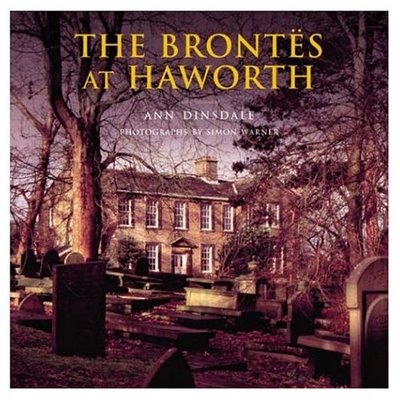
The Brontes at Haworth


Our fearless leader, Bronte Society Chairman Richard Wilcocks at the Bronte Parsonage Blog interviews Parsonage Librarian Ann Dinsdale about her newly published book, The Brontes at Haworth.

For research I didn’t have to stir beyond the library here, which of course contains the best collection of Brontë material in the world. I had access to parish records, contemporary accounts, newspapers, everything. After seventeen years I am quite familiar with what there is.

[...]

Some new or little-known items might stick in the reader’s mind, for example some of the contemporary views of the Brontë novels. One reviewer said that Wuthering Heights would ‘live a short and brilliant life and then die and be quickly forgotten’.

Then there’s the transcript of the account book of the local joiner William Wood, a good name for a joiner I think. He made coffins. His spelling gives an idea of how he spoke.

When ‘Miss Branwell’ died in 1842, her ‘coffen’ cost £5.12s.6d. When Branwell died in 1848 the ‘coffen & scroud making’ totalled only £3.15s. Then there is this:

Emlea Jane Bronty. Died Dec 19th 1848 in the 30 year of hir Age. Coffen 5ft 7” long 16” broad.


If you would like to purchase the book, it is available for order from the Bronte Parsonage online store.

Thursday, November 02, 2006

Reader, I Married Him: Heathcliff

I edited this clip a little to make it fit the requirements of the website. I shaved a few seconds from the Monty Python Semaphore clip. Alas, I think those who find Wuthering Heights a novel of the profoundest love might find this tribute a little lacking. I think Juliet Barker's quotation marks aound 'love' might sum up the attitude to the book. I wonder why on earth they used clips from a 1960s version of Wuthering Heights which look absolutely terrible! Surely there was better footage than this? When Heathcliff comes lumbering over the moors I wondered if he were human- he certainly doesn't move like a human being.

Sunday, October 29, 2006

Fruit and Veg Wuthering Heights

This is certainly the best vegitable and fruit adaptation of Wuthering Heights I have seen today. It really evokes the sprit of the novel as no other fruit and vegitable adaptation has to date. A true classic!

Bronte Boxed Set

Well, Tenant of Wildfell Hall is still unavailable in any format other than VHS and region two but they have come out with a boxed set of three BBC Bronte films. Available November 6th, it can be pre-ordered now and includes the 1983 Jane Eyre with Timothy Dalton and Zelah Clarke, 1996 Tenant of Wildfell Hall, and 1978 Wuthering Heights. A free imaginary cookie to anyone who can guess why Tenant of Wildfell Hall gets top billing.


From the BBC:

The Tenant Of Wildfell Hall (Dir. Mike Barker, 1996): This is the fantastic BBC adaptation of Anne Bronte's novel.

When Helen Graham becomes the new tenant of the dark, decaying Wildfell Halt, her independent spirit and radical views set her apart from the staid rural community around her. Gilbert Markham, a young farmer, finds himself powerfully drawn to her and a series of dramatic events brings them closer together. But the enigmatic Mrs Graham's unconventional life and behaviour disguise a hidden past with many secrets, secrets the world of Victorian England would rather bury forever...

Jane Eyre (Dir. Julian Amyes, 1983): Jane Eyre (Zelah Clarke) is a mistreated orphan who learns to survive by relying on her independence and intelligence. Her first job in the outside world is governess to the ward of Mr. Rochester (Timothy Dalton), a man of many secrets and mercurial moods. The tentative trust between them slowly develops into romance, but their hopes for happiness will soon be jeopardized by a terrible secret.

Wuthering Heights (Dir. Peter Hammond, 1978): Emily Bronte's classic tale of all-consuming love. When Mr. Earnshaw encounters Heathcliff, a ragamuffin orphan, he kindly brings the boy into his home and makes him part of the family. And from the start, Heathcliff falls hopelessly in love with the daughter of the house, the beautiful, headstrong Catherine. She adores him, too, but when a wealthy neighbour woos her, Catherine's material instincts get the better of her, and she agrees to marry the man. However, Catherine discovers that she cannot forget Heathcliff so easily... and that not even death can make them part...

Friday, October 20, 2006

Wuthering Heights 1970 Clip

I couldn't help myself. I had to make this clip. This is about 50 seconds of footage from the 1970 Wuthering Heights. This scene made me laugh hysterically the first time I saw it. It still gives me a chuckle whenever I see it. The film itself isn't as bad as this clip. I suppose my readers who have only seen Timothy Dalton play Mr Rochester should be prepared for some rather unRochesterian acts involving hysterical women and a poker. (I always think those women look like fangirls...)

Saturday, October 07, 2006

Bronte News

Wuthering Heights has inspired an art exhibit on display this month in Massachusetts:

LIBRARY EXHIBIT. "The Colorful World of Wuthering Heights - in Watercolors and Drawings," by artist Mary Haig, is on view in the auditorium at the Morse Institute Library, West Central Street in Natick. The exhibit will run through October.

Bronte Historian extraordinaire, Juliet Barker will be making an appearance at the Examiner Literary Luncheon is Huddersfield:

The ticket price of £19.50 includes a three course meal at the Galpharm Stadium, with coffee and the chance to meet our authors.
Tickets are available only from the Lawrence Batley Theatre box office, telephone 01484 430528. The ticket sales will close on Saturday.


Lastly, remember our debate about fan fiction? The Brontes come up in this article on the subject.

Fanfic has a long history.
In the 19th century, the Bronte sisters wrote fan fiction about the Duke of Wellington, a popular figure in their time.


Not so. Only Charlotte wrote fan fiction about Wellington. (If you believe the scholars, and follow their theories to their natural conclusions than Mr Rochester is nothing more than her invented son of Arthur Wellesley- or his son, however you prefer to look at it: the Duke of Zamora!).

Thursday, September 21, 2006

More on the Radical Brontes Festival


This article introduces us to a new play: 'Charlotte Bronte enters the Big Brother House!'

The production, called Charlotte Bronte Enters The Big Brother House, merges Charlotte with Jane Eyre.

Mr Russell said: "Charlotte first presented Jane Eyre as an autobiography, they were both governesses and had strong personalities. Because of her personality, there's a sense of Charlotte still being among us so I decided to put her in the Big Brother house.

"When she's called to the dreaded diary room she's in limbo and there's a dream-like evocation of her as half Charlotte and half Jane. She imagines her dead sisters are with her and she falls for Rochester - but their wedding is interrupted by his mad wife."

[...]

"Big Brother is contemporary and that's what the Radical Brontes is about. Anything that keeps the Bronte flame going has to be welcomed.

"I suppose the reason we're still fascinated by the Brontes is that they were a curious bunch and remain an enigma. Nobody knows what they were really like.

"And of course Jane Eyre is such a good story, much better than Wuthering Heights. I never saw the appeal of Heathcliff, he has no redeeming features, but you can see why Jane falls for Rochester."

The Radical Brontes runs from September 16 to 24. For tickets ring (01535) 642323 or visit www.bronte.info.

Wednesday, September 20, 2006

In Which I Reveal Myself an Academic

One of my readers told me to look out for this BBC radio broadcast, and I apologise but I cannot remember who it was! Here we have a short clip from the 'Do you think me handsome?' scene, as well as a pretty long discussion of the novel and then adaptations in general. The beginning and end of the show deal with the new series. The last few minutes are interesting for those who are desperate to hear about the interpretation of the novel.

For the most part the show is about literary criticism of the novel with some mention of its history in adaptation. If you are familar with criticism of Jane Eyre not much will be new. And a few very silly statements are made (again, if you're familiar with scholarly approaches to the novel, this won't be a surprise). Among the things which amused me is the reading of the scene where Rochester attempts to overpay Jane's wages as an example of the ways in which he repeatedly attempts to 'buy Jane's sexual favours and get her into bed'. Makes it sound like Pamela, it really does! 'She keeps saying 'no'.' One of those speaking on the beginning of the production mentioned how she had seen many adaptations and that people always expect one to begin with a carriage on the snowy wind-swept moors. I think she might mean Wuthering Heights (minus the carriage).

What truly baffles me, regarding the discussion of previous adaptations is their astonishment that Rochester is a wit, that he actually speaks in the novel and doesn't just sit in a corner brooding silently. They must have missed every major adaptation of the novel to date. And that is surprising since the reason they are on the show is to talk about where the new series fits in terms of these previous adaptation, and yet they must not have been paying attention to at least the two major BBCs series preceeding this one. Then again, perhaps it is also a sign of how almost all of the adaptations so far have neglected the simple idea that Jane falls in love with his intellect first: 'I have talked face to face with what I reverence and delight in: an original, a vigorous and expanded mind,' (and not 'I stared at this silent broody hunk,' or 'I put up with this mysogynistic jerk-' to sum up the apparent cause of Rochester's attraction in nearly all adaptations I have seen).

After the long discussion of how Jane Eyre has been seen from Freudian and Feminist angles, the question is asked if these perspectives are apparent in the production. The panel erupts in a unanimous 'Yes!'

I have made an mp3 of the show which may be downloaded here.

Monday, September 11, 2006

Protecting the Imagination

Karen Utley writes 'the imagination deficit could cripple society' in today's Statesman.

As young girls, the Bronte sisters created and performed imaginative dramas; Agatha Christie conversed with her many imaginary friends; young C.S. Lewis invented worlds and recorded their imaginary histories.

Fascinated by the origin of genius, we remember the childhood inventiveness of these novelists because the fruits of their unique and powerful imaginations have entertained generations of readers and continue to inspire authors and filmmakers today.

[...]

Unfortunately, however, electronic entertainment industries now are targeting even the youngest children. Their products and programming, including a cable network especially for babies, not only usurp the time children once devoted to imagination-strengthening play, they saturate young minds with ready-made, pre-imagined adventures. Constant exposure to the already-visualized creations of TV producers and video-game designers undoubtedly disrupts the natural growth of creativity. Unless parents and teachers take defensive action to protect children's imaginations, the electronically stunted imaginations of future writers will produce no "Jane Eyre" or "Chronicles of Narnia."

The cry has gone up many times in recent years that the imagination is being stunted by modern technology. I tend to agree, although I can't say that the imagination cannot find other ways to develop. There seems to be less tolerance for anything less than perfection in adapations, for instance. There is little allowance made for budget concerns, or other limitations. And yet, perhaps the proliferation of fan fiction, and fandom in general is a sign of where all of those imaginative energies are going. For instance, someone might forgo reading Wuthering Heights, watch the movie instead and then start to wonder what might have happened inbetween scenes, or create alternate plotlines, or look backward into the backstory or forward and create a 'sequel'.

To address the publishing issue, personally I am dissappointed with the quality of writing that has passed through my hands as an editor. The heart is gone. I believe the reason for the dearth of great literature is a more complex issue which cannot be attributed to a single cause. I have not read anything truly imaginative nor powerfully excecuted in a long time. And then, the work only had moments of illumination with long periods of dullness of style. These writers did not have television and cgi to blame. Doubtless, eventually we will see something truly great come along once again.