


You Make Your Own Rainbows
I have been having trouble with Blogger today, which explains the delay in posting today. I have not been idle. Firstly, I would like to inform everyone that there is a new Brontë studies blog, Brontë Parsonage E-Magazine. Little did I think, when I started the first Bronte studies blog this past summer that there would be three in such a short time! Here's hoping this is only the beginning!
Since yesterday I have been recieving more and more about this 'other' Jane Eyre musical. I have some facts to back up the initial impressions, a review, and some more thoughts. This show is interesting from a scholarly stand point because it is contemporaneous to the early run of the most famous musical adaptation, the Gordon/Caird production. While their show played in Toronto, this one was running in Utah. The review is interesting in itself for some of its attitudes towards Charlotte Bronte and Jane Eyre:
By intermission, nothing terribly exciting has happened yet, plot-wise (well, except for a devil-coiffed crazy woman who emerges from the attic long enough to set Rochester's bed on fire, but you can't really count that). This is typical of, ahem, "chick plays" (I'm sorry, but there doesn't seem to be a politically correct term that expresses the thought nearly so well): heavy on romance, light on plot. Keep those questions understated. Introduce a possible love triangle. Let the characters pour their hearts out to us, but not to each other.
I'm not criticizing this genre of storytelling; I'm merely reporting how it is. And the fact that such dilly-dallying with the narrative doesn't usually appeal to me any more than, say, reading a Charlotte Bronte novel does, speaks volumes about this play's accessibility and emotional center. Gollaher and Whitlock give their characters such life, realism and heart that it's impossible not to be sucked in to their story, no matter how little a "story" there actually is.
Madwomen and people nearly burning to death in their beds is no exciting enough for this reviewer. I wonder what would be. Not having seen the show, I cannot comment on his comments about 'Chick plays.' The review seems to imply that the performances are what makes Charlotte's rather hum-drum romance into something we would actually be interested in. Yet another reason why these musicals are so interesting is to see how often they are criticised because the reviewer fails to see any value in Charlotte's novel- that the whole idea of making a musical from it is a mistake.
In any case, just ignore the bemused comment about the 'British accents' making the actors say "Sin Gin". Forgive them, for they know not what they say.
Facts about the show: Patricia York, Music by Jerry Williams, based on the novel by Charlotte BronteJuly 1997 - Directed by Rick Mokler, musical direction by David Potter, setting by Patricia Frank, costumes by Janet Freeman, lights by C. Thomson Garey
Lastly, I have transcribed Mr Rochester's part from a song I just heard today thanks to my source. It has changed my previous impression, that this show is more of a 'guilty pleasure' than anything . This song was fun and had me laughing at the right moments. I couldn't make it all out, so forgive me for any errors. I've also removed Jane's interjections, which amount to "Hmm. I feel strange." I've also tried to make it reasonably clear when he is speaking and singing. Enjoy:
Mr Rochester: It's a story of a French opera mistress, by name Celine Varens. For whom I once cherished a 'grande passion'. It was not, however, quite what you may think. To be succinct
no consumate virtue commended her to me,
consumed by my lust: I liked her company.
I liked her perfume, an odor of sanctity.
Amber and musk.
I gave her every comfort and luxury as well-
believe me, in every detail I excelled.
With a stupid exactness I trod the old track
of an idiot bound to ruin and rack.
Then, one evening I waited with quiet delight
in her room as I smoked a cigar by twilight.
Then, hearing her carriage- the one that I gave her-
and seeing her little foot, quickly forgave her
arriving so late-
oh, how I hated to wait!
I leaned on the balcony, bidding a fond: "ah! Mon ange! Mon ange!"
One of those imbecile lover's emotions
that women are 'angels'. Ridiculous notion.
Don't you agree, Miss Eyre? ...Miss Eyre? Hum! Well, here comes the blow, Miss Eyre,
turning the whole affair into a pagent of absurd proportions.
I beheld, and recoiled in angry contortions,
ANOTHER MAN!
Have you ever felt jealousy, Miss Eyre? No. Mnn. Of course not. You have never felt love. You have both sentiments yet to experience. Your soul sleeps.
You float like a dreamer out far from the shore
not heeding the breakers that broil and roar
through the channels of love that can dash you to pieces
'till it finally kills you... urgh.. or else it decreases.
As was the case in this small impropriety,
the fellow was simply not worth the anxiety.
He was a rival not worth contending with.
He insulted me coarsely, though not with any wit
She was mercenary, heartless- my sweet hypocrite.
Though she did wax quite brilliantly on my defects, I admit.
Ah, but come, Miss Eyre. Come to the curtain.
Where you shall see at last what a fool I was made.
Put your eye there- don't be afraid!
I leaped in the room with a confident air
amid screams, protestations, hysterics and prayers
quite forgotten all mouthed 'a merde!'
She cried: *clears throat, imitates Celine*
"My dearest, my darling, my lover, my pet!
my masculine beauty my taille d'athlete!"
Wherein she differed diametrically from you, Miss Eyre,
Who told me, point blank on the second interview
you did not find me handsome.
I dismissed her,
aquitted her,
offered her my purse.
Then turned, with some pleasure to finally disperse
that brainless rouée, that cavalier cad!
with the chicken wing arms who did beg me and flatter me:
*imitates the vicomte*"Oh! Ah! Oh! S-sp-sp-spare me, Monsieur! Sp-sp-spare me, p-please-se!"
hahahahah!... hem. Well, of course I gratiously forgave all... but not without leaving a nice scar! You must take my word on it, Miss Eyre, it was all satisfactory! The most ridiculous drama one could possibly imagine! But that's love.
Sunday, January 15, 2006

Saturday, January 14, 2006
The Libertine not at Liberty?
Inexplicably, the 'expanded' release of The Libertine, the film about John Wilmot the earl of Rochester has been delayed. Fans report showtimes listed a few days ago and now they are gone without a trace. I have not been able to find any explaination for this. The film was set to 'expand' from release in Los Angeles and New York on the 13th of January. It looks like we may have to wait sometime yet before we get to see what we have heard so much about.
The Moors are A-Callin'!
Someone has sent me another clip from a regional production of Jane Eyre presented as a musical. this is not to be confused with 'Jane Eyre: the Musical' by Paul Gordon and John Caird. This musical is by PatriciaYork and Jerry Williams. I have only heard two songs so far, and it is quite catchy if not entirely atmospherically sound, shall we say. I look forward to hearing the rest of it soon. So far I have heard two songs from the show. The first song is 'She Cannot Charm Him' which is, of course, Jane commenting on Blanche Ingram's failed attempts to woo Mr Rochester. My sources inform me that the show is rather close to the book in plot. All I can say is that it makes me smile in the same way that the 1857 play of Jane Eyre does- and there are a few similarities between that production and this musical. Dancing servants for one. They are featured in this second song, which I will call 'The Moors are A-Callin'' for lack of a better name. The entire production can be purchased on CD from here.
The song is set shortly after Jane has left Thornfield to visit her aunt. Before we get to Gateshead, however, the servants of Thornfield are reacting to some terrible weather by, what else? having a jig and a ol' song 'the Moors are a Callin'. understandibly, Mr Rochester is not impressed. In fact, he's such a wet blanket that they leave him to mope for a bit "what's he on about?" Well, a lot of things. I think the best way to express my first reaction other than "I LOVE IT!" is this little parody I wrote immediately after I listened to it for the first time (I often do this sort of thing. I always parody things I enjoy). I think this also illustrates the dangers of trying to forshadow the voice across the moors:
Servants: ooooooooooh, the moors are a callin'! Callin'! Callin'! Whee-ha! *dance*
Servant: Aye, laddie! Would ye like some dinner?
Mr Rochester: *pout* No. How is dinner going to help with this melancholy? *sniff*
Servants: *get even more cheery* What's wrong with him, eh? La la la!
Mr Rochester: I don't like my house, my soul hurts, my heart cannot trust, and it's raining all the time!
Servants: Wheeha!
Mr Rochester: Can I ever find a heart I can trust? Is there an Eden somewhere? I'm a gonna picket Heaven! That's right, God! I'm gonna sit outside and glower until you come out and feel sad like me! Just because! Rain, rain, rain. That's all we get here. When is the sun coming back? I don't think it ever will, John.
John: Well, sure now-
Mr Rochester: When will it come back? When will she come back? *cries*
Eliza: Mommy's dying! I've done my explication *leaves*
Aunt Reed: I have to EASE MY MIND BEFORE I DIE!
Jane: Hey, letter here, from my uncle, wha?
Aunt Reed: I hated you.
Jane: Oh. ...So, Eliza, how you do miss him. Yes, he is terribly missed.
Eliza: ...'She'. Are you crazy or something?
Jane: Oh?! Heh. No, I um.
Mr Rochester: And my tea is really weak.
Jane: Sorry- where were we?
Mr Rochester: And luke warm. I hate that.
Eliza: You just said my mom was male.
Jane: Oh, I didn't mean to- I
Mr Rochester: Did someone let the fire go out in the next room? I feel a draught.
Jane: It's just that...
Mr Rochester: Aw, Pilot! You've gnawed a hole in this slipper!
Jane: ...He won't ever STOP TALKING IN MY HEART!
Mr Rochester: I could use some soup right about now.
Jane: WHY WON'T HE LEAVE ME ALONE?!!!!!!!!
Mr Rochester: Pity, there isn't any. I live such a wretched life.
Jane: STOP!!!! Why won't you stop?!
Eliza: Okay, I'm out of here...
Jane: I fear I will never escape from his CONSTANT WHINNING!
Mr Rochester: I've worn out my moping chair! It was my favourite one too. Figures. *sigh*
Jane: And he'll always be there muttering complaints in my head. He'll always be there muttering complaints
Both: In my head. Where it Eden? I wish it would stop raining. Rain, rain, rain, all the time.
John: Miss Eyre is back! You make your own rainbows, Mr Rochester. YOU MAKE YOUR OWN RAINBOWS!
Mr Rochester: ...whazubuh?
Very silly, cheesy, but a lot of fun all the same!
Friday, January 13, 2006
Infernal Angria
More news on the comic series, Infernal Angria by Craig McKenney. The
The series is available through Headless Shakespeare Press.
Thursday, January 12, 2006
Literary Naming in 19th century America
Thanks to Mrs. Dionysius O'Gall for this very interesting article about 19th century census taking! The Bronte reference comes at the end, but the rest of the article is well worth the read on its own. This article deals with some of the practices of the census officers sent to take a census of Native Americans living on reserves:
American Indian children who attended school nearly always had an English name. George Gans, Horace Greeley, and Miles Standish are examples of names assigned to schoolboys.
In some years, depending often on the whims of the census-taker, every member of the tribe received an English name.
Big Rope's Mother became Martha Big Rope. Dinero became Dora Money. And for a literary touch, Cacje's Widow became Jane Eyre and Chis-chisla became Charles Dickens.
More Video Clips from JE the Musical and Transvestism in CB
This is sure to please Esther! Thanks once again to Thisbeciel for these clips from the Jane Eyre Musical! Some of these are repeats from the last time, but I don't think anyone will mind too much?
An Icy Lane
You examine me
Waking Rochester
I know who heals my life
the Gypsy
the Proposal
Wild Boy/Farewell Good Angel
Thisbeciel also came across this interesting poem, 'Transvestism in the Novels of Charlotte Bronte' by Patricia Beer
1 When reading Villette, Shirley and Jane Eyre,
2 Though never somehow The Professor
3 Which was all too clear,
4 I used to overlook
5 The principal point of each book
6 As it now seems to me: what the characters wore.
7 Mr Rochester dressed up as the old crone
8 That perhaps he should have been,
9 De Hamal as a nun.
10 There was no need
11 For this. Each of them could
12 Have approached his woman without becoming one.
13 Not all heroines were as forthright.
14 Shirley in particular was a cheat.
15 With rakish hat
16 She strode like a man
17 But always down the lane
18 Where the handsome mill-owner lived celibate.
19 Lucy, however, knew just what she was doing.
20 And cast herself as a human being.
21 Strutting and wooing
22 In the school play
23 She put on a man's gilet,
24 Kept her own skirt, for fear of simplifying.
25 Their lonely begetter was both sister and brother.
26 In her dark wood trees do not scan each other
27 Yet foregather,
28 Branched or split,
29 Whichever they are not,
30 Whichever they are, and rise up together.
"Monsieur de Rochester!" and iJane!
Somehow, when I posted about this Florida production of Jane Eyre the Musical awhile ago, I neglected to pick up on a few interesting items in the plot synopsis! But never to fear, Mrs. Dionysus O' Gall has set me straight:
JANE EYRE is a haunting musical retelling of the Charlotte Bronte classic about an orphan girl who grows up to become the governess of Thornfield Hall. There she meets and falls in love with the enigmatic Edward Rochester, an Earl with a dark secret. Having overcome the obstacles brought on by an abusive childhood, the death of a childhood friend and the prejudice inherent in a relationship between two people socially worlds apart, Jane marries Rochester. Her wedding day is marred when she discovers his secret! Filled with soaring melodies and a romantic lyricism uncommon in the modern Broadway musical, Jane Eyre is a sweeping love story, breath-taking in its scope and beauty.
To be fair, there's a lyric from the show's song 'The Gypsy' where we get to hear Rochester's insinuations of his financial shortcomings to Miss Ingram that would might an innocent reviewer astray:
I see a man in your future, my dear!
O, sister!
A penniless snake you mistake for an earl!
In a history lecture I attended this evening, the professor mentioned as an aside how commoners in France often prefixed their surnames with 'de' to sound like aristocracy. In effect, Adele insists on referring to her 'friend' as 'my lord Rochester.' So, can we really complain? Maybe? No?
Aristocratic Rochester has a long history, going right back to the very first film of Jane Eyre (and possible to the Victorian stage adaptations). Mario Caserini produced the first JE film in 1910, and listed in the credits is, lo! "Lord Rochester." (I would have loved to see this! I am quite a Caserini fan. Alas!)
ETA: Sorry- forgot the second half of this post! Esther, one of your fellow readers, has taken four of the mpegs I posted last month or so and converted them to an iPOD format. I know nothing about iPODS, but here's the file!
iJane
Wednesday, January 11, 2006
Beginning of a Friendship- and Really Bad Films and A really Good One.
Yes, I'm still here! Nothing happened- I just went back to school. ;) In fact, I've been applying to the first of my three graduate programs. So far, so good! i do have some off topic notices for some of my readers, which I will take the privledge of including in this 'public' part of the weblog. If anyone has emailed me in the last little while, be informed that my browser is not allowing me to check my email often- this happened nearly all week. Now that I'm at the university this shouldn't be a problem, but in case you are wondering why I have not written back, this is why. For others, my book was in the press on Monday and I should have a copy of it tomorrow! I'll see about the particulars for those who would like a copy of some really bad poetry.
Speaking of the editing class, I am now taking the Publishing course. We were asked to introduce ourselves and tell the class a few things including what in our opinion is the worst book to film adaptation. I'm ...proud? to say that the Brontes managed to get two out of the 20 bad films mentioned! The first was an unspecified "Withering Heights" (which was once a parody of Wuthering Heights- but I am pretty sure he didn't mean that)and then the 1970 version of Jane Eyre with George C. Scott (that would be my declaration ;). Actually, no, there were three. I went on to explain that I usually enjoy bad films so long as they are bad in the right sort of way- and when they asked me for an example, why, I had to mention the 1997 Jane Eyre with poor Samantha Morton and Ciaran Hinds. What a horrid screenplay. But so funny.
Thanks to Thisbeciel from the League of the Extraordinarily Rochester Obsessed, I can at least bring you an unhealthy number of screencaps from the 1983 version of Jane Eyre, with Zelah Clarke and Timothy Dalton!
JE 83 Ep 1-2 Episodes 1 and 2 obviously. There are 53 pictures.
JE 83 Ep 3-4 94 pictures
JE 83 Ep 5-6 111 pictures
JE 83 Ep 7 76 pictures
JE 83 Ep 8-9 87 pictures
JE 83 Ep 10-11 95 pictures
Sunday, January 08, 2006
The Brontës: Infernal Angria #1
From Headless Shakespeare Press, I give you this odd little book called The Brontës: Infernal Angria #1 by Craig McKenney. I cannot tell exactly what it is from the description on this independent publisher's website but it looks and sounds like a mix of the Brontë children's imaginary world of Angria and The Chronicles of Narnia by C.S. Lewis:
Living in the isolation of the Parsonage house in Haworth Village, the four Bronte children
What caught my eye was the adorable cover art by Rick Geary! But... hmn. Four children exploring another world, testing their beliefs and bonds? Sounds very familiar!
There's also a book on this catalogue called 'Blanche Goes to Paris' unfortunately it has nothing to do with Blanche Ingram, from Jane Eyre, but I couldn't help but think of what that story would be like! (I'm sure she would love every minute- international intrigue, piano concerts! She'd love it!)
Book Review: Literature and the Crime Against Nature
This article, Man and His Kind, from Saturday's edition of The Guardian Limited reviews Literature and the Crime Against Nature by Keith Sagar. His arguement sounds very interesting:
Keith Sagar offers "holisitic" readings of the canon in his thought-provoking survey, Literature and the Crime Against Nature.
[...]
According to the philosopher David Abram, the negative consequence of the invention of writing was a severance of humankind from its immediate environment, a loss of embeddedness in the earth: "Only as the written text began to speak would the voices of the forest and of the river begin to fade. And only then would language loosen its ancient associations with the invisible breath, the spirit sever itself from the wind, the psyche dissociate itself from the environing air." By this account, writing was the original crime against nature.
One would think that the Brontes would come to mind as major players in such a study, but unfortunately the author appears to have missed out on taking them seriously into consideration. The author does discuss Emily's work but, according to the reviewer, it is more about Heathcliff. This is discussed after the reviwer notes another woman author brought in for criticism- and rebuke- Jane Austen:
The most successful chapter is a reading of Conrad's Heart of Darkness entitled "The Case of the Missing Elephants", which proceeds from the simple but powerful intuition that the story is focused on the ivory trade yet oddly silent about where ivory comes from. A larger argument about the intersection of ecological and postcolonial criticism could have been developed here, but Sagar shies away from it. Instead he offers a tart rebuke of Jane Austen for defining her art as a "little bit (two inches wide) of Ivory on which I work with so fine a brush" - the metaphor here is "a dead image, completely cut off from any awareness of what ivory is, where it comes from, and what must be paid for even two inches of it in terms of suffering and death".
Sagar's distaste for Austen is of a piece with the "Iron John" tone of the book. Its notion of a return to nature seems to involve striding down the open road in the company of Whitman's barbaric yawp, catching a large pike with Hughes and then joining Lawrence in a celebration of the phallus as "fertility symbol". The only woman who gets a look-in is Emily Brontë, and she is but a cipher for that other "natural man", Heathcliff.
I should like to hear what the Brontës would have said to the claim that writing is a crime against nature!
Alas, Anne!!
I have a report to make on the state of Bronte currency in this corner of Canada. It looks like things have not improved much lately. And today I had a very sad experience. I still do not own a copy of Agnes Grey, or a proper collection of Anne's poetry. I went to the university bookstore today to get my books for classes which begin next week when I thought I would buy AG for myself since my birthday is in a week. I looked everwhere in the store, and firstly I have to say that this bookstore is the strangest I have ever seen. It does not include any 'literature.' 'Fiction' does not include any works by authors no longer living. I know that there's often a bias towards contemporary literature but this is ridiculous! I retreated, in defeat, to the check out.
"Did you find everything you were looking for?"
"Actually, I was looking for Agnes Grey by Anne Brontë?"
"The novel?"
"Yes."
"Did you try upstairs?"
There was no one upstairs. There shoudl be someone upstairs. So, I went upstairs. There was no one there- until then suddenly someone appeared from nowhere. I repeated my request.
"Grey with an E or an A?"
"You know, I am never sure. E I think."
"...And the first name?"
"Agnes... ...Oh, you mean the author? Anne."
"Hmn... There's so many Charlotte and Emily- the older ones."
There was no Agnes Grey. They had Tenant but Agnes Grey was not even in their catalogue!
Fine, I thought. No problem- I'll go to the mall instead. They have a huge bookstore there with its own coffee shop and kiddie play castle! I decided to call ahead just to be safe.
*something between symphony and circus music is blaring in the background*
"What was that name again?"
"Anne Brontë!"
"Sorry, I couldn't hear over this symphony!"
And... it turned out they didn't have it either! There goes all but the second hand stores. I don't want to make it seem like Anne is the only Brontë suffering in this way. I also looked around for DVDs of Wuthering Heights and found stores only carrying one copy of one version of it. Hmn. I will never forget the time I called in after Jasper Fforde's The Eyre Affair.
"Eyre, spelt-"
"I know how to spell, Air! A-I-"
"No, Eyre- as in 'Jane Eyre"
"..."
"E-Y-R-E."
"Hmnn..." (ie, 'well, we'll just see about that...')
Sometimes I wonder if I live in a Monty Python skit. "That's Dickens with two ks!" I went through the day with even my closest family looking at me like I was touched as I said: "I don't believe it! I just don't believe it! Not one copy of Agnes Grey?!"
Saturday, January 07, 2006
How Rediscovering the Brontës Changed the World
In today's edition of the Sunday Herald (tomorrow is already 'today' in some parts of the world!) this article, 'Victim's No More' by C Vimala Rao discusses the women’s literary movement, which she says led to a metamorphosis in present day society.
There are two ways in which she says feminist literary critics 'build up their critical voice'. The first is to reinterpret male authors and unearth their biases about women, and the second is to recover works by female authors, previously shunned by the predominantly male canon. One of the texts involved in this revolutionary process is Jane Eyre:
As regards their second strategy of resurrecting and rediscovering the neglected women writers, Susan Gubar and Sandra Gilbert in their two seminal works titled— No man's Land: the Place of Women writers in the Twentieth Century, and The Mad Woman in the Attic, have analysed and interpreted novels like Jane Eyre, Pride and Prejudice, Frankenstein, etc, from a feminist critical point of view. They have also edited the Norton Anthology of Women's Writing which is a comprehensive work containing the writings of women from early times to the present in a broadly representative selection. By such efforts they have attempted to regain a literary tradition and history for women's writing.
Her conclusion?
Thus feminist literary critics at present have demanded re-thinking on the problems of form, genre, textual canon, linguistic usages, and literary and critical values and judgements. The women's movement has metamorphosed present-day society and it now necessitates readjustments on the part of not only women but also men.
Friday, January 06, 2006
More Than Meets the Eye
We have seen a lot of strange things on Brontëana, and a lot of fun gifts for Brontë fans. What I have come to talk about today is what might have been. This should have been an illustrated post but, what I have to describe here is so bizarre that I cannot go through with drawing it. I also have too much respect for the Brontës to- well, you'll see.
About two years ago, a friend of mine studying publishing at a university in the eastern US reportedly saw a very interesting presentation on marketting books to children. This presentation involved a showing of a full fledge proposal, including a commercial for a little something to stimulate interest in the Brontës. The target audience were young girls, and the product? Brontë sister action figures.
There was a commercial. The commercial went something like this: Girls are shown playing with the Brontë Sisters (patent pending). The set would also come with 'evil publishers.' The Sisters pay a visit to the Evil Publisher who cackles at them and says they are just women. So, the young girls put false moustaches on the action figures, and the Sisters return to Evil Publisher who now declares their works "Splendid!" Each sister then has her moustachio wiped off: "I am Emily Bronte! And I wrote Wuthering Heights!" "I am Charlotte Bronte! And I wrote Jane Eyre!" "I am Anne Bronte! And I wrote Agnes Grey!" Curses! The Evil Publisher summons his minions (who come down like ninjas on ropes...) and that's when... when... The Brontës form... a Brontësaurus. With rocket launchers.
That's all I have the courage to say. Now you can 
Jane Austen, Marie Antoinette, Leonardo Da Vinci, Jesus, Houdini, Bach, Mozart, Oscar Wilde, Ben Franklin, Charles Dickens, Casanova, Annie Oakley, Edgar Allen Poe, Anne Bonny, Blackbeard, Beethoven, Shakespeare, Sherlock Holmes, Alexander the Great, and Wagner!
None come with rocket launchers. Some witty folks at the Jasper Fford Fforum had suggested we have the Bronte Sisters (patent pending) team up with "The Mighty Morphine Power Byrons" and that special sets could have a Branwell figure with a little beer stein.
Thursday, January 05, 2006
Brontes in Film News, and Something Quirky
Thanks to BronteBlog for some news the past few days on foreign adaptations of Wuthering Heights. Today we are informed that an Italian mini-series of Wuthering Heights, called Cime Tempestose (2004). It is now also available in Spanish subtitles. And the better known French adaptation, Hurlevent has reappeared on the European market. See this Bronteblog post for more details on that.
This article from today's Independent Online Edition does not add to our knowledge on the 'New Jane Eyre' but the reference illustrates the point I made at the end of the previous post. We are getting conflicting news at this point, and that isn't unusual. Writers to the BBC are hearing that there is no such production and here we have a prominent BBC writer off-handedly mentioning his wife's work on 'the new Jane Eyre.' His wife, Sandy Welsh, is not credited with working on any adaptations of Jane Eyre, although she has worked on North and South. Her imdb page can he viewed here. I assume, then, that he means she is currently working on 'the new one'.
We now have quite a running list of strange references to films and books being 'Bronte like'. Previously, I mentioned Memoirs of a Geisha, Pride and Prejudice, and King Kong. Well, here we have another critic drawing parallels between Kong andHeathcliff. More intriguingly, adapting Wuthering Heights is the very first thing he suggests for the director's next challenge!
The last truly relevant thing in this post before I move onto the more tenuous and quirky news, another novel is being compared to the works of the Brontes. This time is a gothic novel, which doesn't really have much in common with the novels of the Brontes except for atmosphere.
I promised you quirky- and here's quirky. Meet, the Bronte Sisters: Australian surfers from Bronte beach, affectionately known as 'the Bronte Sisters.'
The things we can find on Google News!
Jane's Journey Part 4, and More News on JE '06?
And now we have James Barbour's interview from the November 6th episode of Broadway Beat 2000. A special thanks to 'English' and Kathey for helping me date this piece.
James Barbour (Mr Rochester): I had read the novel three times- the third time just before I went to do La Jolla, and that time with Rochester in mind. And I just realized at that point that- I mean, I've done roles like Billy Bigalow and The Beast. Billy Bigalow is a multidimentional role and he's always on all the time. The difference is this man has probably thirty more layers than Billy Bigalow does. And once I got in production, once we got in rehearsal I realised how- I mean, he's delicious! And that's what I gravitated to but it's the darkness, the happiness, the torture, the love, the unrequited love, I mean just unbelievable levels. And trying to make them all fit into one character was the challenge- and it still is the challenge. That's what I enjoy about it.
Next time, Mary Stout (Mrs Fairfax)!
For more on James Barbour and Rochester, see the post entitled Actors on Playing Mr Rochester Part 3.
Next, mysticgypsy informs me that she has recieved word from the BBC Drama webteam that there are no plans to produce either 'Jane Eyre' or 'Villette' anytime soon. This is no cause for alarm, I think. My friends discovered that the BBC was planning on releasing the 1973 production after months of hearing that they had no plans to.
Wednesday, January 04, 2006
A Brontë on History Bites
What is History Bites, you ask, and What does it  have to do with the Brontës? History Bites is a brilliant (if I may say so) Canadian skit comedy program which still runs on the History Television channel. This is how they describe themselves- I cannot do better:
History Bites is a skit comedy show that asks, "What if television had been around for the past 5,000 years?"
Each episode explores an important historical event by channel surfing through news, sports, talk shows, commercials, and game shows. The Sports Desk covers Gladiator fights. Martha Stewart plans a Roman orgy. Pharaoh Ramses meets the press. A Mongol barbarian appears on Larry King. The X-Files delves into the latest plague. Cops are Knights.
By viewing ancient events through television parodies, History Bites connects our past to our present. Spoofing popular TV formats makes historical events as urgent as today's news; and it gives today's urgent news stories a historical context. Viewers discover that history does repeat itself and there are lessons to be learned from the past.
Of special interest to us is one episode in particular:
Episode 59
When Irish Eyes Are Starvin'
IRISH POTATO FAMINE 1840'S AD
The great Irish Potato famine that caused a huge wave of immigrants to leave the old world for Canada. It's a story of immigration and economics done as a telethon to raise money for food, or money to ship the Irish off to the new world. There are also on-the-street interviews with apathetic English citizens, and Larry King grills the politicians who did too little, too late. Other parodies include Dennis Miller offering his thoughts, Martha Stewart on how to cook for a famine, and the game show "Who Wants To Have A Wee Bit Of Potato?"
And who has generously decided to sponsor an Irishman but our very own Emily Brontë! Sadly, I don't have any pictures of her from this episode. I have drawn some, however! Not really accurate, since the last time I saw this show was more than 5 years ago... nevertheless, better than nothing! She starts off, in the field reporting for the telethon. It's a bit damp in Ireland. 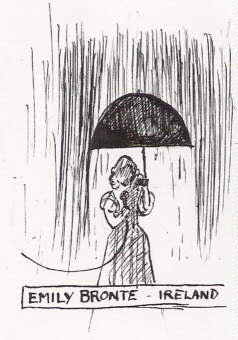
She there interviews a miserable man named 'Murphy.' Emily "Brontie", despite the rain, is inspired on the spot and asks him if nothing does grow "on those hills, surely something... something must flower in that verdant heath?" "Naw, t' hap o' dairt's good fur nothin'," replies 'Murphy'. "..How awful." She will not let her spirits down, for this Emily- this blond ringletted and very sprightly Emily, is as I said 'sprightly' and cheerful. But considering the other people involved in the telethon it's alright- at least she isn't trying to slip in promos for Wuthering Heights. Some of the composers involved in the charity are obviously only there to spin their operas (hmph).
Sometime later we return to Emily. She has sponsored Murphy's immigration to America and she has just recieved a letter from him. After excitedly opening it, she reads. "Alas, the streets here are not paved with gold. They are, in fact, not paved at all. And they seem to expect me to pave them," she smiles weakly before reviving. "I finally got a chance to read your book, Wuthering Heights! While the characters were most intriguing, I felt that the conclusion extends far beyond the natural ending... and the... *mumble* ...contrived..." 
Poor Emily. (As you see only one was inked. I just began applying for grad programs, and I am so anxious/excited that my hand is unsteady a mite- as you can see from the first illustration and my inky fingers which you cannot see. The joys of dip pen sketching!)
The photos in this post are from other History Bites episodes and feature fans of 'The Greekles,' and Ivan the Terrible on Oprah with Dr.Phil.
Tuesday, January 03, 2006
Visit Literary England!
See England by chair
Armchair travelers, have we got a program for you: Golden Gate Geographic Society, America's foremost professional travel film producer, presents "Literary England," a tour that goes inside the homes of Samuel Johnson's London, Jane Austen's Bath, Lewis Carroll's Oxford and Beatrix Potter's Lake District.
Producer Hal McClure will be on hand to talk about the cinematic trip, which also touches on areas where Chaucer, Kipling and the Bronte sisters wrote.
Choose from four screenings:
2 p.m. Jan 14
at Oakland's Paramount Theatre,
2025 Broadway;
2 p.m. Jan. 15
at Belmont's Notre Dame Theatre,
1540 Ralston Ave.;
2 and 7:45 p.m. Jan. 19
at Moraga's Rheem Theatre,
Rheem Boulevard and Moraga Road,
and 2 and 7:45 p.m. Jan. 23
at the Mountain View Center for the Performing Arts,
500 Castro St.
Tickets are $10 general; $5 for children.
Call (800) 247-4447.
Jane's Journey Part 3
Another installment of transcripts I've made from an episode of 'Broadway Beat' from December (or Novemeber) 2000 (thanks again to thisbeciel for sending it to me!). This time, an interview with Marla Schaffel who played Jane Eyre in Jane Eyre: The Musical. Marla Schaffel: I'd not read the book when I got it. I read it after I did the reading. And I definately felt some sort of spiritual connection with Jane Eyre. Definately on a very basic level. But, actually, the first version of the show was so complete I really didn't even need to read the novel. It was four hours long, basically, and so thorough that everything in the novel was basically included. And Paul's brilliance is that he also takes a lot of Charlotte's words and sets them to music which is so extraordinary for an actor! To have that kind of language to music that just takes it to another level.
Richard Ridge: What's interesting about this is they're so held back from all of those Victorian images and how they're brought up but you crack the veneer by the time the show ends, don't you?
Marla Schaffel: I think we do, I think why the show touches people as it does is because we all have that veneer to a certain degree, we all put up our walls. And we know that certain experiences finally tear them down and make us understand and forgive ourselves- it's such a large message of the piece. And how they come together and that the walls are knocked down by loving, losing and tearing yourself away from someone you don't want to be apart from but you know that it's the only thing you can do to survive. And then making choices. It's so universal.
Next time: James Barbour's interview.
Monday, January 02, 2006
Bronte Berry Lip Balm?
Vegan Lip Balm with a blushing berry bouquet. "Your lips are parched." (Shirley - 1849)
At which point Shirley offers some Bronte Berry lip balm, of course!
Also available in: Alcott Apricot, PoeMegranate, and ...oh wow, ShakesSpearmint!!!Some Things to Consider, I hope!
This article formed the preface to the 1988 Penguin edition of Jane Eyre. In many ways insightful, but in places slipping strangely into uncertain territory. As I read along, the first thing to grab my attention was a mention of 'Lord Rochester'. This is not, in fact, Lord Rochester- John Wilmot, but Mr Rochester gratuitiously elevated to the nobility. I have read much Bronte criticism, and it surprises me how often little slips like this occur. I am sure my professors would object to such things as creating entire plot points but I have seen that as well as imagined characters. I do not recall which article it was, but in one article about Mr Rochester (I think it was) I learned that there was damning evidence that Jane had been merely a tool for Mr Rochester (and patriarchy) all along for her first action in their relationship is to mail a letter for him. She is in fact mailing a letter for Mrs Fairfax when she meets Mr Rochester- and she volunteers to take it, in fact.
A wonderful professor of mine insisted that we must not only set up citations but thoroughly explain them to make best use of the evidence. Maybe this is what is lacking in this paragraph which deals with the Byronic 'dangerousness' of Mr Rochester:
Emily Brontë's Wuthering Heights is more clearly an adult's rendering of incestuous childhood obsession than are any of Charlotte Brontë's novels, but the romantically dangerous Rochester is most likely a remnant of the children's sensational world, the poetic antithesis of all that was dull, dreary, routine, and circumscribed in the world of Haworth Parsonage. Here is Jane's first vision of the man she will adore: Something of daylight still lingered, and the moon was waxing bright; I could see him plainly. His figure was enveloped in a riding cloak, fur collared and steel clasped; its details were not apparent, but I traced the general points of middle height, and considerable breadth of chest. He had a dark face, with stern features and a heavy brow; his eyes and gathered eyebrows looked ireful and thwarted . . .; he was past youth, but had nor reached middle age. Like Emily's Heathcliff, that Byronic, doomed hero; yet unlike Heathcliff—who after all starves himself to death in his deranged attachment to the past—since, by the novel's end, after he goes blind, Rochester does become domesticated. The Gothic has become tamed, and redeemed, by ordinary marital love. However unlikely for Brontë's time, or for ours, Jane Eyre ends upon a note of conjugal bliss: I am my husband's life as fully as he is mine. No woman was ever nearer to her mate than I am: ever more absolutely bone of his bone and flesh of his flesh. I know no weariness of my Edward's society: he knows none of mine, any more than we each do of the pulsation of the heart that beats in our separate bosoms; consequently, we are ever together.... We talk, I believe, all day long: to talk to each other is but a more animated and an audible thinking. The orphan Jane is no longer "resisting all the way"; no longer, at this point, required to be Jane. The novel's passionate energies consume themselves as the apocalyptic fire at Thornfield consumes unregenerate Bertha.
Firstly, I have no idea what she means by Emily's 'incestuous Childhood obsession.' If anyone would like to speculate on this, feel free by all means (as always)! But let's look at this quote carefully. This 'first vision' is of a late man in a cloak, average in height, deep of chest, and angry. the cloak can't be important- it's wintertime. The physical description doesn't say much about his character, and his 'ire' and 'thwarted' look should be understandible considering that he just sprained his ankle falling from a horse! I'd like to suggest that it's quite a leap from this to pronouncing him 'byronic and doomed' and 'like Heathcliff'. As for the second quote, I wonder why Jane would have to resist herself? For, as she says elsewhere, she is 'indulging her sweetest desires'. How is she 'not being Jane'? She nowhere says that she has changed her thoughts or conversation to suit Mr Rochester- they happen to harmonise with one another. The image of their heart beats is not one of submission of one to the other- each is separate and yet familiar enough to be inextricable. Also, there are more than a few readers who would say the 'passionate energies' are by no means burned off with Bertha. That is granting far too much symbolism to Bertha- she is not the focus of eroticism that she is often made out to be.
And in a paragraph presumably about the 'increasing melodrama' of the work, after she discusses Mr Mason (who is not at all melodramatic, as the quote she uses illustrates) she moves on to Bertha:
When, later, Jane is brought into Bertha Mason's presence and mockingly introduced to Rochester's wife, she is naturally revulsed—she feels no kinship with this creature. And though Jane charges Rochester with cruelty in so despising and exhibiting his mad wife, claiming that Bertha cannot help her condition, Jane cannot really identify with the woman; and rather too readily forgives Rochester his curious (and ungentlemanly) behavior.
I have read this scene very many times and I have never detected mockery. Rochester speaks ironically, but not mockinging and these are two different things. he does not believe that Bertha is his wife in any other than a nominal sense. Otherwise, I fail to see where this comes from. And why can Jane not identify with Bertha? Why does she reproach Rochester, then- when throughout the novel she has been anxious for him to get rid of her for his own safety (in the figure of Grace Poole)? She has changed her position, apparently but the article does not acknowledge this. She does feel at least enough 'kinship' to refer to her as a 'poor woman' and not a monster or a beast any longer. In addition, she says nothing about Rochester's 'exhibiting' his wife. He has not been 'exhibiting her'- she has been concealed for ten years. He wishes now that his secret is known, to have it known completely.
I write on this article mostly because this following paragraph touches on a nerve I have. It is regarding the 'Whitcross' section of the novel. It begins:
Numerous readers have felt that the long Whitcross section, consisting as it does of nearly one hundred pages, is an awkward digression in Jane Eyre; and one is nudged to recall that the publishing firm of Smith, Elder had rejected Charlotte Brontë's earlier novel, The Professor, as "undersized." (But if Currer Bell would write a full-scale, three-volume novel for them, they would be "most interested.") Still, the carefully transcribed section is required for symmetry's sake. Brontë's authorial strategy is to balance one kind of temptation with its obverse (if Rochester is all romantic passion, urging her to succumb to emotional excess, St. John Rivers is all Christian ambition, urging her to attempt a spiritual asceticism of which she knows herself incapable).
There is a startling tendency to view this part of the book as the artcle describes, and I think it is completely groundless. All I will conceed is that it is evident that Charlotte is playing with the Gothic convention of the two men- one dark and dangerous, one fair and virtuous. It is one of the most vital sections of the work- not an 'awkward digression.' It would take far too long for me to outline my reasons, here but I hope to use one example to at least challenge this perspective. There is a point at which St.John attacks Jane's feelings for Mr Rochester, claiming that the 'tie' she cherishes is unlawful but also that she is being selfish and will live obscure if she persists in it. It is only one brief statement he drops, and yet very profound for at the end of the novel there are two things that I am sure no one would seriously dismiss. Jane is 'living with and for' what she 'best loves on Earth' (Mr Rochester), living 'for' him unselfishly when she could live contentedly and selfishly with someone more conventionally eligible or on her own. But more importantly, instead of dying nameless in India, an anonymous female missionary following the program not her own, she has written her autobiography, claimed her life and sealed her name to it- the very opposite of 'living obscure'!
