


More on Tenant of Wildfell Hall
When I first saw the VHS cover, posted previously this week, I thought of how very like a character from Angria Hellen looked. 

After pondering this for some time, I recalled that I have a picture of a character named 'Rosa', drawn by Charlotte Bronte. I have made these images to compare the two, and it seems striking to me how similar they are. Even down to the angle of their faces. I am sure that this only shows their attention to the fashions of the day.
Monday, January 02, 2006

Sunday, January 01, 2006
The Tenant of Wildfell Hall (1968)
I stumbled across this film adaptation while trying to find more information on the 1970 production of Villette. It turned out haply that Bryan Marshall, the actor who played Dr. Graham Bretton in Villette, also played Gilbert Markham in this 1968 production of The Tenant of Wildfell Hall! He is also well known as Captain Wentworth from the earliest available BBC production of Persuasion by Jane Austen- and he was in Vanity Fair.
Director: Peter Sasdy
Writer: Christopher Fry
Producer: David Conroy
Janet Munro.... Helen Graham
Jeremy Burring.... Arthur
Nicola Davies.... Esther Hargreaves
William Gaunt.... Lawrence
Bryan Marshall.... Gilbert Markham
Corin Redgrave.... Huntingdon
Villette (BBC 1970)
Come on, BBC! I cannot tell if a recording of this is still in existence but surely there must be a chance of it. And if it does exist, why on earth is it not released when thousands of readers adore this book, when we have about 8 or 9 films of Jane Eyre, half a dozen Wuthering Heightses, and about two million works by Jane Austen? This is all I could find out, and all of it from www.imdb.com
director Moira Armstrong
writer Lennox Phillips
Judy Parfitt... Lucy Snowe
Peter Jeffrey.... Paul Emmanuel
Mona Bruce.... Madame Beck
Bryan Marshall.... Dr. John Graham Bretton
Angela Richards.... Ginevra Fanshawe
Mary Healey.... Rosine
Joan Heath.... Mrs. Bretton
ETA: Well, nothing more turned up about the production but I did forget to include a few items. Firstly it was a 5 part mini-series, each episode was 45 minutes in duration. The producer was Martin Lisemore.
Also, a few photos of the cast did turn up. Here are the actors who played our Lucy Snowe and Paul Emmanuel:


Playbills
Thanks to Kathey for finding the list I once posted of upcoming productions of Jane Eyre: The Musical! I will be restructuring Bronteana shortly to make it easier to find previous posts. Until then, please forgive the repetition.
ABILENE CHRISTIAN UNIVERSITY
ABILENE, TX US
From 2/16/2006 Until 3/4/2006
BREBEUF JESUIT HIGH SCHOOL
INDIANAPOLIS, IN US
From 3/2/2006 Until 3/4/2006
PULASKI COUNTY HIGH SCHOOL
DUBLIN, VA US
From 2/24/2006 Until 3/4/2006
QUINCY MUSIC THEATRE
QUINCY, FL US
From 2/24/2006 Until 3/5/2006
ETA: Tickets for the Quincy Music Theatre production can be purchased on the show's website, here.
Drink with the Brontes, and a Review of Tenant (1996).
Here's a cute little gift idea. Penguin Books has a line of mugs designed after the covers of their original 1935 series of classics. Two of these titles are Wuthering Heights and Jane Eyre. They also have lawn chairs and other things if mugs don't appeal.
I have also found a very long review of the 1996 
The Tenant of Wildfell Hall stands apart from the other adaptations of Bronte novels to film. Why? Because it remains true to Anne's original novel. The words uttered by the cast are very close to those of her book and this is an admirable thing because only one other film version of a Bronte novel has been this accurate and particular in following their works and this was a BBC version of Jane Eyre produced in 1983. But despite great performances that film had weak production and an unimpressive lighting and set design. The Tenant of Wildfell Hall is by far the most atmospheric attempt made by any filmmaker who has tried to capture the essence of what the Bronte's conveyed in their brilliant novels. It is the one film adaptation that isn't afraid to be as gritty and harsh as the rocky moors that the novel was conceived among.
The performance by Tara Fitzgerald as Helen is absolutely brilliant and I'm sure Anne Bronte would have approved of her work in the film. Fitzgerald refused to wear any makeup whatsoever because she wanted it to look as authentic as possible and it does. There are no people with luminous skin and elaborate hairstyles. (This is definately not a frilly, go find a husband, Jane Austen type production.) This film is far more beleivable considering the time and area for which it takes place. Tara Fitzgerald plays her Helen as one who is stoic and stubborn, all the while knowing that goodness, faith and truth will be her guide and her savior through the dimmest days. Fitzgerald never wavers for a second. She IS Helen from the first frame to the last and her determination in staying true to what was written is very admirable. The other two leads in the film are equally as awesome, that of her farmer and 'good guy' friend Gilbert Markham played by Toby Stephens and the tormented and brutal Arthur Huntington played by the 'great at being morose' Rupert Graves. His name says it all and he is completely believable as the husband who has succumbed to adultery and alcohol. Graves plays Arthur with a tense, always thinking, always full of unrest, state of mind. The kind which Anne Bronte was trying to evoke. He pulls this off to perfection every second his face on the screen. No one could have been better in this role. Even Arthur Jr. played by Jackson Leach is brilliant as the impressionable but otherwise happy child who is trying to make sense of all that has transpired around him. Leach never hams it up or gets overtly emotional for the 'big scenes'. He is just completely natural with his portrayal and registers very well as the child. The Direction by Mike Barker is remarkable. He is equipped with great camera methods that serve to enhance the film's aura. In moments of fear his camera spins round like a top out of control. When there are moments of isolation, Barker's camera is far and distant as though he wants us to see Helen's seclusion in all it's wide open sadness. When there are moments of great anger the camera pans back and hovers behind solitary objects, just watching in silence. There is a difficult task for this film when it has to follow the novel's flashbacks to when Helen was first married and trials she underwent. These scenes are painstakingly placed within the present day storyline. Just like the book, they are a bit shakey to follow at times but in the end it all succeeds.
Saturday, December 31, 2005
Hardcover JE Reviews and An Up Coming Production of Jane Eyre the Musical
In a previous post, I directed those interested in buying an edition of Jane Eyre to a post at another blog. The same blog also has a review of hard cover editions of JE, which can be found here.
And just a reminder, Jane Eyre the Musical is soon to open at Abilene Christian University, Abilene, Texas.
Winter Dinner Theatre:Jane Eyre
Book and additional lyrics by John CairdLyrics and Music by Paul GordonBased on the classic novel by Charlotte Brontë
This sweeping story of love and suspense, with universal and timeless themes, is a musical feast your heart will never forget. Faithful to the cherished novel, Jane Eyre is thrilling from the start to the tearful, triumphant ending. A recent Broadway favorite, the musical features songs such as "Forgiveness," "In the Light of the Virgin Morning" and "Brave Enough for Love." Don't miss this inspiring family treat.
Feb. 16-18, 24-25, March 3-4, 2006
Fulks Theatre
For tickets, call 325-674-ARTS (2787)
Googling for Brontes
I stumbled upon this website this evening. It is called Googlism. You type something into the search engine and instead of getting a list of websites, it tells who what your query "is". I am sad to report that there are not enough websites about Anne and Branwell to bring up anything whatsoever, but here are some interesting and sometimes hysterical things I dug up (read to the end, and tell me you didn't laugh out loud at the last one!):
Emily Bronte is...
emily bronte is imho the greatest poetess who ever lived
emily bronte is very concise
emily bronte is a perfect little "spinster"
emily bronte is discovered by a policeman and brontefan
emily bronte is one of many victorian novelists to revere the dog
emily bronte is an almost indescribable person
emily bronte is a “peat person
emily bronte is the story of catherine earnshaw and heathcliff
emily bronte is a copy cat
emily bronte is not mine and is used without permission
emily bronte is doing the twist with kipling
emily bronte is laid out on the sofa in a light doze
emily bronte is heathcliff
Charlotte Bronte is...
charlotte bronte is a dog
charlotte bronte is truly one of the greatest writers who ever put a pen to the page
charlotte bronte is a fine example of how a person can rise amidst turmoil and personal tragedies
charlotte bronte is sheer genius especially with the work jane eyre
charlotte bronte is a better writer than our entire honors class combined
charlotte bronte is slaughtered in this cold
charlotte bronte is the 1970 edition which follows the original
charlotte bronte is mentioned often here
charlotte bronte is undistinguished
charlotte bronte is my all
Jane Eyre is...
jane eyre is more concentrated than baa baa black sheep
jane eyre is sometimes available for bookings on short notice
jane eyre is a story of hunger
jane eyre is the ultimate poisoned chalice
jane eyre is perfect but she is fictional
jane eyre is representative of the western civilization
jane eyre is not a byron
jane eyre is a past version of supermarket romance novels
jane eyre is a psychological romance
Mr Rochester is...
mr rochester is older
mr rochester is sponsored by the royal victoria and bull hotel
mr rochester is still married to mr mason's mad sister
mr rochester is sharp and witty
And now for my personal favourites...
Heathcliff is...
heathcliff is marked by her characteristic flippant indifference
heathcliff is a boy or a girl but he definitely has a young family
heathcliff is an irc operator
heathcliff is not a disaster in the league of bernadette or the fields of ambrosia
heathcliff is sent to an obedience school
heathcliff is now a recovered rabbit and back to his usual bunny habits
A New Year Full of Bronte
As we prepare for the new year, it seems that more than a few people are turning their attention to the Brontes, in particular to Jane Eyre but also Wuthering Heights. Several bookish bloggers have prepared, instead of a list of resolutions for the new year, a reading list. Several of these include JE and WH. Others have chalked up the Brontes on their list of books read in 2005. Still others take this liminal time to reflect on change, and this brings to mind Charlotte Bronte's Jane Eyre. I can certainly see why the novel would be fit for such reflection although it had never occurred to me before. Although many many people are apt to forget it, JE is not only a romance. I recomend reading Eva's post, New Year, New Meaning?
Also, we should not forget that there is quite a lot for us to look forward to in the new year!
-A possible new BBC adaptation of Jane Eyre starts production?
-Release after more than thirty years of the BBC's 1973 version of Jane Eyre.
-Release of Anne Bronte's Tenant of Wildfell Hall on DVD.
-Biopic 'Bronte' possibly to begin production?
-University courses.
And, quite exciting for me: Publication of 'Jane Eyre'on Stage, 1848-1882: an Edition of Eight Victorian Plays Based on Charlotte Bronte's Novel
Looking for a New Copy of Jane Eyre?
I know that you all have a copy of Jane Eyre already, right, but you can never have too many editions. Or maybe you don't have a copy after all, and don't know which one is right for you. This post is just what you need to sort out the difficulty. Four editions of Jane Eyre are examined from the type face and paper texture down to the critical goodies. The editions are the Norton Critical Edition, Penguin, Oxford World Classics, and Modern Library. I do agree with her conclusion- the Norton edition is superb as is the Oxford World Classics edition. Admittedly I don't have the other two for comparison. I have many many others, however, and I enjoy the Norton for its 'critical goodies.' It is also the only book I own in which I write- I am slowly trying to overcome a horror of writing in books. This one already had writing in it, so I feel less terrible about jotting down notes.
I am not in a position to review the other Bronte novels in this way, as much as I would like to. If anyone else wishes to do so, let me know if you would like to write a post. Otherwise you might have to wait until I can ransack the university library.

Friday, December 30, 2005
Too Bronte, not Bronte enough!
What [sweet] madness is this? This year has been ridiculous for reviews criticising films and plays for being too Bronte or not Bronte enough, when in fact the Brontes have nothing at all to do with it.
Jasper Fforde has a unique explaination for where Heathcliff acquired his fortune: he made in starring in Hollywood films. Somehow, I don't think this is what he meant. 

(for much and more raillery besides, drop by Austenblog).
The list goes on and on... Previously on Bronteana I responded to claims that Memoirs of a Geisha was like Jane Eyre, and now the new Andrew Lloyd Webber musical 'Woman in White' has been railled against for not being Bronte enough.
I would like to think I know something about the Brontes, and yet, I have no idea what is meant by a film being 'too Bronte' or 'not Bronte enough'. Do they mean Romantic, or Gothic? Why not just say 'Gothic'? I suppose that 'Romantic' is too much associated with 'romantic' to be of any use. Is Bronte, then, a modern short-hand for Romantic? (I've never heard someone say a work is 'too Wordsworth!'
Thursday, December 29, 2005
'The Circle of Affection' and Duncan Campbell Scott
[...]
Duncan Campbell Scott was also a Canadian author of poetry and fiction, and published many volumes of each, he along with Archibald Lampman, Sir Charles G.D. Roberts and Bliss Carman, is considered one of the Confederation Poets. At the age of 31 Scott began publication with “The Magic House and Other Poems” in 1893 also “New World Lyrics and Ballads” in 1905, “The Green Cloister” in 1935. Much of his discussion revolves around Scott’s sympathetic Poetic treatment of Native Culture versus the severe policies of the department he headed. Many of his narrative poems, such as “The forsaken,” deal with Native American life. Scott is also known for his devotion to the career of his friend, Archibald Lampman. Scott was involved in the publication of several of Lampman’s books. He also wrote short stories.
-from a biography.
He also loved Emily Bronte.
In his work 'Wayfarers' he visits places where authors lived who made deep impressions upon him. The opening lines declare his love for his subject:
I PROPOSE TO ASK THE READER to visit, with two wanderers, a few of the places that interested them, where the associations are with spirits that can never die, with minds that are as vital as life itself. The sense of obligation lends to these scenes the desire to acknowledge a debt that can never be paid.
In part five he visits Haworth:
Let those who come to Haworth, the home of the Brontes, come to it through sunshine. Let them leave the plain of East Yorkshire from magnificent York and go toward the higher plateau at Harrowgate. If the gods are kind to them they will have brilliant sunshine and be reminded of the clarity of Canadian skies and the rolling, unconfined fields of North Sasketchewan where the wheat is ripening. At Knaresborough they will find nothing to remind them of the West. Over the deep glen through which the river Nidd flows, dark and silent, under the ruins of John of Gaunt’s Castle a change has come into the sunlight. It may be just as bright but it falls on a landscape which takes its interest from associations that crowd out any thought of a country innocent of events greater than sowing and reaping.
He has come for one reason- Emily:
One is prone to think of Haworth as always in shadow and mist, the very center of storm. The accent of much of the Bronte literature is on that aspect of nature. Even on this day in August the clouds press down on the moors and the vista is diminished to a glimpse of Keighley through mist and its own smoke. These two visitors come to the home of Emily Bronte; others may think of the three sisters and pay due homage; to us Emily alone is the source of the faithful wonder and admiration which leads us to her shrine.
Yet he cannot escape another Emily, the other 'great woman poet'- Emily Dickinson:
Thinking of her genius one inevitably thinks of that other Emily, Emily Dickinson, and our two great women poets are joined in thought, so dissimilar yet so in spirit akin and almost “equal in renown.”
I cannot refrain from comparing this dour landscape with the little, gentle space of earth that Emily Dickinson looked upon in 1848, the year of Emily Bronte’s death. There the fruitful fields of Massachusetts were outspread holding the village of Amherst, and at the center of Amherst life was the spacious dwelling of the Dickinsons. It was planned on the generous New England scale and today it maintains that tradition of dignity in domestic architecture. Around the house was an intimate garden, farther away were fields which could give Emily the feeling of an estate, and the countryside was familiar to her. But when she was in the early power of understanding and interpreting the larger scene, the world was drawn close about her by her own will; her outlook was restricted to the trees, the paths and the flowers of this garden. In 1870 she could reply to an invitation by the refusal absolute, “I do not cross my father’s ground to any house or town.” In Massachusetts violent storms break and there is deep cold and heavy snow; the reader traces these changes in Emily Dickinson’s letters and poems; they play only a small part in the general fruitful serenity of the State. In 1886, the year of her death Amherst could still be called a ‘village’ and the farms came to its margin. When I visited it in 1929 and 1930, forty-three years had made it more than a town. The house and garden had not changed; flowers from this soil and these trees had been companions, one source of her deepest thought on life and nature. I recalled her admiration of Emily Bronte, ‘magnificent’ among all the modern writers she was familiar with, and remembered the words of that immortal poem of hers read by Col. Higginson at the funeral. Both my visits to Amherst were made in the full sunshine of July and September, and in the summer there was a vireo hidden in the garden preaching to a heedless congregation of leaves. How then could I refrain from comparison between that light and song with this shadow that is soundless.
The rest of the work can be read here: Circle of Affection and Other Pieces in Prose and Verse.
Graduate Seminar in Brontë Disseminations
It is too late for me, at any rate, but perhaps it will be useful to those like myself who are desperately seeking study of the Brontës. The University of Dalhousie in Halifax, Nova Scotia are running a graduate seminar this year (2005-2006) called Brontë Disseminations. If only I did not have to stay here this last year... this would have suited me exactly! But it was not to be. Still, it looks like this university's English department has more Brontë study than anywhere else in Canada. Be sure that I will be applying there shortly!
There is so little on the Brontë front in Canada that I really must leave that there. However, I admit that it seems appropriate to me that it is Halifax that seems to be the hub of Brontë studies. I believe in coincidence. I will take the liberty of telling this digressive story because it illustrates the very real aspect of the coincidence quite nicely and in a vaguely Janian manner, coincidences being one of the major 'flaws' of the text, and this story being all about finding cousins in incredible circumstances.
Several years ago, I began some serious research into my family history. I traced one branch back to Nova Scotia, where they were settled by the British government in the 1750s. They arrived first in Halifax, then went on to found the city of Lunenburg nearby. They are by no means numerous or famous, just one of many old families. And so, I went to Nova Scotia in order to gain more information and to see some of the places connected with them. I had never set foot in the province before, and knew no one but my mother demanded that I find actual relatives and not only graves and names on paper.
No problem, right? One week, in a strange land? Of course I can find relatives. I ignored the imperative and went on with my studies. At the provincial archives, on the first visit, I met someone in the elevator. She later helped me figure out their catalogues. When she heard that the name I was researching was Boutilier she told me that a book was just published on local families, including mine and moreover that the book signing was the following day, and she gave me directions to someone's house.
So, we turned off the highway and up a long gravel road running into dense forest. We didn't get far before a couple leaped out of the forest and stopped our car. "Oh, we thought you were someone else" they said. It was the place, though. We walked over but no one came to the door. "Hello!" I shouted. A voice from the other end of the house told us to come in. I walked into the livingroom and saw an elderly woman sitting on a sofa, drinking tea- a guest for the book signing. She looked up and smiled at me. "Hello," I said. "I'm a Boutilier." "So am I." She said. She proved it in the course of our talk by referring to my great great great grandparents Serena Charlotte and William as 'Aunt 'Rena and uncle Billy'.
To make a longer story shorter, we travelled on to Lunenburg where I saw the church where my ancestors were married in 1760 (my friends tease me because it is called St.John's...). When I saw it, the most recent renovations were from the 1850s I believe. Within two months it was burned to the ground by arsonists.
In Halifax itself, there are two streets and a suburbed named after my family. And now, the university there is only one with a vibrant study of the Brontës! I suppose I should have known. ;)
Brontë gifts and Random Acts of Brontë
What do you get for the Brontë enthusiast who has everything? How about a reconstituted 
I think Charlotte would be amused at her portrait looking so fiercely across at that of Byron (where's Thackeray, hum? ...Or is he too ugly to have his face up on someone's faux marble wall decoration?). I'm not sure what I would do with a reconstituted marble or bronze resin portrait medallion of Charlotte. Strangely, enough, the idea of surreptitiously affixing them to the local libraries comes to mind (they have such things for Dickens and several American authors, I've noticed...). When I was an art major they would call such acts 'guerrila art'. I prefer random acts of Bronte. Now, there's an idea! ;)
Now I definately have to initiate official 'Random acts of Bronte' in my hometown to aid in the struggle to raise their profile here. Several local poets are involved in a similar Canada-wide project at the moment. I took part in it, randomly which is the point more or less. It is called 
Got a little off topic there. I also bring to your attention this lovely CD with music from The Brontës ballet! You can order it directly from this link!
Wednesday, December 28, 2005
Northern Ballet Theatre's Wuthering Heights
Another post about a Brontean production from a few years past- and another dance production! This time we have Wuthering Heights, starring Charlotte Talbot as Cathy and Jonathan Ollivier as Heathcliff, produced by the Northern Ballet Theatre. This is the first time I have heard of Emily Bronte's novel being produced as a ballet but, I never can tell. Often something even older turns up. Unlike other productions, this one still has an active website with a fair bit of information, including a long synopsis, reviews, an e-flyer (with probably even more great finds), and even wallpaper for your computer desktop (in two different sizes: 800 x 600 and 1024 x 768) , as well as many colour and black and white photographs! Here is one of the reviews, to give you a sense of the show's reception:
DANCE EXPRESSION MAGAZINE - MAY 2003
"Nixon has created a narrative ballet where the story is clear, the characters come through the choreography (which doesn't shun emotional values), the music sets a mood (it's tuneful as well) and the dancers have some difficult work to do establishing their roles as Nixon challenges them at every turn. Jonathan Ollivier expertly expresses the glowering moods of Heathcliff....I particularly enjoyed Desiré Samaai's empty-headed Isabella...The scene where she eventually catches Heathcliff's eye - is quite erotic in its intensity. ..What makes this two-acter so palatable is the dramaturgy of Patricia Doyle, the pleasant windswept score of Claude-Michel Schönberg, complemented by Nixon's choreographic structure.....NBT has a winner"

Jane Eyre in the world of Modern Dance
I could not find much about this production of Jane Eyre from the Axis Dance Company, other than a brief description and a video clip, both from the Axis Dance Company website. The company "has created an exciting body of work developed by dancers with and without disabilities. They are in the forefront of paving the way for a powerful and inclusive dance form, “physically integrated dance”. The piece called "Jane Eyre" (1999) lasts 25 minutes. Choreography by Joe Goode, music by John Lurie, Simon Fisher Turner, Philipp Schatz. It is described this: 
Two standing female dancers dressed in white nightgowns stand on the backs of the wheelchairs of two dancers dressed in evening coats. They move slowly, naturally and quietly around each other in the space. There are many leans and lovely lines made with the chair dancers and the two ladies in nightgowns. Pastoral feel.
A video clip is available for viewing and downloading here. (I believe you can save it by right clicking this link). The clip shows not four but five dancers. There are about three main movement sequences, all of which are very interesting to consider. Modern dance is one of the most poetic and ambiguous media we have today- and often the most deeply layered. These are merely my first impressions on the work.
The music- from which the 'pastoral feel' comes is mostly a soundtrack of birdsong. In the first movement, the 'two ladies in nightgowns' (who might encourage comparisons with Jane and Bertha although not necessarily), climb onto the top of the wheelchairs of two men- to rest nearly on their heads.
The pose is abruptly dropped- one of the women moves away briefly before returning. Her partner leans forward, resting his head into her lap. The other woman, meanwhile, has knocked over her partner's wheelchair and is dragging it (and him) across the stage, from a crawling position. This sequence ends with the first woman leaving once more, and the second woman laying down near her partner's head.
The third dancer arrives. The third dancer pairs up with the 2nd woman, and all move backwards in symetrical formation to recreate poses similar to the first movement, only this time with the ladies leaning together away from and dancers in wheelchairs leaning towards the fallen partner who has stopped moving entirely. At this point intrumental music comes in- a slow woodwind.

For the last moment of the clip, the ladies drop to the stage and all turn to face the fallen partner. There's still nearly half an hour of the dance still to go- I cannot imagine how it would play out, and what it all means. There is no news on the piece being performed recently, but perhaps news of it will turn up and then we can take a better look! 
This is not the only Brontean dance piece; there has also been a ballet about the lives of the Brontes (a post about which is coming up shortly).
Tuesday, December 27, 2005
Jane Eyre Graphic novels? Or "Up, up, and away!"

As promised, here are a few scans of some of the Jane Eyre comic books I have. Most of them are questionable, as I said. This is the first page of the Classics Illustrated edition- which is by far the most widely known and appreciated one. However, I hope that something seems amiss to you, dear reader... Never fear, this edition I have comes with a brief 'notes' section in the back where it explains that, yes, Jane and Mr Rochester are a little glamorised. It doesn't explain Jane's super powers though:
To the right we see Jane- barefoot on the beach with St. John Rivers. Clearly seen is her super Jane cape and she is apparently leaping into flight. It isn't a very good illustration, none of the Classics Illustrated illustrations are very skillful or interesting, but it is one of my favourites just because of how silly it looks.
The runner up for most silly Jane Eyre illustration is, I think, the Mr Rochester doing a Grinch Who Stole Christmas impersonation, from a brief French introduction to the novel:

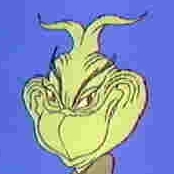
Above: Mr Rochester (left), Grinch (right).
My own adaptation of the novel was interesting in that the characters all had minimal facial features. Mr Rochester's large black eyes were tiny indeed, and yet people still remarked on how large and black they were! Also, very very early on someone noticed that my drawings of Mr Rochester all seemed to take on the appearance of actors who had played him in productions I had seen! I was even able to take illustrations and match them up to photographs. It was eerie... I do have a visual sort of memory, being an artist. So I must have stored them all in my head! ;) I am still trying to find it, but here, in any case is what Mr Rochester and Jane ended up looking like:

Monday, December 26, 2005
Jane's Journey Part Two
More transcripts! This time, I bring you the Broadway Beat 2000  interview with Paul Gordon, composer of the Jane Eyre musical. Part one can be read here- Broadway Beat interview with John Caird (lyrics and co-director for Jane Eyre).
Paul Gordon (composer): It began ten years ago for me. An I was looking for a project to musicalise. And I came across the novel in a bookstore and just decided that I was going to read it. And I got into about page twn and I was in tears and I knew that this was the project that I wanted to do. Then it was just the challenge of waiting until I finished the book before I'd start writing because I was so eager to write.
Richard Ridge: What did you love about the book initially when you read it? I'm sure there are millions of things...
Paul Gordon: There are a lot of things but I was initially attracted to Jane's journey-Jane's spiritual journey, the idea of forgiveness- that message. And that, even though it had a lot of darkness to it, and it gets very complicated and very deep in a lot of places, ultimately it is an uplifting journey, an uplifting tale. I was very attracted to that.
Richard Ridge: So, how has the music and lyrics changed since your initial readings at Manhattan Theater Club, to La Jolla, and now to here?
Paul Gordon: It's changed quite a bit. John Caird has come in and done so much work with me and together, since he became the book writer, he's really taken it several levels above where I initially started. And I've learned so much from him. And, you know, our Toronto production was sort of one concept and it was almost composed-through, not sung-through. And when we went to La Jolla we took a lot of the music, of the underscoring out and the songs sort of stood on their own as songs. So the musical's been developing in ways like that as we go about our journey.
Clockwise (from left): James Barbour (Mr Rochester), Paul Goron (composer), John Caird (lyrics), Marla Schaffel (Jane Eyre).
You can sample and check out Paul Gordon's latest work at his website, http://indieclectic.com. His current projects include a musicalisation of Emma, which should be very interesting!
Saturday, December 24, 2005
Villette the Comic Book It seems fitting that today's post should be about this little project of mine. It was begun nearly one year ago. It is the second work of the Brontes that I have attempted to illustrate in this way- the first was Jane Eyre which is complete. The Jane Eyre comic book was only published once online but has since disappeared after I became aware of how easily it could be pirated. Jane Eyre has been used as the subject for many comic books. I have a few of these, all are of questionable quality- one features a likeness of Mr Rochester which I swear is the Grinch who stole Christmas- only less green. Another has the novel packed with beautiful people, and Jane appears to fly at one point (my favourite part). In the frame directly following 'the voice across the moors' she cries "I'm coming!" as she leaps into the air, Wonderwoman-like, her blond hair waving in the wind and her blue super-Jane cape streaming behind her! I will have to scan this, for I don't think my words do it justice... In any case, I have not been able to find a comic book of Villette. It is possible that mine is the first but rather unlikely. If anyone has heard of another, please drop me a line either in the comments or send me an email at bronteana.blogATgmailDOTcom!
I intend to try publishing these as one book, once I have finished illustrating all of the Bronte novels. I began Jane Eyre on a whim late one night when I was tired and silly after studying for too long again. It was posted for my close friends but soon drew the attention of others. Someone suggested that I offer it to the Bronte Society but it is far too long for publication there, I think.  Villette has been far less popular although those who do follow it are very enthusiastic (and cheer on their favourites, mostly Monsieur Paul and... Alfred deHamal! But only because he looks very cute as a line drawing- lots of snarky vows of admiration worthy of Miss Snowe herself). So far my reward is in forcing my friends to go out and read more of the Bronte novels. One of these had refused to try them, thinking they would be 'Victorian and dull' but after getting about a third into the Jane Eyre comic book, I recieved the instant message that it was 'all my fault' that she had gone to the library and is now completely conquered. I have complained long about how little known the Brontes are where I live. And it is nice to know that, even in my limited capacity, I am doing my part in changing things.
More Bronte-like?
It seems like a lot of current films and novels are being heralded as similar in style to the workds of the Brontes. This time, it is the debut novel of a Yorkshire French teacher. The novel is called The Thirteenth Tale, and the author is Diane Setterfield.
The novel tells the story of a reclusive novelist who recounts the events of her strange life to the young woman she has selected to be her biographer.
It is written in a mysterious, gothic style with resonances of works by the Brontës, Daphne du Maurier and Wilkie Collins, as well as contemporary novels such as Sarah Waters' Fingersmith and The Shadow of the Wind by Carlos Ruiz Zafon.
The book marks "a return to that rich mine of storytelling that our parents loved and we loved as children", said Jane Wood, Orion's editor-in-chief, who has already sold rights to Germany, Holland, Italy, France, Norway and Brazil. "It also satisfies the appetite for narrative-driven fiction that has beginnings, middles and endings, like the great novels of the 19th century. She creates a wonderful fictional world."
The entire article can be read here.
Friday, December 23, 2005
'The Red Queen' by Margaret Drabble
I was just speaking of eastern settings for stories with Brontëan resonances (it has certainly 
From 'Marrying the Madness of Prince Sado', an article by Jennifer Anne Waring:
The story of the 18th century Korean crown princess and her marriage at the age of 10 to the insane Prince Sado is a testimony to Korea's diverse and interesting culture. Based on the princess's original diaries, "The Red Queen" charts Prince Sado's descent into debauchery, murder and finally death. The Korean princess's tale culminates with Prince Sado's slow and torturous end, at the hands of his own father. Shakespeare himself would have struggled to invent a more dramatic and psychological grueling tale.
The crown princess's story is juxtaposed with the modern day story of Dr Barbara Halliwell, a medical professor, who happens to read the princess's diaries on her way to South Korea to speak at a conference. Inspired by the princess, Barbara's narrative continues the themes of insanity, gender and sickness. It moves between memories of her own suicidal ex-husband; her exploration of the princess's former palaces; modern day Seoul and a last minute love affair with a dying man.
[...] This way of examining the text [having the Queen recreated as a ghost who comments upon her own narrative from a modern, objective viewpoint] is both humorous and thought provoking. It also allows the reader to draw certain parallels between Korea and the Western world through the ages. For example, the Korean princess's treatment of women, space and illness calls to mind clear similarities between more recent writers such as the Brontes and even Virginia Woolf. It is truly amazing how modern and forward thinking the princess actually was. It also gives the Western reader a valuable link into Korean society.
The princess' diaries are available in this edition from Amazon.com: The Memoirs of Lady Hyegyong: The Autobiographical Writings of a Crown Princess of Eighteenth Century Korea
ETA: Here is the synopsis of the memoirs from Amazon.com:
Lady Hyegyong's memoirs, which recount the chilling murder of her husband by his father, is one of the best known and most popular classics of Korean literature. From 1795 until 1805 Lady Hyegyong composed this masterpiece, which depicts a court life whose drama and pathos is of Shakespearean proportions. Presented in its social, cultural, and historical contexts, this first complete English translation opens a door into a world teeming with conflicting passions, political intrigue, and the daily preoccupations of a deeply intelligent and articulate woman. JaHyun Kim Haboush's accurate, fluid translation captures the intimate and expressive voice of this consummate storyteller. The Memoirs of Lady Hyegyong is a unique exploration of Korean selfhood and of how the genre of autobiography fared in premodern times.
...Can I get dibs on writing a paper about this book? No, I thought not.
Subscribe to:
Posts (Atom)
