Random Acts of Bronte- a brief guide.
Still recovering from this very hectic week! Not only has there been an unusual amount of work to complete for my classes, but Bronteana readers have given me so many options for new posts that I hardly know where to begin- not that I'm complaining! So, I'm diving in with more Random Acts of Bronte because, really, it would be nice if this took off. And it is something everyone can participate in- and besides, it's fun!
Bronteana reader, 'Carol' offers us this brief guide to helpful allusions for common situations! Here are a few exerpts:
Quotable Bronte:
It's a cold rainy day on campus, so how can I help declaring: "There was no chance of taking a walk that day" ? Ironically, I have to walk to class nonetheless because I don't have a car.
"You eat like a bird!" says my friend while surveying my P&J sandwich and Capri Sun. Of course, I reply, "I am no bird! And no net ensnares me!" You can imagine the stares I get at the lunch table.
St. Patrick's Day is fast approaching as my roommate and I observe in Target while looking at T-shirts that read "Kiss me. I'm Irish" and "Ireland" in big, flashy letters. What better time than this to burst into song?
Ireland! I really must Object!
Jane, this is best
I disagree, sir
Jane, when your gone
I will miss our walks, our little talks, the look of sunlight on your face
soon to be a memory...
Okay, so Charlotte Bronte didn't actually put it that way, but I still brought awareness to fellow Target customers. My roommate is used to my Bronte moments by now.
Creative Applications and Experiments:
I am fascinated by the way Bronte depicts restraint in her characters, especially in Rochester. Several times throughout Jane Eyre, Rochester seems to be struggling intensely from a wish to profess his love for Jane all at once, but he always manages to control himself. I always wondered what would happen if his feelings had overpowered him in the gypsy scene. I imagined the result would be quite comical. So, I talked my sister and cousins into participating in a mock talk show addressing this alternative event: that Rochester, overcome with emotion while reading into the significance of Jane's forehead, finally gives in to his impulses, grabs Jane, and kisses her heartily (all the while, still disquised as a gypsy woman). I was the host of the show, and the guests--played by my sister and cousins--were Jane, Rochester (still dressed like a gypsy), Blanch Ingram, and I think some other characters. Jane is so shocked and confused, she can hardly answer the interview questions. Blanch, appalled by Rochester's strange behavior, decides that insanity and cross-dressing trumps riches and social status; she quickly turns her affections elsewhere. Rochester sits absently, looking very pleased with himself in his wide-brimmed hat and tattered cloak. I don't remember most of the dialogue, but I recall that it was a bit disturbing--but incredibly hilarious.
So far my Random Acts have been limited to spontaneously quoting Anne Bronte's poetry, or such. You have inspired me to be more creative. Perhaps I could use the finger puppets...
An off-topic conclusion to this post is that yesterday I recieved an acceptance from one of the master's programs I applied to. If all goes well, and as it may, I will be an assistant to a Bronte professor next year. I literally just got in from my first conference as well! It was a success, and a lot of fun.
Saturday, March 11, 2006

Thursday, March 09, 2006
Resource Update: E-texts and Translations
A very special thank you to Professor Maddalena De Leo for providing e-texts for the Brontëana resource site including several texts more complete than those previously posted there. Professor De Leo was also very kind in allowing me post her translation- the first in Italian- of Albion and Marina.
This translation comes from Professor De Leo's groundbreaking work, 'All'Hotel Stancliffe e altri racconti giovanili' (edited and translated by Maddalena De Leo, 2004, Edizioni Ripostes, Salerno-Roma).
Jane Eyre (1952)
I have finally seen this production, thanks to Thisbeciel who sent me the DVD in the mail. In most respects it is mediocre at best, but now and then it is interesting- and sometimes ridiculous. I have only seen the production once through so I may have different impressions on a second viewing. The first thing to catch my attention was that Jane is listed third in the credits. This is not accounted for by order of appearance or anything else I can think of. The perspective of the production is unique, I think. We begin with Jane looking back at her experiences at Thornfield. It is clear that she 'can never go back to Thornfield.'
A Brontëana reader had asked what was 'wrong' with Mr Rochester's mouth in the scene where he walks into the garden after being thrown from his horse (off stage). It is stage blood, but the quality of the recording makes it difficult to tell from the images I posted. The 'Hay Lane' garden scene is rather different from canon. Jane becomes a little rude towards the end, tired of the stranger's questions she tells him to be quiet just before Mrs. Fairfax runs in and identifies him. The acting is affected, but usually not to the point of absurdity or of annoyance. But Jane has an infuriating way of making giddy love-sick faces now and then.
One positive point is how often the theme of Jane's social standing becomes an issue. First Mrs. Fairfax heartily declares she is 'not a servant' and will be treated as such. Blanche, however, makes a point of calling her a servant twice- once in an accusatory tone to Mr Rochester.
A few things are peculiar. It seems, from my knowledge of early stage adaptations of the novel, that it was very common to shift the scene of the fire into the drawingroom or library. This solves the problems of having to show the bed on fire, and having to have a bedroom set which is only used for one scene. It causes another problem: the audience now knows about Bertha. This production, for some reason, felt that this just wasn't enough of a hint- having a cackling maniac set the drapes on fire, then run upstairs. So, we get to see Bertha look out from the third floor door and smile at us, just in case we didn't get it yet! When she reappears she is wearing manacles! Manacles that are completely ineffective as she escapes from two handlers and chews on Mr Rochester's coat for an instant before she is hauled away. Before she appears, Briggs asks: "Is this necessary?" A good question! I don't see why we needed to see this, we had already seen her try to kill him. Chewing on his clothes isn't so bad as that.
Now and then it was absurd. Having Bertha smile at us was absurd, and so is the wedding scene. He is very gallant leading Jane to the garden wedding ceremony but in his haste he makes a few errors. The minister politely hints that he is standing on the wrong side. When Briggs turns up he is only a little put out, and seems capable of ignoring the interruption: "Produce him or get out," he says in an even, uninterested tone. Then Mason appears. This level-headed Rochester now goes berserk- he leaps on Mason and throttles him to the ground, while Mr Mason gasps: "he's married to my sister- ack!" "Enough!" Cries Rochester, throwing Mason to the ground again. "Enough! Enough! Enough! She lives! She lives! She lives! She lives!"
Before the proposal, Jane had already made plans to leave for Ireland and had her bags packed. Mr Rochester tries to convince her to stay, then agrees to let her sleep on it. She must have gone to Ireland after all because the next scene is of Mr Rochester looking out of a window, and then a shot of the sea. Otherwise he must have very good vision to see the sea from Thornfield. We see Jane surrounded by trees. She looks crazy, and is muttering about Mr Rochester, and looking around vaguely. She starts talking to him before we hear his voice, giving the impression that she really has lost her mind.
A Very Random Act of Brontë
I am half-way through my week of trails. There's still the in-class essay and the conference to prepare for. This afternoon I met with several colleagues also presenting at the Classics conference. They were drafting a letter accepting invitations to the conference's luncheon. The three of us are in some way students of English and Classics. We amused ourselves with writing the most grandeloquent prose humanly possible, describing our professors as "most sapient", and beginning with terms such as "Lord Admiral Nelson (Ph.D)," and "*professor's name here*, Duchess of Lambton Tower," and ending with something like "your most obliguing and obedient servants." I think 'conference' was consistently replaced with 'confabulation.' When it came to how I would be mentioned in this letter, the first option proposed was to make me an esquire. But then I explained how ladies can't be esquires...
"Unless you are Shirley, from the novel of the same name by Charlotte Brontë- She is the only one allowed to break this rule!"
And a hush falls, since no one knows what I'm talking about. But it's a start! I just have to keep mentioning it and eventually someone will ask me to explain. I do not remember how they resolved my title. It was troublesome:
"You're not married to a baronet, are you?"
"...Not to my knowledge."
Click here if you do not remember Random Acts of Brontë.
Tuesday, March 07, 2006
Sangdil (1952)
In between essays, I bring you this clip from Sangdil. This clip is of the scene where Kamala (Jane) rescues Shankar (Mr Rochester) from a fire in his room. I had heard of this Hindi adaptation of Jane Eyre but I had not thought much about it because I had heard that it was very loosely based on the story:
A loose adaptation of Charlotte Bronte's classic. Childhood sweethearts are separated and grow up in different worlds. The girl is brought up to be a 'pujaaran' (priestess) while the boy grows up to be a dejected 'thakur', turned vindictive by life's injustices. Fate inevitably brings them together at a later juncture, and all seems happy and perfect for the young couple, until she discovers his deep, dark secret. (from imdb.com)
From the DVD:
Kamala (Jane) is brought up by Shankar's (Mr. Rochester: yes Jane and Rochester are childhood sweethearts in this) father (kinda like Helen Burns as well as Mr. Reed). Shankar's mother despises Shankar's growing attachment for Kamala. She torments Kamala. Shankar's feeling for tormented Kamal deepens as they both fall in love. Shankar's father dies and his mother's greed to devour Kamala's wealth separates the two lovers. Kamala is driven into a sanctuary. Her childish inquest changes into devotion and she dedicates her life to Shankar. Shankar gets involved in a worldy web of wealth and women. The passage of time creates a vast gulf between the two lovers until destiny brings them face to face. Their union brings back the lost love but not the companionship that Shankar's Sangdil heart desires.
However, Thisbeciel obtained a copy of the film and assures us that it is far from a 'loose' adaptation. In fact, it looks like it follows the novel more closely than most films of Jane Eyre. There's nothing like pictoral evidence: below, Kamala meets 'Mr Brocklehurst', a rider in Hay Lane. 

The clincher is this: Kamala and the Astrologer, who of course is actually Shankar (This would make this the earliest, if not the first film adaptation of Jane Eyre to include the Gypsy Scene). And probably the most disturbing 'Bertha' yet: 

A flashback while Shankar tells Kamala about his marriage. And after she hears him calling to her before devoting herself as a priestess, she returns to Shankar- who is now blind.

Clip and images courtesy of Thisbeciel.
Monday, March 06, 2006
"Where did you see Latmos?..."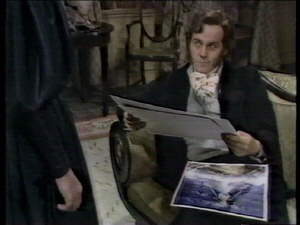
Why, here of course. Thanks to Thisbeciel, we have some clips to show you from the BBC's 1973 Jane Eyre, starring Sorcha Cusack and Michael Jayston, which is due for DVD release this June. It is much loved for its fidelity to the book as well as for the calibre of the cast.
"I was tormented between my idea and my handiwork. Each time I would imagine something- something I was quite powerless to realise..."
The Interrupted Wedding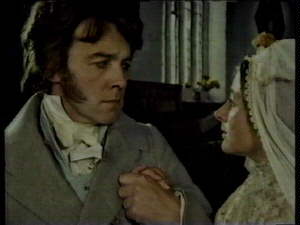
As you see, there are other Jane Eyre clips on this site, including the 'Sirens' performance from Jane Eyre: The Musical presented at the Tony awards, for which the show was nominated. Also there is a clip from the Hindi film Sangdil, which I will have much to say about at a later date.
Also, I would like to say that the Brontëana resource site also has a bunch of new etexts, mostly juvenilia but there are also some pieces by Branwell, and Patrick Brontë
I may have to be scarce this week. As I told one of my professors today, my workload for the week will probably reduce me to a puddle of goo by Sunday. At least I have that novel edited and annotated... and a commentary written... and... suggested revisions made... I just have to write the backcover copy, then write a paper on writer contracts, another paper on the Romance of the Rose, prepare for an in-class essay on Beckett, and then prepare for my first real conference! I will be presenting a paper on Emperor Claudius- which is fitting because last night I stepped on a thorn and now I have a nice Claudian limp. Here's hoping that those attending the conference think that I'm trying to be amusing.
Sunday, March 05, 2006
Brontëana Resources: Albion and Marina, Villette.
Especially for Brontëana, Charlene has taken the time to transcribe one of Charlotte Brontë's Angrian tales- Albion and Marina. The e-text is now available on the Brontëana recource site and in the sidebar to the left. I have also made some substantial changes there. I'm working on the design elements but I have also made some progress with uploading the ridiculous number of images I have. There is now a page for illustrations of Villette from an early edition of the novel (I would guess early 1900s, from the style). I would prefer having a separate directory for each edition, since I have illustrations by more than one artist, but I am still trying to work this out.
These images of Villette were donated by Charlene as well.
Saturday, March 04, 2006
Bronte Craft Corner
I think this is the first time I have written about the many things readers do to show their enthusiasm for the Brontes. This is by no means an exhaustive list. In fact, I have done no research at all for this post. I simply noticed that my friends and I are very peculiar and wanted to share this fact. Firstly, my friend Kristina made me a pair of Jane Eyre finger puppet gloves for me to use in lecture when I am a professor (above: Blanche, St.John, Diana, and Mary). She also made a little plush Mr Rochester doll. Mysticgypsy made some as well! Here's little finger puppet Jane and Rochester: 

I have mentioned before that last year I created a comic book of Ja ne Eyre and am currently working on one for Villette (I intend to one day illustrate all of the novels and then to have them bound). Another common project is to make an icon, banner or bar sometimes will captions:
(Right top: By Alisa and Thisbeciel. Right bottom: by myself and Natasha Ranken)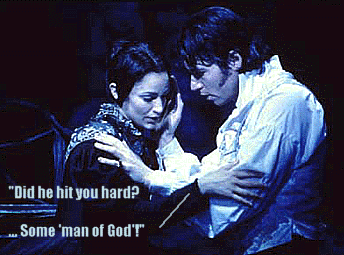
And below is a bar of illustrations from a book I have, rough work for my comic book, two contributed by Arliamay in Australia, two ink sketches of mine, and from Lady Branwen's comic book! I'm sorry for the lack of Wuthering Heights fun but I don't have permission to post what I have come across.

Please respect the artists and do not save, copy, or repost these images without permission.
"Who am I"?: The many faces of women's identity in Victorian Literature.
This a really interesting excerpt from an essay by Bronteana reader, and fellow Bronte-scholarling, mysticgypsy. She compares several answers to the question 'who am I' as a woman in Victorian literature, two of which are from Bronte heroines:
I am my beloved: Catherine Linton (Emily Bronte's Wuthering Heights)For Catherine, who she is as an individual depends on how much she is a part of her soulmate, Heathcliff. As long as she was free to be with Heathcliff, she could be herself, but the moment she goes against her nature, i.e. try to "better" her self by marrying Linton, and thereby breaking her relationship with Heathcliff, she loses a part of herself. After her marriage to Linton, Cathy takes on another persona. She is no longer the girl who would roam wild and free in the moors. Instead, she is confined to the suffocating gradure and Victorian sense of propriety in Thruschcross Grange. Cathy even acknowledges to Nelly that she and Heathcliff were one when she says "I am Heathcliff". Hence, in this case, the woman takes the identity of her beloved.
I am his equal: Jane Eyre (Charlotte Bronte's Jane Eyre)For Jane, her identity as an intelligent, independent woman is resolved through ties with Edward Rochester, her imposing employer and master of Thornfield. Although Jane does seek her own independence (and thereby her identity as a single woman), in the end, she finds she does need Rochester to be complete. Firstly, there is the telepathic relationship that she shared with Rochester, which I believe was a strong indicator (from the author) that as long as that supernatural connection was there between Jane and Rochester, they could not be entirely happy without each other. They needed each other to be whole because they were "equals" and complemented each other. Jane needed Rochester during moments of her insecurity (when Rochester was more controlling of her), and by the end of the story Rochester needed Jane when he was (phsycially) found wanting (thus Jane controls Rochester). This kind of relationship is differnet from that of Cathy and Heathcliff in that this is a relationship of equals, where only each will do for the other, but each keeps their own identies. Jane is NOT Rochester in the manner as Cathy affirms she IS Heathcliff.
The rest of the post (although not the rest of the essay) can be found here.
Thornycroft Hall (1864) by Emma Jane Worboise
Thanks to reader, Shoshana, I stumbled upon this rewrite of Jane Eyre. A very... interesting one.
Published in 1864, Thornycroft Hall has more than a few echoes of Charlotte Bronte's Jane Eyre, which appeared some eighteen years earlier. It seems that the evangelical Emma Jane Worboise felt the need to provide a more "Christian" version of the earlier novel, including not only a spirited defence of Rev. William Carus Wilson and "Lowood School", but also repeatedly urging the necessity for immediate acceptance of Christ.
I have not had the time to read much of it, but here are a few more excerpts from literaryheritage.org.uk:
The similarities between the opening chapters of this book and Jane Eyre are striking. An orphaned girl is brought up by uncongenial relations, and a furious (though justified) temper tantrum leads to her being sent away to school. But here the novels diverge: Ellen is very happy at the Clergy Daughters' School, and defends both it and Rev. William Carus Wilson vigorously from Charlotte Bronte's strictures.And it was no "Do-the-girls Hall," as some people have asserted: I here
solemnly declare that during the whole of my residence--nearly five years--I never saw the table otherwise than plentifully and wholesomely supplied…I confess that sometimes, at the breakfast hour, our olfactory nerves were saluted with a perceptible odour of burnt porridge; but I have known the milk to be burnt now and then at Thornycroft Hall; and certainly our bread and butter was cut in "planks," not slices, and the butter was, perhaps, a little hard to find…but if you had seen the large dishes-full replenished again and again till every girl was satisfied; if you had seen them passing down the long narrow tables in the lofty eating-room, disappearing with astonishing rapidity; if you had counted the number of "planks" each young lady consumed, you would not have imagined any pupil to be badly served.
The pious and slightly priggish Marshall Cleaton is certainly no Mr. Rochester, but he and his mother are surprisingly appealing characters, despite the rather heavy-handed evangelistic fervour they both display.
...Pious and priggish? The full e-text is now listed in the sidebar.
Patrick Brontë's The Rural Minstrel
As soon as I finished posting Emma (which is being revised right now- I did catch a handful of errors, and I still have to add bibliographic information) I recieved offers of more resources for the site, including more e-texts and transcriptions. When I said that the site would not be empty for long, I meant what I said! Two new e-texts in as many days isn't bad. Thisbeciel was good enough to find the e-text she had once sent me before I began blogging. It is of Patrick Brontë's The Rural Minstrel. These poems are now available at the Brontëana Resource site, and the text is now listed in the sidebar.
1 Erewhile, the morning o'er the blushing sky,
2 In milder beauty, held the soverign sway;
3 The streaky east, with many a changing hue,
4 Glowed on the confines of the ether blue,
5 And gently ushered in the king of day.
6 Now hangs the sun, his golden lamp on high,
7 Diffusing, brighter, warmer light;
8 The sleepy charms dissolving, of the drowsy night,
9 The spirits cheering, with a quicker flow,
10 And fostering all the rosy flowers of health that blow.
11 How charming is the scene!
12 The fields in flowery green,
13 Scent the soft breezes, with their fragrant smell:
14 The blackbird and the thrush,
15 Make vocal every bush;
16 Perched on the milk-white thorn, the linnet sweetly sings;
17 The labouring bee, shakes music, from his mellow wings:
18 Loud tolls the Sabbath Bell;
19 From yonder ancient tower, proceeds the solemn sound,---
20 Where dusky yews, and lofty ashes bend,
21 Beneath a load of years, their crazy head,
22 Mourn o'er the living, and protect the dead.
Friday, March 03, 2006
Emma Chapter Two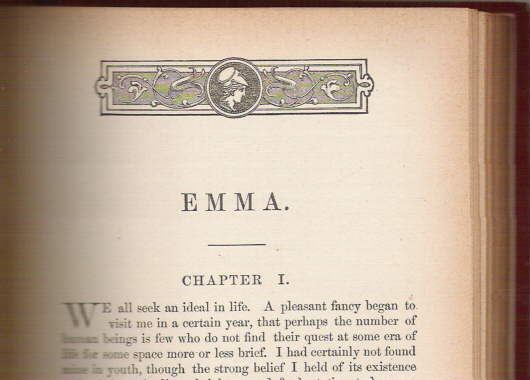 This morning I finished transcribing Charlotte Brontë's Emma. It is now available as one transcript, in a text file (it had been an html file), at the Brontëana Resource website. I am sorry to use the same image for two posts but when I thought of scanning the last page illustration I remembered that it might ruin the effect of the last words. As I transcribed this I realised that this edition is obviously American. I did not standardise any spelling although I did fix one punctuation error.
The book was published by Porter and Coates Philadelphia, and it is not dated. The illustrations are very similar to an edition of Longfellow that I have which is from the 1890s. Other books I have from the period show similar wear, although the title page of this book is remarkably clean and white which makes me think it wasn't as well read as the other volumes in the set... If I can get a digital cammera I will post an image of it- the pages here are too nicely tight to press on a scanner, I think. And I'm afraid of tearing the tissue covering the illustration on the fronticepiece.
A Broadway Surprise
I thought never to hear more about this production- the 1958 Broadway Jane Eyre. I know of it's existence and nothing else. But now, one of its stars will be performing:
Jane White, who originated the role of Queen Aggravain in Once Upon a Mattress, has added her one-night-only engagement to Feinstein's at the Regency's starry 2006 line-up. She will perform on March 13th at 8:30 PM.
[...]
White most recently appeared on Broadway as Solange LaFitte in the revival of Follies. Other Broadway credits include The Cuban Thing, a 1958 production of Jane Eyre, Take a Giant Step, The Climate of Eden, Razzle Dazzle and Strange Fruit.
If anyone knows anything at all about this 1958 production, I would love to hear from you!
Brontës make Happiest and Most Depressing List
In a previous post we discussed Jane Eyre making the list for books adults should read before they die. Jane Eyre and Wuthering Heights have also made another sort of World Book Day list- most happiest and most depressing ending lists!
Pride and Prejudice was voted the happiest ending in literature, followed by To Kill a Mockingbird and Jane Eyre.
Only one in fifty readers, it seems, likes to be left tearful at the last page, so the survey also asked which unhappy endings readers would most like to change: Tess of the D’Urbervilles was a clear winner, with readers demanding clemency more than a century after Thomas Hardy sent his tragic heroine to her death. It was also felt that the endings of Wuthering Heights, 1984 and Gone with the Wind were all too depressing, and should be perked up.
The snarky columnist decides to try their hand at refashioning the ending to Jane Eyre, to see how it might be made a little darker:
And since we are making unhappy endings cheerier, for the gloomy 2 per cent there are ways of rendering happy endings a little darker, starting with Jane Eyre: The original “My Edward and I, then, are happy” needs another clause “. . . or we would be, if that bloody Bertha hadn’t found the fire escape.”
The columnist also goes on to note the boom in fan fiction.
The Fanfic.net website has more than 200,000 Harry Potter stories that J. K. Rowling never wrote.
It also contains half a dozen Brontë 'fics'. They don't deserve a category, which is accorded to Jane Austen, and Mindsweeper... yes, the computer game where you click those little boxes and sometimes kill a smiley face. Several of the best stories on the Brontë novels had been 'boojumed' to use a term from Jasper Fforde, because they violated regulations on the use of colons and other punctuation. These were mostly hilarious works, such as a parody in which we find that Mr Rochester has Brittney Spears living in his attic. Another asks the question, what if Jane had gone to India?
Thursday, March 02, 2006
Emma Fragment and Brontëana Website

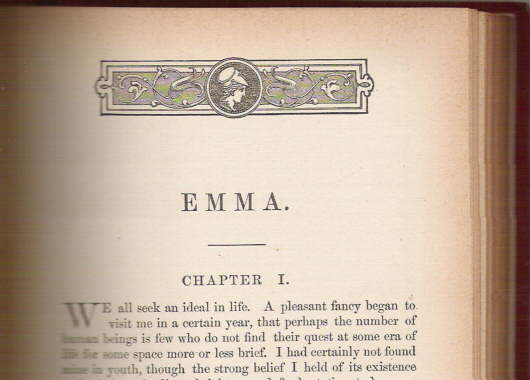
I have spent most of the day working on this. What began as the simple task of transcribing Emma, the two chapters of Charlotte's last unfinished novel, turned into a website. This website: http://bronteana.bravehost.com I had plans to make a website for some time, but at last I was forced to create one in order to share this transcript. It would be simply too large for a post. So far, the only item there is 'Emma'. The design is a template, and very unattractive but for now, it will have to do! There is also a handy guestbook so everyone can leave me a note. I am able to add a message forum but I am not sure if I want to go that far at this point. If there is interest I may add it.
This transcript is of chapter one of Emma. I transcribed it personally from a book I have. It appears, from the type, wear, illustrations etc to be from the 1890s. It is part of my collection of antique books. The image above is a scan I made of the first page of 'Emma'. The book itself is the unloved last volume of 'Bronté Works'. And is the 'Professor Emma and Poems' volume. There are also a few illustrations. I can tell from its condition that it was seldom read... The transcript is now listed along the sidebar along with the other Brontë e-texts, and the website is also listed in the links list above.
The Emma fragment was made into a novel called Emma Brown recently. Comment on this book will be forthcoming. I am quite exhausted at the moment. Remind me not to edit half a novel, transcribe a chapter from another, and make a website all in one day. It hurts... The second chapter should be up before next week, when I shall go back to school and return to my regularly scheduled essays and seminars. Speaking of which, when I wasn't working on Emma and the website I was editing and annotating the Mr Christi novel (an unpublished novel by one of Canada's first Modernists). Can you imagine Jane Eyre boarding in a house full of Ginevra Fanshawes? Now, that's terrifying!
In the same volume is also Thackeray's wonderful 'Last Sketch' preface to Emma, and tribute to Charlotte Brontë. I'll have that posted later as well.
Shop Brontë Parsonage Museum
After witnessing my distress over not being able to find a copy of Agnes Grey, reader Alan Bentley reminded me that the Brontë Parsonage Mueum Shop now has an online store front. I say reminded because I first heard about their new presence through the Brontë Parsonage E-Magazine Blog, run by the editor of the Brontë Society Gazette.
In our shop you will find a wide range of books, gifts and souvenirs including old favourites, new temptations and curiosities, many of which are exclusive to us. Profits from sales help support and maintain the museum and its collections.
At the museum shop we are passionate about the lives and works of the Brontës. Our aim is to provide the largest collection of Brontë related products for the enthusiast or for those with a growing interest.

It looks like they carry most things, but not 'BrontëBerry Lip Balm'.
Wednesday, March 01, 2006
Jane Eyre 1952 Images Continued.
Here are the last of the screencaps from Westinghouse One's Summer Theater production of Jane Eyre from 1952, starring Katherine Bard as Jane Eyre and Kevin McCarthy as Mr Rochester: 


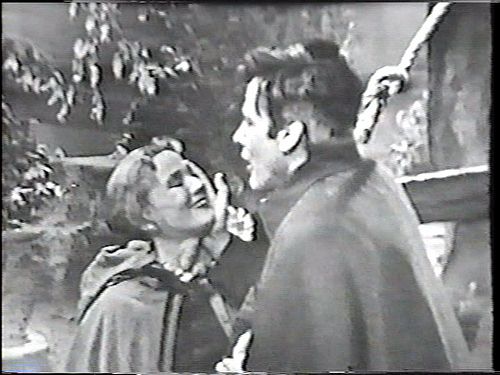


I really like this last picture- it looks like she tripped and fell into his arms (a bit hard to see at this size). Thanks once again to Thisbeciel for sharing these with me.
ETA: Hm... and, his hand has reappeared in the last frame as well! Thisbeciel tells me that it seems like he was only pretending that he had lost a hand in the fire...
The Brontes as Propaganda?
From The Tyee:
I'm calling it the propaganda novel, for the lack of a catchier term (which will no doubt surface). Of course, it's true that all novels (and I would argue all art) are propaganda in the original sense of the word, in that they direct audiences to see the world through the artist's eyes. Charles Dickens seduced us into that annual shopping festival, Christmas. William Gibson spelled out just why corporations are so darn scary. And the Brontes have a lot to answer for in convincing young women that angry, abusive bad-boys are sexier than nice guys.
Well? Are all novels propaganda? And more seriously, have the Brontes brainwashed women into devoting their lives to abusive losers?
Jane Eyre Makes List of Essential Reads To mark World Book Day, liberarians were asked to name the book adults should read before they die. Harper Lee's To Kill a Mocking Bird came out the winner, with the Bible and Lord of the Rings in second and third place.
Other well-loved classics which feature in the rundown are Charlotte Bronte's Jane Eyre 1984 by George Orwell, Charles Dickens' A Christmas Carol and Jane Austen's Pride and Prejudice.
From BBC News.
Brontëana Update Phase Two No more work has been done on the index, but now you may find below it a list of e-texts of the Brontë novels, and poetry as well as other related works such as Gaskell's The Life of Charlotte Brontë and several 19th century adaptations of Jane Eyre. The first of these is the 1857 play by John Brougham which I encourage everyone to read- it's very entertaining, as you can discern from the cover art. I don't think they had Mr Rochester suspended from wires but this was the Victorian stage, so one can never tell.
There's also our personal favourite, Miss Mix: a parody of Jane Eyre from the 1860s.
The new e-text links are available at the bottom of the sidebar at left.