


Another Update on BBC Bronte Films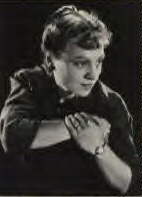
Once again, our thanks to LaMcKay for providing the following stats on several BBC productions currently unavailable:
Jane Eyre (1963) was broadcast on 7-4-63. The BBC 2 classic serial 28-12-68 Tenant of Wildfell Hall is complete as is their Wuthering Heights first broadcast 28-10-67 (4 episodes). Villette 1970 (also from BBC 2) aired on 31-5-70 and had 5 episodes.
And finally Blogger is allowing me to post images once again. This is the picture I found earlier this week of Daphne Slater who played Jane Eyre in the 1956 BBC series (playing opposite Stanley Baker). I have not been able to verify what the image is from- but the watch definately makes one think that this is not an image from the production! The search continues.
Friday, June 30, 2006

Fan Fiction, more Odds and Ends
Firstly, after years of complaints fanfiction.net has finally added two categories for Bronte fan fiction. The categories are for Wuthering Heights and Jane Eyre. Don't be discouraged by the small number of stories archived there. The vast majority of Bronte fan fiction on the site is still lurking in 'miscellaneous books' or films, and even one or two are filed away under 'Jane Austen.' I'm not exactly thrilled, knowing what 'fandom' does to beloved works of literature. Then again, now and then something really great will turn up. Although this particular site has a reputation for bad writing (thanks to Impairedlogic for the notice about the new Jane Eyre category).
It looks like the BBC's Jane Eyre 2006 has been pre-sold to Bulgarian television along with quite a lot of other programmes.
The Bronte Parsonage has recieved its seven millionth visitor- who is quite bemused as he had never really been that interested in the Brontes but now he'll give Wuthering Heights a try.
And we have another sighting of the Charlotte Bronte-saurus! (See Bronte-saurus, Charlotte and Brontesauri).
Thursday, June 29, 2006
Update: Jane Eyre 1963 and Villette 1970
The internet is a marvellous thing. I am astounded by how quickly this search is going. Before I started keeping this blog, work was slow and frustrating. Being in touch with so many Brontephiles like myself is making my work go far more smoothly!
The newest information comes from Bronteana reader, LaMcKay. There is both good and bad news. The bad news is that the 1963 version of Jane Eyre, with Richard Leech and Ann Bell (the photo I discovered earlier this week from this production is here), is unlikely to be released. The current opinion is that the series is missing two of its six episodes- episodes two and three. While most of us would loudly cry that this is no reason to hold it back, it would look awful to the marketting deptartment I'm sure if one third of the production were missing.
The good news is that the current opinion is that Villette survived the archive purge intact! This gives me great hope that it could be released someday. LaMcKay suggests that Jane Eyre could be released with it as bonus material, but I think it is unlikely. What they might do would be to put together a boxed set. To my knowledge there have been no boxed set of Bronte films- only discounts if you buy Jane Eyre and Wuthering Heights. It is a thought. I must say that the interest in a 'new' Bronte work- which is neither Jane Eyre nor Wuthering Heights- should be immense. Add this 'lost' footage, and 1968 Tenant of Wildfell Hall (I am not sure this one exists, to be fair) and a loss just isn't an option. Everyone will want to have this collection I am absolutely certain.
Review of Voice and the Victorian Storyteller by Ivan Kreilkamp
This review of Voice and the Victorian Storyteller provides an interesting critique of the book's discussion of a particular passage from Jane Eyre. The passage is quoted in a section of the book on Charlotte Bronte and the trope of 'witheld speech.'
There is a striking example in his discussion of the famous episode of extrasensory perception in Jane Eyre, in which Rochester tells Jane that he cried out to her and heard her reply, and Jane realizes that the words he “heard” were those she had actually spoken (“I am coming: wait for me!”):
The passage is quoted in full, and then follows the critique, that the author had omitted a sentence in order to shape the passage to his argument. The work also discusses Villette.
Voice and the Victorian Storyteller
264pp. Cambridge University Press. $85.0 521 85193 9
Contents:
1. ‘The best man of all’: mythologies of the storyteller;
2. When good speech acts go bad: the voice of industrial fiction;
3. Speech on paper: Charles Dickens, Victorian phonography, and the reform of writing;
4. 'Done to death': Dickens and the author's voice;
5. Unuttered: withheld speech in Jane Eyre and Villette;
6. ‘Hell's masterpiece of print’: voice, face, and print in The Ring and the Book;
7. A voice without a body: the phonographic logic of Heart of Darkness.
Addendum: BBC Archive Project
Biedroneczka writes in with a little more information on the list she provided of BBC adaptations of Jane Eyre, specifically the two radio adaptations I have not found yet- the ones from 1990 and 2004:
"There's practically no info on the 1990 version. As far as I remember, it's only 30 minutes long. The 1994 programme is indeed the one with Ciaran [Hinds]. And the info on the 2004 one reads as follows: Anne-Marie DUFF reads Charlotte BRONTE bold and passionate story of a woman's search for independence and love on her own terms. Lonely, ignored and ill treated, the orphaned Jane is growing up at Gateshead. Abridged by Sally MARMION. Producer Di SPEIRS. 15 episodes, 15 minutes each. BTW, Here's the link to the site: http://open.bbc.co.uk/cataloguemeta. Sadly, the catalogue is currently unavailable."
The catalogue seems to be in a prototype stage at the moment, according to its blog but is going through a review process. This is how the project is described on the BBC's website:
This experimental catalogue database holds over 900,000 entries. It is a sub-set of the data from the internal BBC database created and maintained by the BBC’s Information and Archives department. This public version is updated daily as new records are added and updated in the main catalogue. This figure is so high because, for example, each TV news story now has an individual entry in the catalogue.
Perhaps more importantly for our purposes is that it clearly excludes productions which no longer exist. It is safe, I think, to suppose then that the 1956 and 1963 Jane Eyre productions are still extant. Once the project is up again, we should be able to see if 1970 Villette, the 1968 Tenant of Wildfell Hall and perhaps others we don't know about are also hidden away there.
Bronte News and Update on BBC Search
Last Sunday Kenneth Griffith, Mr Mason in the 1970 production of Jane Eyre with Susannah York and George C. Scott, died at the age of 84. Thanks to peridramnews for the notice.
Well, now we have this article from the Guardian about the limited re-release of Daphne duMaurier's Rebecca. In passing this painfully psychoanalytic article suggests that all romances are paedophilic.
Whether it's Pride and Prejudice, Jane Eyre, Bridget Jones's Diary or any old Mills and Boon novel, the grist that feeds the fantasy mill is the same.
Several Bronteana readers have sent in some info which should be helpful in tracking down some of these remaining adaptations which are not currently available. Liz, who wrote to the BBC about the Villette mini series sends the whole text of their email reply which certainly suggests that the series exists but that copyright arrangements prevent distribution of copies- thus, the letter writing compaign mentioned earlier.
Also, Biedroneczka sends along a list she found of BBC productions of Jane Eyre from a site connected to the BBC archives. This is the list (programmes denote episodes):
6 programmes in 1956
6 programmes in 1963
5 programmes in 1972 (radio)
5 programmes in 1973
11 programmes in 1983
3 programmes in 1990 (radio)
4 programmes in 1994 (radio)
15 programmes in 2004 (radio)
In my travels I came across one source claiming there had been productions in the 1940s as well. It is possible that they were mistaken, or perhaps this list is of those versions extant. The 1972 radio adaptation must be the Megwynn Owen/Patrick Allen series. And possibly the 1994 version is the one with Sophie Thompson and Ciaran Hinds. I have not heard the 1990 and 2004 versions yet (15 episodes?!).
Wednesday, June 28, 2006
Charlotte Bronte's Descendents to Attend Premiere of Jane Eyre
Oh, good grief.
Bronteana reader Agnes points us to this 'interesting' article about the Blackpool production of Jane Eyre: The Musical- which I think has certainly taken the prize for most error-ridden publicity as far as the musical is concerned. Our last post about the production highlighted some of these errors including its claim of being the UK premiere, and a claim that the show is 'new' and 'direct from Broadway.' But, this really beats all:
Premier Theatre Company, who are to staging Jane Eyre The Musical at Blackpool Grand Theatre next week have revealed that two descendants of the writer Charlotte Bronte are to attend the opening night gala performance on Tuesday, June 27
Out of the three known surviving descendants of Charlotte Bronte, Carol Bronte and Dr Patrick Bronte-Hearne have accepted the company's invitation to attend the opening of this premiere.
Just so everyone is clear on this: the Bronte sisters left no descendents. No descendents. None. Not a one. They don't exist. Carol Bronte does exist. Her picture is on this earlier Bronteana post when the family got together to fete the publication of a book about Patrick Bronte earlier this year. But perhaps more annoying is that there are relatives of the Brontes- and quite more than three! One of them is Kate Bower, a regular reader of this blog. She wrote a special guest post for us concerning the present extended Bronte family here.
All Bronteana posts about the family should be indexed here (but the archives are still not completely indexed so there are probably more posts).
Jane Eyre BBC 1956
There's been no new information on the 1963 Jane Eyre, but my search has led me back to the previous BBC production- the 1956 version. I have no images ,[I've just found one!] and I don't know if this one still exists either but it sounds very interesting! I have heard some enthusiastic comments from people who remember it. I don't know if it would appeal to modern lovers of fidelity to the novel, though...
We saw that in 1963 Jane and Rochester came nearest to the 'perfect' age difference. In 1952 the BBC cast a Rochester who was only a whopping.. one year older than Jane. He was 29 and she was 28. Meanwhile, St.John was 32. Anyway, the strangeness continues. The production lists Constance Cox as a co-adaptor with Ian Dallas. She is also the adaptor of the 1963 version! Furthermore, our Jane (Daphne Slater) had just finished playing Elizabeth Bennet, and Harriet Smith before that, and Anne Elliot in 1960. There are a few fan recollections of Stanley Baker's performance: " I seem to remember a strong (and sexy!) performance as Mr Rochester." As with Richard Leech we can infer something about Stanley Baker's performance from his acting style in general.
To start off with, he was over 6 foot, and described personally as: rugged Welsh mining stock, unruly, quick to flare, and first to fight, proud and self-willed, posessing 'a fine speaking voice, a smouldering intensity, and a strong spirit.'
His was good-looking, but his features were angular, taut, austere and unwelcoming. His screen persona was taciturn, even surly, and the young actor displayed a predilection for introspection and blunt speaking, and was almost wilfully unromantic. For the times a potential leading actor cast heavily against the grain. Baker immediately proved a unique screen presence - tough, gritty, combustible – and possessing an aura of dark, even menacing power.
[...]
Film welcomed the adult Baker as the embodiment of evil. Memorable early roles cast the actor in feisty unsympathetic parts.
[...]
He established his own niche as an actor content to be admired for peerlessly portraying the disreputable and the unsympathetic. In that he was a dark mirror, more accurately reflecting human frailty and the vagaries of life than many of his more romantically or heroically inclined contemporaries.
He was also knighted in 1976. You can read more of this lengthy encomium here.
So, I imagine something like Wuthering Heights meets Pride and Prejudice... I have an image of Stanley Baker from the year of the production but once again Blogger is not co-operating. The link to the image is here.
Tuesday, June 27, 2006
Villette BBC 1970
Bronteana reader Liz has been writing to the BBC regarding their 1970 mini series of Villette, featured in this old Bronteana post (including photos of the actors who played Lucy Snowe and Monsieur Paul Emmanuel). She infers that the production still exists from their comment that it is 'not commercially available' and the recomendation that she write to BBC Worldwide to have it released. So, then, the hundreds of you out there who read my posts each day, this is the only adaptation of Villette. If it still exists, it should be available. If you feel as I do, send a polite note to BBC Worldwide and hopefully it will not take 30 years as Jane Eyre 1973 did!
BBC Worldwide. Commissioning Editor, BBC Worldwide Ltd, Woodlands, 80 Wood Lane, London, W12 0TT
Bronte News and A little More About Films
An extremely brief article about the students of the Ripley Academy of Dance and Drama taking part in filming for the BBC's new production of Jane Eyre to air in autumn 2006.
A brief review of the book Angry Words Softly Spoken: A Comparative Study of English and Arabic Women Writers by Alanoud Alsharekh.
The main premise of this study relies on many of the theories presented by the 1970’s feminist critical movement, especially that of Elaine Showalter’s tripartite structure.It also suggests a new tripartite structure for the evolution of feminist consciousness in works of fiction involving an inversion of scales in ‘softness’ and ‘anger’ explored through the work of such authors as Charlotte Brontë, Sarah Grand, Virginia Woolf, Layla al Othman, Nawal al Saadawi and Hanan al Shaykh.
The search for more information on Jane Eyre 1963 is on. I spent much of yesterday sifting through internet posts and fora- in some cases finding something exciting only to find that the post had been deleted. If anyone has any memories of the production, or knows if anything has survived from it, do not hestitate to contact me at bronteana.blogATgmailDOTcom.
So far, the obituary of Richard Leech, who played Mr Rochester, contains the best information on the style and reception of the work:
Leech had a busy career in films. His army officer in Ice Cold in Alex typified many of the offers that came his way: well-spoken and very much officer material. However, he always brought a definite sympathy and elegance to such roles. Sometimes he gave them a fine touch of irony, which allowed him to develop his skill at underplaying a character. In Tunes of Glory (in which he cut a fine figure in a kilt and did an athletic Eightsome Reel), he was one of the mess officers caught in the unholy struggle between John Mills and the hard drinking Guinness. Leech delivered careful, well-rounded performances in numerous other films, including Gandhi, Young Winston, The Dam Busters and The Shooting Party.
Leech was also a well-known face in numerous television dramas. In 1963, he was cast in a BBC serialisation of Jane Eyre as Mr Rochester (opposite Ann Bell), but it cut little ice with the public.
Monday, June 26, 2006
Jane Eyre 1963 Steps out of the Shadows
Well, this is surprising. I was looking for some images of a theatre production when I came across this. I had finished my search and thought that I would see what might turn up. This is an image from the BBC's 1963 mini-series of Jane Eyre. This is Richard Leech as Mr Rochester and Ann Bell as Jane Eyre. All the information available on this production can be fit into this post: It had a run time of 6 episodes (at 25 minutes each?)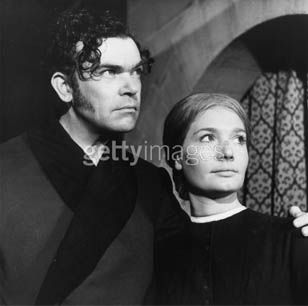
Directed byRex Tucker
Writing credits (in alphabetical order)
Charlotte Brontë
novel adaptation Constance Cox
Cast (in credits order)
Ann Bell.... Jane Eyre
Richard Leech.... Mr. Rochester
rest of cast listed alphabetically:
Elsie Arnold.... Mrs. Fairfax
Rachel Clay.... Jane Eyre (as a child)
Justine Lord.... Blanche Ingram
Nan Marriott-Watson.... Grace Poole
Jane Merrow
Elaine Pratt.... Adele
William Russell.... St. John Rivers
Produced byDouglas Allen
Original Music byTristram Cary
The specifications on the image provide hope for new material as well:
Caption:Actor Richard Leech as Mr Rochester and actress Ann Bell in the title roll [sic] of Jane Eyre being serialised by the BBC at the Television Centre, Shepherds Bush.
By/Title:Harry Todd/Stringer
Date Created:29 Mar 1963 12:00 AM
Collection: Hulton Archive
Source: Hulton Archive
Date Submitted: 27 Oct 2003 08:46 PM
Object Name:98n/52/huty/13073/58
Release Information:No release.
Barcode:JE5908
More information, at the time of the production Richard Leech was 41, and Ann Bell was 23, making their difference in age almost match that of the book- in the book Mr Rochester is 20 years older (here he is 18 years older).
Some more trivia about the cast. Richard Leech was a practicing doctor, and his children had Noel Coward and Alec Guiness for godfathers. The actor playing St.John played Ian Chesterton, the 'companion' of the First Doctor in the original Dr.Who. While Ann Bell played Doris in Fahrenheit 451.
Sunday, June 25, 2006
Bronte News
So, here's today's news and the backlog as well. I thank you all for your supportive comments. I am feeling more at ease now. The etext is also finished but I would like to check it against the text before posting it to the Resource Site.
Author Sarah Waters claims Jane Eyre and Wuthering Heights influence her work, such as her novel Fingersmith.
Here is another review of Reader, I Married Him by Michele Roberts.
Jane Eyre is not part of this lady's emergency kit. Well, her loss. A friend of mine keeps a small copy of Villette at all times 'in case of emergency!' It would also come in handy for Random Acts of Bronte.
Canadian cities can learn a thing or two about marketting from Haworth.
Forget 'York' and 'Lancaster', this English class has a head-to-head literary death match- or rather a 2 hour quiz- with teams including 'The Bronte Sisters,' in Qatar:
There were six teams of senior students each consisting of six members with shingles commemorating Shakespeare, Wordsworth, Agatha Cristie, Bronte Sisters, Sarojini Naidu and Tagore.
[...]
Sarojini Naidu Bronte Sisters and Tagore were pipped at the post though raced hard.
Religious and literary pilgrimages merge in this article which mentions the venerable home of the Brontes.
And we have some very strong voices of protest against David Brooks' earlier article about gendered education which listed the Brontes as among the favourite books of women. You will have to scroll down to read this letter.
The 'lost classic' of Welsh literature, described as 'the Welsh Wuthering Heights' is to be made into a BBC radio4 production. The novel is called Country Dance:
Country Dance is a story of passion, jealousy and revenge centred around a young girl who grows up in an isolated rural community on the border between England and Wales.
She keeps a diary of everyone she meets but her daily scribblings fall into the wrong hands.
Saturday, June 24, 2006
Miscellany and an Apology
I must apologise. This post will not be very well structured. There is a backlog of news but I cannot concentrate this evening enough to cover everything. I hope to catch up in the morning. I'm in the midst of a family crisis which has shaken me somewhat.
Regarding my previous post about the BBC's linking to the wrong Ruth Wilson, I am glad to say that they wrote back to me that very day and have since corrected the mistake.
This morning, Mandy from the Yahoo! BRONTE message board inquired about a poem by Charlotte called 'Watching and Wishing'. I went to the Project Gutenburg etexts for the Brontes' poems but it was not there. I have two 19th century editions of their poems and in these I found the poem she was looking for. I also found two other poems which are not available online either: 'When Thou Sleepest' by Charlotte and 'The Outcast Mother' by Emily. I have started making an etext for these but I will have to wait until I can concentrate properly before I continue it. I hope to have it ready sometime tomorrow.
Bronteana reader Vaire also sends along this slideshow from the BBC regarding the project to revive the Sri Lankan lace industry, a project which includes their new production of Jane Eyre.
I do have 'Watching and Wishing' prepared (although it still needs to be checked against the text). So here it is, for Mandy and the rest of my readers:
Watching and Wishing
Oh, would I were the golden light
That shines around thee now,
As slumber shades the spotless white
Of that unclouded brow!
It watches through each changeful dream
Thy features' varied play:
It meets thy waking eyes' soft gleam
By dawn--by op'ning day.
Oh, would I were the crimson veil
Above thy couch of snow,
To dye that cheek so soft, so pale,
With my reflected glow!
Oh, would I were the cord of gold
Whose tassel, set with pearls,
Just meets the silken cov'ring's fold
And rest upon thy curls,
Dishevelled in thy rosy sleep,
And shading soft thy dreams,
Across their bright and raven sweep
The golden tassel gleams!
I would be anything for thee,
My love- my radiant love--
A flower, a bird, for sympathy,
A watchful star above.
Friday, June 23, 2006
The Evolution of Jane Eyre: The Musical, Part 4- La Jolla
This production features a massive revisioning of the entire work. It is odd how much is it and is not the same musical. All of the major songs remain, but the way the novel is treated has completely changed. The previous production was a 'musicalised BBC mini-series' this one is a feature film, an art film perhaps. And for the first time Bertha is drawn deeply into the domestic levels of the piece. It is evident that the show is concerned now with psychology, and with eliciting as much sympathy for Bertha as possible. Sometimes this goes over the top, sometimes it is done very well.
The change is immediate. The opening now begins with a music box playing the theme of the new ballad, 'Child in the Attic.' The lines 'in everyone's life there is darkeness and light' are changed to 'in one woman's...' and of course we are never sure which is 'the' woman, but of course they both are. We first see young Jane being hauled to, not the Red Room, but the attic of Gateshead. We don't see her rage, she simply asks what she has done. Her aunt says that she is willful and talks back. Following this is a scene in the attic in which the chorus emphasise over and over again that she is in THE ATTIC, attic, attic, attic, in the attic, the dark and ghostly attic attic attic. This would be one of the over the top parts. Got that? Attics will be important later on. Another interesting bit here is the rag doll. I do not know what was done on stage for this production but in all later ones Bertha has such a rag doll. When Jane meets her, Bertha is whinning for it and Jane hands it to her. Then they curtsy to eachother before Bertha walks off. The scene continues with the narrating Jane wailing- and, yes, this wail will be taken up by Bertha. John Reed appears to torment Jane, and suggesting that she kill herself. He mutilates her ragdoll with a pair of siscors. Both Janes sing over it, making the doll their sympathetic child as well as double. The sympathy will extend to Bertha as well.
The Gothic has been turned up. Thornfield has gone from 'a rambling manor on the northern hills' 'in a silent glade' to 'a dark, looming manor' in a 'silent valley' surrounded by 'lowering' 'misty hills' and 'mighty old thorn trees.' It never really recedes. Perhaps the closest it comes to receeding are in the scenes with the company or Mrs. Fairfax's songs. Suffice to say, all of the domestic scenes are cut. In Hay Lane, the rider introduces more gothicism into the tale- denominating Jane a witch, and himself 'a thoroughly unpleasant, violent fellow.' There is also more humor although it is a bit obvious. When Jane says that she is from 'just below' Rochester says: "Ah hah! I see! From just below. From some nether region of spirits! Some horse-terrifying limbo of darkness, eh?"
Adele's Opera is now a spoken scene. And it is cute, comedic, and extremely and obviously another device to amplify sympathies between characters and Bertha. In this version Celine was not a dancer but a tragedian, and Adele wants to be 'tragique' like mamman. She runs around wearing some curtains, and basically, acting out the novel. When Mrs. Fairfax calls out to her, Adele cries: "What voice speaks to me, through the raging storms?" Once Jane arrives things get worse. Threatened with her Latin lesson she cries: "I warn you! I will climb up to the battlements and throw myself to death!" "To 'my' death, shouldn't it be?" say Mrs. Fairfax. No, to Bertha's, but nevermind. Adele then takes on Ophelia just as Rochester comes in. As soon as she catches sight of him she exclaims: "Oh! Hamlet! My prince!" After Rochester bellows for her to take off the rags and 'learn something useful' she switches into French, saying he's a beast and she hates him.
Bertha seems to say 'shh! It's okay! It's okay!' before singing the wail Jane first uttered at Gateshead, laughing, gibbering and muttering, and finally whining and snarling over Rochester. After she has set the fire, she starts to sob and Jane's chorus says: 'in one woman's life there is darkness and light' as Bertha's crying melts into hysterical laughter before she runs off and Jane runs in. The song 'Sirens' features Rochester but also Jane and Bertha. Another element here is Mr. Mason. Previously he merely says that he can remember a time he could do some good for her. Now he emphasises her suffering much more: "I tried to stay away, forget her agony, but when I close my eyes it is her face I see."
Skipping well ahead now, there are slight changes to the scene of Bertha's revellation. In the time it takes them to get into the attic the audience may already be there. In later versions the audience is plunged into the attic immediately and we see Rochester, Jane and the others enter. Bertha is sobbing and wailing up a storm up there before they enter. Another change are Rochester's first lines. Previously, Bertha would attack less than 5 seconds after he had opened the door and he had only just time to snap 'just a few moments, Grace!' Now Rochester sings quite a bit: "The secrets of the house are right before your eyes! You stare at fate's abhomination! How gruesome is the sight of God's forgotten soul, so deep in her despair! How far beyond repair!"
Sadly, I haven't had time to touch on how Blanche has changed (and that the connections between she and Jane are also amplified). One last thing! Jane never goes to Morton- she ends up back at Gateshead where St.John is taking care of Mrs. Reed (who leaves all of her money to Jane).
Several short clips from a few of the productions are available here, and also the whole of Child in the Attic.
Songs: Secrets of the House, The Fever, the Orphan, Naughty Girl, Forgiveness, Helen's Death, The Graveyard, Sweet Liberty, Perfectly Nice, Hay Lane, The Governess, As Good As You, As I Retired for the Night, The Rescue, Sirens, The Aristocrats, The Finer Things, How You Look in the Night, The Pledge, Secret Soul, Sympathies, Sirens, Painting Her Portrait, In the Light of the Virgin Morning, The Gypsy, Second Self, The Chestnut Tree, Slip of a Girl, The Church, Gypsy Reprise, Farewell Good Angel, The Fever/My Maker, Child in the Attic, Forgiveness Reprise, In the Light of the Virgin Morning Reprise, Voice Across the Moors, Poor Sister, Brave Enough for Love.
Thursday, June 22, 2006
Jane Eyre: The Musical at Blackpool and a Lesson in Lighting
Jane Eyre the Musical is set to open at the Grand Theatre, Blackpool. This article gives the impression of a very interesting production:
The production is being staged using some of the most advanced lighting and sound techniques both being provided by West End professional organisations and the production is set to follow in the steps of the blockbuster Ragtime which took the Grand Theatre audiences by storm last June.
This is very good to hear. Jane Eyre's turn on Broadway marked a revolution in theatrical lighting- in more ways than one. The setting involves a massive carrousel above the stage to project images onto scrims, a device which was invented to meet the needs of the production which desired to create a show which was clearly a series of memories. Here is a diagram of the device, showing the scrims (which also rotate): 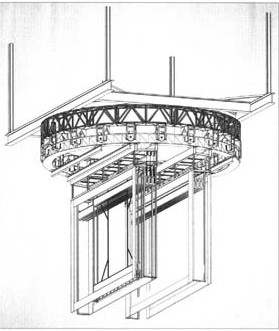
There is performance space between the frames. I have seen some footage showing how this may have worked. For example, during the gypsy scene, the guests are on one side of the device, while the frames (which probably appear as walls) rotate along with a section of the stage (oh, yes, the stage also had several rotating sections- nothing too astonding...) so that one scene slips into the next, and the gypsy is revealled on the other side of the frames as they turn towards the audience.
It will be interesting to see what West End techniques will be used in this production!
Jane Eyre The Musical runs from June 27 to July 1 with performances nightly and matinees on Wednesday and Saturday. The company is offering generous concessions for all those in full time education. Tickets are from £6.50 and are available at the box office on 01253 290190
Now, for some irksome business. Once again, the impression is that this production is a premiere. It is not. The show has already premiered in the UK. But, for some reason, many productions want to claim that theirs is a premiere nowadays (there were about three or four premieres in the US this year, I believe). This one even calls the show a 'new musical' just before mentioning that it opened in 2000 (on Broadway... the show had a run in La Jolla California, and Toronto Canada before that). One or two of my readers should be amused by this as well:
'It is without doubt still a modern day love story.'
Oh, and their poster gives us this interesting news: 'direct from Broadway.' ...The show closed 5 years ago.
Wednesday, June 21, 2006
A Housekeeping Notice and some Odds and Ends
I have been tinkering away behind the scenes here. The resource branch of the site, which is currently here, is not meeting the needs of this blog. Thankfully, the lovely people at Dalhousie University have given me webspace! So, as soon as I can find the time to imput the code, I should have a lovely new site that will be much easier on the eyes and easier to get around as well. (Having three pages for Jane Eyre illustrations is just silly, and I haven't even started posting items from my personal collection yet!) As always, contributions will be most welcome. I am hoping that copyright and storage quotas will also allow me to find some stable homes for the tons of radio, film, and audio adaptations I have been reposting ad nauseum. There's hope.
Also, I have already set up a forum for extended discussion. I hope to get that up and running with the website. The archives, are still in a terrible mess and I apologise for not making more progress in indexing everything.
While I am at it, I have to messages for my readers in general. First, a lot of my readers have been sending me their stories lately. I would like to hear more of them! You can find my email address through my profile. Also, I have the constant problem of links expiring. If you have had this problem and you want to have a file reposted it is best to email me directly. I often find it difficult to find which program, song, or file you mean when your message is only left in the comments.
Now, for some news!
Bronteblog has found a few more names for the supporting cast of Jane Eyre 2006.
Speaking of Jane Eyre 2006, I am sorry to say that the BBC has blundered... Following the lead of imdb, who despite my warnings did not fix the error on their page in time, the BBC have linked to the wrong Ruth Wilson. I must make this clear, since it is actually confusing some people... Jane Eyre is being played by the 24 year old Ruth Wilson and not the one who is 48. This is a mistake. I have written again, but by the time they catch it we might have our DVDs of the series already! (now, there's a happy thought!) (To make matters even more interesting, we now have THREE, three, count 'em three Ruth Wilsons!) I have already written to the BBC to point out the mistake.
One more bit of news... I am in anticipation that there will be something fun and surprising for those readers who admire the BBC's 1973 production of Jane Eyre, in the coming weeks- I hope. It may all come to nothing, but we'll see.
Tuesday, June 20, 2006
More Bronte News
I will be continuing the posts about the musical, but in the interim, we have a few news items:
This is totally harmless, but it made me smile this morning:
Towler cites Willa Cather, Edith Wharton, George Eliot, Charles Dickens and Jane Eyre as some of her biggest influences.
*hums 'one of these things is not like the others...'*
The Acting Company will be producing a production of Polly Teale's Jane Eyre in Hampton, Virginia.
Polly Teale's Jane Eyre comes up in an article otherwise off topic.
A translator makes a slight slip in naming Charlotte Bronte the author of Wuthering Heights. Only the other day one of my readers was telling me that her sister's teacher said they would be reading "Jane Eyre by Emily Bronte." When the sister said "but, sir, Charlotte wrote Jane Eyre. Emily wrote Wuthering Heights," the teacher only replied "I'll look into it." Look into it, as in look at the front cover of the book, perhaps... although I have actually seen covers which get it wrong. Therefore, I say 'slight slip.'
And Juliet Baker's brilliant 'The Brontes' is singled out for good comfort reading after a divorce!
Image is of Erin Moon and Jenn Miller Cribbs. Photography by Richard Termine.
Sunday, June 18, 2006
Bronte News
News about the Brontes has truly dried up this weekend. Everything is either repetitive or not at all interesting. I did save up some articles to share, so we do have something to discuss today.
Firstly, a production of Jane Eyre will be playing in Salt Lake:
The Riverton Arts Council will be performing "Jane Eyre" on June 30, July 1, 5, 6, 7 and 8 at the Riverton Civic Center's Sandra Newman Lloyd Auditorium. "Jane Eyre" is a haunting retelling of the Charlotte Bronte classic about an orphan girl who grows up to become a governess of Thornfield Hall. Tickets will be available after June 17 at Peterson's Marketplace and at the door on performance nights. Tickets are $8 for adults, $6 for children and seniors.
From google blog search, there are a few interesting articles:
This is a brief citation of Charlotte's The Professor in the context of, I suppose, Marxism?
The Conneticut Post has a post from Jane Freeman who wrote for the Bronte Society Gazette. She reprints her essays on Jane Eyre, starting with Jane Eyre and the Symbolic Landscape. She starts off her post with a brief plug for the BBC's 1973 Jane Eyre- which is always nice.
And Chris Saliba, draws my attention to Cold Comfort Farm by Stella Gibbons.
My favourite character was Mr Mybug, an author who is working on a biography of Branwell Bronte. His theory is that it was the sisters who were drunks, and not Branwell.
Friday, June 16, 2006
Makeovers for Wuthering Heights and Jane Eyre.
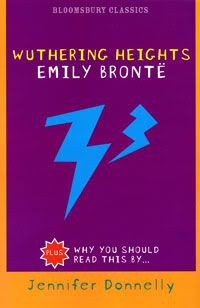
This august Bloomsbury in the UK is coming out with new editions of Wuthering Heights and Jane Eyre marketted to young readers: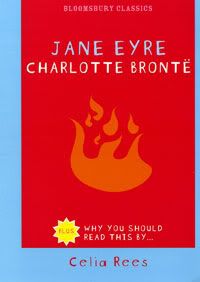
Emma Matthewson, deputy editorial director at Bloomsbury, also hopes that using specially-commissioned introductions will help to attract teenage readers. In August Bloomsbury will be launching a batch of classic titles - Jane Eyre, Wuthering Heights, Frankenstein, David Copperfield and, yes, Jane Austen’s Pride and Prejudice - in editions aimed at 14- to 16-year-olds. “When you had to read a classic for school, often the only available edition had a smudgy painting on the cover. It got me thinking that it would be so fantastic to have a version of a classic that looked amazing and pickupable and had lots of extras in it. Our new classics have introductions by authors that teenagers will be familiar with - it’s almost like having an author you really respect, whether it’s Philip Reeve or Meg Cabot, picking up the phone and saying: ‘Hey, you’ve got to read this book!’” The books will have gossipy, newspaper-like end sections to provide further information and historical context.
Wuthering Heights is introduced by Jennifer Donnelly, and Jane Eyre is introduced by Celia Rees. Here also are samples of their catalogue copy:
Orphaned as a young girl, Jane Eyre is brought up by her cruel and uncaring aunt. It is a gloomy start, but when Jane becomes governess to the dark and shadowy Mr Rochester, her life will never quite be the same again. So begins one of the greatest love stories of all time — a tale of grim secrets, passionate love and the power of the human spirit.
After her parents die, Cathy and Heathcliff grow up wild and free on the Yorkshire Moors and despite the continued bad feeling between Cathy’s brother, Hindley, and Heathcliff they're happy - until Cathy meets Edgar Linton, the son of a wealthy neighbour. It is Catherine’s eventual betrayal of Heathcliff which causes him to seek a violent revenge in this moving and intense masterpiece.
Celia Rees is an author of fiction for young adults and children. She has three books: Witch Child, Sorceress, and Pirates- all historical thrillers. Jennifer Donnelly has also written for children, and has three books to her credit: A Gathering Light, The Tea Rose, and Humble Pie.
Thursday, June 15, 2006
John Thornton likes Mr Rochester, Though Jane's a Little Dull
That would be John Thornton the critic not the character from North and South. I have recently read his review of Jane Eyre, and was much amused by his conclusion:
Thus Jane Eyre remains a beautiful sandcastle while it's being experienced, but not one of which much (save its brief heart) remains after the tides of time and memory crash down over its Thornfieldean parapets.
I like the word 'Thornfieldean' and I think this is the first instance of its use. For the record, I do not agree with Mr.Thornton but perhaps you could have guessed as much. It will never cease to amaze me how so many sensible people can read a book and then, taking a notion of what it is 'about', deem huge chunks of it irrelevant because it doesn't fit this notion. Shouldn't the presence of these other 'episodes' as he calls them indicate that the book is not simply about Rochester? It is true that the Thornfield chapters are so engrossing that many readers skip over those with St.John- critics do so all the time. The fault is not in the book but in how we read. If we are reading only for what is exciting or fun we will miss a lot. Mr.Thornton says a few silly things (although much of what he says besides is sensible). Some of this silliness is to think of the rest of the book as simply a device to make the book 'about Jane.' He claims there is no threat or challenge to Jane's values in the Lowood or Morton sections. I must say this is surprising to me. My only explaination can be that he also rushed through the Morton chapters. Sometimes I wonder what happened to close reading.
Now for something completely different...
Emily Brontë beat out a filly by a length (this would be Emily Brontë the racehorse...).


