


Jane Eyre BBC 1956
There's been no new information on the 1963 Jane Eyre, but my search has led me back to the previous BBC production- the 1956 version. I have no images ,[I've just found one!] and I don't know if this one still exists either but it sounds very interesting! I have heard some enthusiastic comments from people who remember it. I don't know if it would appeal to modern lovers of fidelity to the novel, though...
We saw that in 1963 Jane and Rochester came nearest to the 'perfect' age difference. In 1952 the BBC cast a Rochester who was only a whopping.. one year older than Jane. He was 29 and she was 28. Meanwhile, St.John was 32. Anyway, the strangeness continues. The production lists Constance Cox as a co-adaptor with Ian Dallas. She is also the adaptor of the 1963 version! Furthermore, our Jane (Daphne Slater) had just finished playing Elizabeth Bennet, and Harriet Smith before that, and Anne Elliot in 1960. There are a few fan recollections of Stanley Baker's performance: " I seem to remember a strong (and sexy!) performance as Mr Rochester." As with Richard Leech we can infer something about Stanley Baker's performance from his acting style in general.
To start off with, he was over 6 foot, and described personally as: rugged Welsh mining stock, unruly, quick to flare, and first to fight, proud and self-willed, posessing 'a fine speaking voice, a smouldering intensity, and a strong spirit.'
His was good-looking, but his features were angular, taut, austere and unwelcoming. His screen persona was taciturn, even surly, and the young actor displayed a predilection for introspection and blunt speaking, and was almost wilfully unromantic. For the times a potential leading actor cast heavily against the grain. Baker immediately proved a unique screen presence - tough, gritty, combustible – and possessing an aura of dark, even menacing power.
[...]
Film welcomed the adult Baker as the embodiment of evil. Memorable early roles cast the actor in feisty unsympathetic parts.
[...]
He established his own niche as an actor content to be admired for peerlessly portraying the disreputable and the unsympathetic. In that he was a dark mirror, more accurately reflecting human frailty and the vagaries of life than many of his more romantically or heroically inclined contemporaries.
He was also knighted in 1976. You can read more of this lengthy encomium here.
So, I imagine something like Wuthering Heights meets Pride and Prejudice... I have an image of Stanley Baker from the year of the production but once again Blogger is not co-operating. The link to the image is here.
Wednesday, June 28, 2006

Tuesday, June 27, 2006
Villette BBC 1970
Bronteana reader Liz has been writing to the BBC regarding their 1970 mini series of Villette, featured in this old Bronteana post (including photos of the actors who played Lucy Snowe and Monsieur Paul Emmanuel). She infers that the production still exists from their comment that it is 'not commercially available' and the recomendation that she write to BBC Worldwide to have it released. So, then, the hundreds of you out there who read my posts each day, this is the only adaptation of Villette. If it still exists, it should be available. If you feel as I do, send a polite note to BBC Worldwide and hopefully it will not take 30 years as Jane Eyre 1973 did!
BBC Worldwide. Commissioning Editor, BBC Worldwide Ltd, Woodlands, 80 Wood Lane, London, W12 0TT
Bronte News and A little More About Films
An extremely brief article about the students of the Ripley Academy of Dance and Drama taking part in filming for the BBC's new production of Jane Eyre to air in autumn 2006.
A brief review of the book Angry Words Softly Spoken: A Comparative Study of English and Arabic Women Writers by Alanoud Alsharekh.
The main premise of this study relies on many of the theories presented by the 1970’s feminist critical movement, especially that of Elaine Showalter’s tripartite structure.It also suggests a new tripartite structure for the evolution of feminist consciousness in works of fiction involving an inversion of scales in ‘softness’ and ‘anger’ explored through the work of such authors as Charlotte Brontë, Sarah Grand, Virginia Woolf, Layla al Othman, Nawal al Saadawi and Hanan al Shaykh.
The search for more information on Jane Eyre 1963 is on. I spent much of yesterday sifting through internet posts and fora- in some cases finding something exciting only to find that the post had been deleted. If anyone has any memories of the production, or knows if anything has survived from it, do not hestitate to contact me at bronteana.blogATgmailDOTcom.
So far, the obituary of Richard Leech, who played Mr Rochester, contains the best information on the style and reception of the work:
Leech had a busy career in films. His army officer in Ice Cold in Alex typified many of the offers that came his way: well-spoken and very much officer material. However, he always brought a definite sympathy and elegance to such roles. Sometimes he gave them a fine touch of irony, which allowed him to develop his skill at underplaying a character. In Tunes of Glory (in which he cut a fine figure in a kilt and did an athletic Eightsome Reel), he was one of the mess officers caught in the unholy struggle between John Mills and the hard drinking Guinness. Leech delivered careful, well-rounded performances in numerous other films, including Gandhi, Young Winston, The Dam Busters and The Shooting Party.
Leech was also a well-known face in numerous television dramas. In 1963, he was cast in a BBC serialisation of Jane Eyre as Mr Rochester (opposite Ann Bell), but it cut little ice with the public.
Monday, June 26, 2006
Jane Eyre 1963 Steps out of the Shadows
Well, this is surprising. I was looking for some images of a theatre production when I came across this. I had finished my search and thought that I would see what might turn up. This is an image from the BBC's 1963 mini-series of Jane Eyre. This is Richard Leech as Mr Rochester and Ann Bell as Jane Eyre. All the information available on this production can be fit into this post: It had a run time of 6 episodes (at 25 minutes each?)
Directed byRex Tucker
Writing credits (in alphabetical order)
Charlotte Brontë
novel adaptation Constance Cox
Cast (in credits order)
Ann Bell.... Jane Eyre
Richard Leech.... Mr. Rochester
rest of cast listed alphabetically:
Elsie Arnold.... Mrs. Fairfax
Rachel Clay.... Jane Eyre (as a child)
Justine Lord.... Blanche Ingram
Nan Marriott-Watson.... Grace Poole
Jane Merrow
Elaine Pratt.... Adele
William Russell.... St. John Rivers
Produced byDouglas Allen
Original Music byTristram Cary
The specifications on the image provide hope for new material as well:
Caption:Actor Richard Leech as Mr Rochester and actress Ann Bell in the title roll [sic] of Jane Eyre being serialised by the BBC at the Television Centre, Shepherds Bush.
By/Title:Harry Todd/Stringer
Date Created:29 Mar 1963 12:00 AM
Collection: Hulton Archive
Source: Hulton Archive
Date Submitted: 27 Oct 2003 08:46 PM
Object Name:98n/52/huty/13073/58
Release Information:No release.
Barcode:JE5908
More information, at the time of the production Richard Leech was 41, and Ann Bell was 23, making their difference in age almost match that of the book- in the book Mr Rochester is 20 years older (here he is 18 years older).
Some more trivia about the cast. Richard Leech was a practicing doctor, and his children had Noel Coward and Alec Guiness for godfathers. The actor playing St.John played Ian Chesterton, the 'companion' of the First Doctor in the original Dr.Who. While Ann Bell played Doris in Fahrenheit 451.

Sunday, June 25, 2006
Bronte News
So, here's today's news and the backlog as well. I thank you all for your supportive comments. I am feeling more at ease now. The etext is also finished but I would like to check it against the text before posting it to the Resource Site.
Author Sarah Waters claims Jane Eyre and Wuthering Heights influence her work, such as her novel Fingersmith.
Here is another review of Reader, I Married Him by Michele Roberts.
Jane Eyre is not part of this lady's emergency kit. Well, her loss. A friend of mine keeps a small copy of Villette at all times 'in case of emergency!' It would also come in handy for Random Acts of Bronte.
Canadian cities can learn a thing or two about marketting from Haworth.
Forget 'York' and 'Lancaster', this English class has a head-to-head literary death match- or rather a 2 hour quiz- with teams including 'The Bronte Sisters,' in Qatar:
There were six teams of senior students each consisting of six members with shingles commemorating Shakespeare, Wordsworth, Agatha Cristie, Bronte Sisters, Sarojini Naidu and Tagore.
[...]
Sarojini Naidu Bronte Sisters and Tagore were pipped at the post though raced hard.
Religious and literary pilgrimages merge in this article which mentions the venerable home of the Brontes.
And we have some very strong voices of protest against David Brooks' earlier article about gendered education which listed the Brontes as among the favourite books of women. You will have to scroll down to read this letter.
The 'lost classic' of Welsh literature, described as 'the Welsh Wuthering Heights' is to be made into a BBC radio4 production. The novel is called Country Dance:
Country Dance is a story of passion, jealousy and revenge centred around a young girl who grows up in an isolated rural community on the border between England and Wales.
She keeps a diary of everyone she meets but her daily scribblings fall into the wrong hands.
Saturday, June 24, 2006
Miscellany and an Apology
I must apologise. This post will not be very well structured. There is a backlog of news but I cannot concentrate this evening enough to cover everything. I hope to catch up in the morning. I'm in the midst of a family crisis which has shaken me somewhat.
Regarding my previous post about the BBC's linking to the wrong Ruth Wilson, I am glad to say that they wrote back to me that very day and have since corrected the mistake.
This morning, Mandy from the Yahoo! BRONTE message board inquired about a poem by Charlotte called 'Watching and Wishing'. I went to the Project Gutenburg etexts for the Brontes' poems but it was not there. I have two 19th century editions of their poems and in these I found the poem she was looking for. I also found two other poems which are not available online either: 'When Thou Sleepest' by Charlotte and 'The Outcast Mother' by Emily. I have started making an etext for these but I will have to wait until I can concentrate properly before I continue it. I hope to have it ready sometime tomorrow.
Bronteana reader Vaire also sends along this slideshow from the BBC regarding the project to revive the Sri Lankan lace industry, a project which includes their new production of Jane Eyre.
I do have 'Watching and Wishing' prepared (although it still needs to be checked against the text). So here it is, for Mandy and the rest of my readers:
Watching and Wishing
Oh, would I were the golden light
That shines around thee now,
As slumber shades the spotless white
Of that unclouded brow!
It watches through each changeful dream
Thy features' varied play:
It meets thy waking eyes' soft gleam
By dawn--by op'ning day.
Oh, would I were the crimson veil
Above thy couch of snow,
To dye that cheek so soft, so pale,
With my reflected glow!
Oh, would I were the cord of gold
Whose tassel, set with pearls,
Just meets the silken cov'ring's fold
And rest upon thy curls,
Dishevelled in thy rosy sleep,
And shading soft thy dreams,
Across their bright and raven sweep
The golden tassel gleams!
I would be anything for thee,
My love- my radiant love--
A flower, a bird, for sympathy,
A watchful star above.
Friday, June 23, 2006
The Evolution of Jane Eyre: The Musical, Part 4- La Jolla
This production features a massive revisioning of the entire work. It is odd how much is it and is not the same musical. All of the major songs remain, but the way the novel is treated has completely changed. The previous production was a 'musicalised BBC mini-series' this one is a feature film, an art film perhaps. And for the first time Bertha is drawn deeply into the domestic levels of the piece. It is evident that the show is concerned now with psychology, and with eliciting as much sympathy for Bertha as possible. Sometimes this goes over the top, sometimes it is done very well.
The change is immediate. The opening now begins with a music box playing the theme of the new ballad, 'Child in the Attic.' The lines 'in everyone's life there is darkeness and light' are changed to 'in one woman's...' and of course we are never sure which is 'the' woman, but of course they both are. We first see young Jane being hauled to, not the Red Room, but the attic of Gateshead. We don't see her rage, she simply asks what she has done. Her aunt says that she is willful and talks back. Following this is a scene in the attic in which the chorus emphasise over and over again that she is in THE ATTIC, attic, attic, attic, in the attic, the dark and ghostly attic attic attic. This would be one of the over the top parts. Got that? Attics will be important later on. Another interesting bit here is the rag doll. I do not know what was done on stage for this production but in all later ones Bertha has such a rag doll. When Jane meets her, Bertha is whinning for it and Jane hands it to her. Then they curtsy to eachother before Bertha walks off. The scene continues with the narrating Jane wailing- and, yes, this wail will be taken up by Bertha. John Reed appears to torment Jane, and suggesting that she kill herself. He mutilates her ragdoll with a pair of siscors. Both Janes sing over it, making the doll their sympathetic child as well as double. The sympathy will extend to Bertha as well.
The Gothic has been turned up. Thornfield has gone from 'a rambling manor on the northern hills' 'in a silent glade' to 'a dark, looming manor' in a 'silent valley' surrounded by 'lowering' 'misty hills' and 'mighty old thorn trees.' It never really recedes. Perhaps the closest it comes to receeding are in the scenes with the company or Mrs. Fairfax's songs. Suffice to say, all of the domestic scenes are cut. In Hay Lane, the rider introduces more gothicism into the tale- denominating Jane a witch, and himself 'a thoroughly unpleasant, violent fellow.' There is also more humor although it is a bit obvious. When Jane says that she is from 'just below' Rochester says: "Ah hah! I see! From just below. From some nether region of spirits! Some horse-terrifying limbo of darkness, eh?"
Adele's Opera is now a spoken scene. And it is cute, comedic, and extremely and obviously another device to amplify sympathies between characters and Bertha. In this version Celine was not a dancer but a tragedian, and Adele wants to be 'tragique' like mamman. She runs around wearing some curtains, and basically, acting out the novel. When Mrs. Fairfax calls out to her, Adele cries: "What voice speaks to me, through the raging storms?" Once Jane arrives things get worse. Threatened with her Latin lesson she cries: "I warn you! I will climb up to the battlements and throw myself to death!" "To 'my' death, shouldn't it be?" say Mrs. Fairfax. No, to Bertha's, but nevermind. Adele then takes on Ophelia just as Rochester comes in. As soon as she catches sight of him she exclaims: "Oh! Hamlet! My prince!" After Rochester bellows for her to take off the rags and 'learn something useful' she switches into French, saying he's a beast and she hates him.
Bertha seems to say 'shh! It's okay! It's okay!' before singing the wail Jane first uttered at Gateshead, laughing, gibbering and muttering, and finally whining and snarling over Rochester. After she has set the fire, she starts to sob and Jane's chorus says: 'in one woman's life there is darkness and light' as Bertha's crying melts into hysterical laughter before she runs off and Jane runs in. The song 'Sirens' features Rochester but also Jane and Bertha. Another element here is Mr. Mason. Previously he merely says that he can remember a time he could do some good for her. Now he emphasises her suffering much more: "I tried to stay away, forget her agony, but when I close my eyes it is her face I see."
Skipping well ahead now, there are slight changes to the scene of Bertha's revellation. In the time it takes them to get into the attic the audience may already be there. In later versions the audience is plunged into the attic immediately and we see Rochester, Jane and the others enter. Bertha is sobbing and wailing up a storm up there before they enter. Another change are Rochester's first lines. Previously, Bertha would attack less than 5 seconds after he had opened the door and he had only just time to snap 'just a few moments, Grace!' Now Rochester sings quite a bit: "The secrets of the house are right before your eyes! You stare at fate's abhomination! How gruesome is the sight of God's forgotten soul, so deep in her despair! How far beyond repair!"
Sadly, I haven't had time to touch on how Blanche has changed (and that the connections between she and Jane are also amplified). One last thing! Jane never goes to Morton- she ends up back at Gateshead where St.John is taking care of Mrs. Reed (who leaves all of her money to Jane).
Several short clips from a few of the productions are available here, and also the whole of Child in the Attic.
Songs: Secrets of the House, The Fever, the Orphan, Naughty Girl, Forgiveness, Helen's Death, The Graveyard, Sweet Liberty, Perfectly Nice, Hay Lane, The Governess, As Good As You, As I Retired for the Night, The Rescue, Sirens, The Aristocrats, The Finer Things, How You Look in the Night, The Pledge, Secret Soul, Sympathies, Sirens, Painting Her Portrait, In the Light of the Virgin Morning, The Gypsy, Second Self, The Chestnut Tree, Slip of a Girl, The Church, Gypsy Reprise, Farewell Good Angel, The Fever/My Maker, Child in the Attic, Forgiveness Reprise, In the Light of the Virgin Morning Reprise, Voice Across the Moors, Poor Sister, Brave Enough for Love.
Thursday, June 22, 2006
Jane Eyre: The Musical at Blackpool and a Lesson in Lighting
Jane Eyre the Musical is set to open at the Grand Theatre, Blackpool. This article gives the impression of a very interesting production:
The production is being staged using some of the most advanced lighting and sound techniques both being provided by West End professional organisations and the production is set to follow in the steps of the blockbuster Ragtime which took the Grand Theatre audiences by storm last June.
This is very good to hear. Jane Eyre's turn on Broadway marked a revolution in theatrical lighting- in more ways than one. The setting involves a massive carrousel above the stage to project images onto scrims, a device which was invented to meet the needs of the production which desired to create a show which was clearly a series of memories. Here is a diagram of the device, showing the scrims (which also rotate): 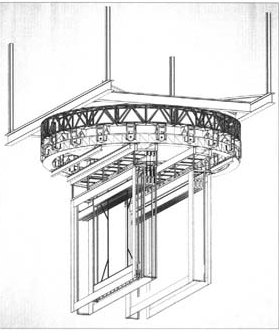
There is performance space between the frames. I have seen some footage showing how this may have worked. For example, during the gypsy scene, the guests are on one side of the device, while the frames (which probably appear as walls) rotate along with a section of the stage (oh, yes, the stage also had several rotating sections- nothing too astonding...) so that one scene slips into the next, and the gypsy is revealled on the other side of the frames as they turn towards the audience.
It will be interesting to see what West End techniques will be used in this production!
Jane Eyre The Musical runs from June 27 to July 1 with performances nightly and matinees on Wednesday and Saturday. The company is offering generous concessions for all those in full time education. Tickets are from £6.50 and are available at the box office on 01253 290190
Now, for some irksome business. Once again, the impression is that this production is a premiere. It is not. The show has already premiered in the UK. But, for some reason, many productions want to claim that theirs is a premiere nowadays (there were about three or four premieres in the US this year, I believe). This one even calls the show a 'new musical' just before mentioning that it opened in 2000 (on Broadway... the show had a run in La Jolla California, and Toronto Canada before that). One or two of my readers should be amused by this as well:
'It is without doubt still a modern day love story.'
Oh, and their poster gives us this interesting news: 'direct from Broadway.' ...The show closed 5 years ago.
Wednesday, June 21, 2006
A Housekeeping Notice and some Odds and Ends
I have been tinkering away behind the scenes here. The resource branch of the site, which is currently here, is not meeting the needs of this blog. Thankfully, the lovely people at Dalhousie University have given me webspace! So, as soon as I can find the time to imput the code, I should have a lovely new site that will be much easier on the eyes and easier to get around as well. (Having three pages for Jane Eyre illustrations is just silly, and I haven't even started posting items from my personal collection yet!) As always, contributions will be most welcome. I am hoping that copyright and storage quotas will also allow me to find some stable homes for the tons of radio, film, and audio adaptations I have been reposting ad nauseum. There's hope.
Also, I have already set up a forum for extended discussion. I hope to get that up and running with the website. The archives, are still in a terrible mess and I apologise for not making more progress in indexing everything.
While I am at it, I have to messages for my readers in general. First, a lot of my readers have been sending me their stories lately. I would like to hear more of them! You can find my email address through my profile. Also, I have the constant problem of links expiring. If you have had this problem and you want to have a file reposted it is best to email me directly. I often find it difficult to find which program, song, or file you mean when your message is only left in the comments.
Now, for some news!
Bronteblog has found a few more names for the supporting cast of Jane Eyre 2006.
Speaking of Jane Eyre 2006, I am sorry to say that the BBC has blundered... Following the lead of imdb, who despite my warnings did not fix the error on their page in time, the BBC have linked to the wrong Ruth Wilson. I must make this clear, since it is actually confusing some people... Jane Eyre is being played by the 24 year old Ruth Wilson and not the one who is 48. This is a mistake. I have written again, but by the time they catch it we might have our DVDs of the series already! (now, there's a happy thought!) (To make matters even more interesting, we now have THREE, three, count 'em three Ruth Wilsons!) I have already written to the BBC to point out the mistake.
One more bit of news... I am in anticipation that there will be something fun and surprising for those readers who admire the BBC's 1973 production of Jane Eyre, in the coming weeks- I hope. It may all come to nothing, but we'll see.
Tuesday, June 20, 2006
More Bronte News
I will be continuing the posts about the musical, but in the interim, we have a few news items:
This is totally harmless, but it made me smile this morning:
Towler cites Willa Cather, Edith Wharton, George Eliot, Charles Dickens and Jane Eyre as some of her biggest influences.
*hums 'one of these things is not like the others...'*
The Acting Company will be producing a production of Polly Teale's Jane Eyre in Hampton, Virginia.
Polly Teale's Jane Eyre comes up in an article otherwise off topic.
A translator makes a slight slip in naming Charlotte Bronte the author of Wuthering Heights. Only the other day one of my readers was telling me that her sister's teacher said they would be reading "Jane Eyre by Emily Bronte." When the sister said "but, sir, Charlotte wrote Jane Eyre. Emily wrote Wuthering Heights," the teacher only replied "I'll look into it." Look into it, as in look at the front cover of the book, perhaps... although I have actually seen covers which get it wrong. Therefore, I say 'slight slip.'
And Juliet Baker's brilliant 'The Brontes' is singled out for good comfort reading after a divorce!
Image is of Erin Moon and Jenn Miller Cribbs. Photography by Richard Termine.

Sunday, June 18, 2006
Bronte News
News about the Brontes has truly dried up this weekend. Everything is either repetitive or not at all interesting. I did save up some articles to share, so we do have something to discuss today.
Firstly, a production of Jane Eyre will be playing in Salt Lake:
The Riverton Arts Council will be performing "Jane Eyre" on June 30, July 1, 5, 6, 7 and 8 at the Riverton Civic Center's Sandra Newman Lloyd Auditorium. "Jane Eyre" is a haunting retelling of the Charlotte Bronte classic about an orphan girl who grows up to become a governess of Thornfield Hall. Tickets will be available after June 17 at Peterson's Marketplace and at the door on performance nights. Tickets are $8 for adults, $6 for children and seniors.
From google blog search, there are a few interesting articles:
This is a brief citation of Charlotte's The Professor in the context of, I suppose, Marxism?
The Conneticut Post has a post from Jane Freeman who wrote for the Bronte Society Gazette. She reprints her essays on Jane Eyre, starting with Jane Eyre and the Symbolic Landscape. She starts off her post with a brief plug for the BBC's 1973 Jane Eyre- which is always nice.
And Chris Saliba, draws my attention to Cold Comfort Farm by Stella Gibbons.
My favourite character was Mr Mybug, an author who is working on a biography of Branwell Bronte. His theory is that it was the sisters who were drunks, and not Branwell.
Friday, June 16, 2006
Makeovers for Wuthering Heights and Jane Eyre.
This august Bloomsbury in the UK is coming out with new editions of Wuthering Heights and Jane Eyre marketted to young readers:
Emma Matthewson, deputy editorial director at Bloomsbury, also hopes that using specially-commissioned introductions will help to attract teenage readers. In August Bloomsbury will be launching a batch of classic titles - Jane Eyre, Wuthering Heights, Frankenstein, David Copperfield and, yes, Jane Austen’s Pride and Prejudice - in editions aimed at 14- to 16-year-olds. “When you had to read a classic for school, often the only available edition had a smudgy painting on the cover. It got me thinking that it would be so fantastic to have a version of a classic that looked amazing and pickupable and had lots of extras in it. Our new classics have introductions by authors that teenagers will be familiar with - it’s almost like having an author you really respect, whether it’s Philip Reeve or Meg Cabot, picking up the phone and saying: ‘Hey, you’ve got to read this book!’” The books will have gossipy, newspaper-like end sections to provide further information and historical context.
Wuthering Heights is introduced by Jennifer Donnelly, and Jane Eyre is introduced by Celia Rees. Here also are samples of their catalogue copy:
Orphaned as a young girl, Jane Eyre is brought up by her cruel and uncaring aunt. It is a gloomy start, but when Jane becomes governess to the dark and shadowy Mr Rochester, her life will never quite be the same again. So begins one of the greatest love stories of all time — a tale of grim secrets, passionate love and the power of the human spirit.
After her parents die, Cathy and Heathcliff grow up wild and free on the Yorkshire Moors and despite the continued bad feeling between Cathy’s brother, Hindley, and Heathcliff they're happy - until Cathy meets Edgar Linton, the son of a wealthy neighbour. It is Catherine’s eventual betrayal of Heathcliff which causes him to seek a violent revenge in this moving and intense masterpiece.
Celia Rees is an author of fiction for young adults and children. She has three books: Witch Child, Sorceress, and Pirates- all historical thrillers. Jennifer Donnelly has also written for children, and has three books to her credit: A Gathering Light, The Tea Rose, and Humble Pie.


Thursday, June 15, 2006
John Thornton likes Mr Rochester, Though Jane's a Little Dull
That would be John Thornton the critic not the character from North and South. I have recently read his review of Jane Eyre, and was much amused by his conclusion:
Thus Jane Eyre remains a beautiful sandcastle while it's being experienced, but not one of which much (save its brief heart) remains after the tides of time and memory crash down over its Thornfieldean parapets.
I like the word 'Thornfieldean' and I think this is the first instance of its use. For the record, I do not agree with Mr.Thornton but perhaps you could have guessed as much. It will never cease to amaze me how so many sensible people can read a book and then, taking a notion of what it is 'about', deem huge chunks of it irrelevant because it doesn't fit this notion. Shouldn't the presence of these other 'episodes' as he calls them indicate that the book is not simply about Rochester? It is true that the Thornfield chapters are so engrossing that many readers skip over those with St.John- critics do so all the time. The fault is not in the book but in how we read. If we are reading only for what is exciting or fun we will miss a lot. Mr.Thornton says a few silly things (although much of what he says besides is sensible). Some of this silliness is to think of the rest of the book as simply a device to make the book 'about Jane.' He claims there is no threat or challenge to Jane's values in the Lowood or Morton sections. I must say this is surprising to me. My only explaination can be that he also rushed through the Morton chapters. Sometimes I wonder what happened to close reading.
Now for something completely different...
Emily Brontë beat out a filly by a length (this would be Emily Brontë the racehorse...).
Wednesday, June 14, 2006
Richard Lauer Jane Eyre illustrations
I uploaded these some months ago but have not had the chance to set them up properly at the Brontëana Resource Site (which is due for some major renovations). I am disappointed with the quality of these particular illustrations. At first glance, readers who are familiar with film adaptations of the novel commented that it was a little odd that the illustrations of Jane and Rochester should look so much like the actors who portrayed them in the 1997 film. In fact, I recognise a handful of these illustrations from actual frames in the film. I get the sense that someone was too lazy to come up with something more original- which is a terrible shame. Moreover, it seems to me that not only were the compositions copied from the film but I believe that the artist did not even draw these freehand. The kind of erratic hatching seen here is not the work of a freehand artist but comes across often when tracing is involved. I think the artist traced these illustrations from the film itself. The illustration of the proposal, for example is obviously from this scene (I apologise for not having a screencap from the exact moment):

The rest of the illustrations are available on the second page of Jane Eyre illustrations here.
Bronte News
There isn't very much to report. What has come up is still fairly repetitive or incidental so I thought it best to assemble it into one post.
Firstly, there's another news blip about the BBC's new version of Jane Eyre with Ruth Wilson and Toby Stephens. Apparently they bought some of their props from Matlock Antiques and Collectibles Centre.
Michael Berkeley's opera 'Jane Eyre' is reviewed again.
Jane Eyre and Wuthering Heights also headed a list of favourite books according to a poll of women.
Tuesday, June 13, 2006
UK Edition Extras for BBC Jane Eyre 1973
I have had confirmation that the UK edition does have a small photo gallery. For those of us who bought the US edition, the pictures are available here, thanks to Siansaska and Thisbeciel! A few of them are screencaps but two or three are new. One of them is clearly computer wallpaper material: 
Evolution of Jane Eyre: The Musical, Part Three- Royal Alexandra Theatre, Toronto, Canada.
By necessity, this post will pass over some very important information and observations. Firstly, because all that seems to remain is an audio recording of only fair to poor quality, which contains several gaps, and of course there is no indication of what was going on onstage. I can speculate, but I would rather have more solid proof. Secondly, this recording is over 3 hours long, and a proper analysis would simply be too long for this post.
In short, it has been said that this version is a musicalised BBC miniseries, and that truly is the best way to describe it. It is not sung-through, but it comes close to it. It was a task to come up with a list of the songs because characters very often sing for a few bars between songs, but sometimes I chose to include these pieces as proper songs because I felt they were too important to pass over without comment. A very many scenes which only appear in mini-series length productions are included- there is even a sung-through scene when Rochester haggles with Jane before she leaves for Gateshead. The hyper-fidelity of the previous adaptations is still present. Uncle Reed has lost his song, but now we have Jane's uncle John Eyre singing a reprise of 'Dream of a Child.'
What I like particularly about this production is its sense of balance. There are so many adaptations which take one element and blow it up to obscure all others that some have come to think it is not possible to be more subtle. This, the first fully dressed setting of the work hits on a nice balance between the gothic and the domestic, between romance and philosophy, between drama and comedy. We can see this in the treatment of Thornfield Hall. Jane's chorus describes it to us against a swell of uplifting music as 'a rambling mansion on the northern hills', and Jane completes the sketch with "in a silent glade. I'm alone in a strange new place, and I am not afraid." The gothic story inhabits the third floor, the story of Jane's domesticated life of tedium inhabits the school room, and the story of her developing romance the drawingroom and her bedroom.
Sorry- I cannot resist one more observation. This production answers a question I've had about later versions. I saw this picture* below, and wondered why on earth Mr Rochester would be in Jane's room. Later I saw a recording of the Broadway show which only told me that the scene was his 'Wild Boy' speech (which usually takes place in the garden). The scene had been cut short. In this version, after the 'wild boy' speech, Mr Rochester finds the portraits Jane painted of herself and Blanche. He reads the inscriptions, comments on them. It is only after this that he asks if she will sit up with him. So, problem solved except that there's a maddening silence in the middle of the scene! He has just finished saying 'she is a rare one, is she not Jane?' when there's a very long silence until he whispers back "goodnight, Jane." And I have no idea what is going on there! (incidentally, the later version turns the ending into a farce. In place of the dramatic tension of this scene, Rochester says: "I would be lonely here without you, my little elf!" and then thumps her on the back like a footballer saying " 'Night m'Jane!" So, no clues there...)
I had a very hard time deciding which song to upload. My computer is very slow, so I settled for a shorter clip- a Lowood scene. You can listen to the entire highlights CD here. It is out of print, so if you'd like to purchase it, you will have to hunt for it on Ebay. One note for anyone readapting this- fewer reprises would be nice.
Songs: The Secrets of the House, The Parents' Theme, Gateshead, As I lay Myself Down, Naughty Girl, Children of God, Forgiveness, Lowood Hymn, What You Prove Yourself to Be, Presentiments and Signs, Helen's Death/My Maker, Perfectly Nice, Upper Floor, Restless, Silent Rebellion/Hay Lane, The Master, The Governess, Adele's Opera, As Good As You, As I Retired for the Night, The Rescue, Next Morning, The Aristocrats, A Perfect Match, How You Look in the Night, Painting Her Portrait, Mr. Mason, The Pledge, Upper Floor Reprise, Portraits Reprise, Secret Soul, Dream of a Child, The Gypsy, Fifteen Pounds, Return to Gateshead, Dream of a Child Reprise, Forgiveness Reprise, In the Light of the Virgin Evening, Second Self, The Chestnut Tree, Slip of a Girl, The Wedding, Upper Floor Reprise, Wild Boy, Gyspy Reprise, Farewell Good Angel, My Maker Reprise, Morton, In the Light of the Virgin Morning Reprise, The Revelation, Portraits Reprise, In the Light of the Virgin Evening Reprise, A Voice Across the Moors, Return to Thornfield, Poor Sister, Finale, Brave Enough for Love.
*Pictures to come soon. I am having trouble with Blogger this morning.
Monday, June 12, 2006
Pulp Covers for Classic Books
This is the second fake book cover for Jane Eyre that I've come across in my travels. The other one, you might remember, was a contest winner designed by the Association of Librarians of the Czech Republic and featured a gun weilding Jane in shiny black leather. This one is a bit more disturbing since I've seen a lot of REAL covers which look more ridiculous than this!
Coincidentally, I made one of my own last night. It is a long story, but a friend who had been gone for a while returned with pictures of Michael Jayston from a 1970s drama he was in. One of these was from the credits and featured a really silly painting of him and the female lead (well, there is some resemblance in the face but as fit as Mr. Jayston is, those are clearly not his pecs). After laughing over it for too long, I was tempted to make this. Otherwise, I should never have done something so contrary to all I believe in. But it was 3 am...
There wasn't much to do. I merely replaced the painted heads with ones from a screencap of Jane Eyre! If anyone actually wants to see the original in all of its cheesy glory, this can be arranged.
You can see the rest of the covers, including the Iliad, Moby Dick, Little Women, Alice in Wonderland, and Animal Farm here.

Friday, June 09, 2006
Evolution of Jane Eyre: The Musical Part Two- Wichita
I have to confess that my notes are nowhere to be found. I do wish to move on, so I will simply have to catch up later. Another reason for my silence resently is that I am graduating tomorrow and I have been running about making sure everything is coordinated for the event.
So, this version is probably properly called a demo. The performers are clearly not yet comfirmed in their roles (only the regular leads- Marla Shaffel and Anthony Crivello are featured). It is, however, from a live performance onstage unlike the previous recording we looked at in the previous post. I do know something about the staging at this point- there was a basic sort of scafold stage, and that this design was 'blown up' for the Toronto staging due in part to a lack of time to rework the setting- apparently.
The show has started to look more like what will become the standard set of songs for the remaining versions with a few important exceptions. This version generally features greater hyper-fidelity to the novel than the demo. In this version Jane's parents have a song but Jane's uncle Reed also! The scene illustrates Jane's arrival at Gateshead as an infant. 'How We Pity Her' is titled by myself. It consists entirely of the Reeds heaping abuse on Jane- and was thankfully a song never seen again. The chorus now comes further out of the background. They now feature in 'Jane's Letter' for instance.
The gem of this work is clearly 'Silent Rebellion.' It seems to be the descendant of 'My Hope of Heaven' although the tune is entirely different. This is the 'feminist on the roof' scene once again. The music is lovely, the lyrics also. I suspect, however, that negative reviews in the press led to the song being toned down and reworked into 'Sweet Liberty' (several reviewers claimed, with wild inaccuracy, that the show imposed radical feminist ideas onto the text of Jane Eyre- the offending items being, in fact, direct quotes or paraphrases from the novel). The same charge was levelled at 'Sweet Liberty.' The song survives to Toronto. I prefer these earlier lyrics for their way of capturing the inner imaginative life Jane has for herself on the 3rd floor.
'The Governess' is a delightful song which survives to Toronto and then La Jolla but was cut before the show went to Broadway. Imagine Jane and Rochester's first interview set to music which highlights the teasing banter as well as some of Rochester's changes of mood in that scene. 'Wild Boy' has been shifted to the moment when Rochester has just revealled Bertha to everyone. There and then he tells his story, followed by 'Gypsy Reprise' which is Rochester trying to persuade Jane to stay. It is a good song, except for one troubling bit of incongruity- he keeps referring to her as 'sister' which is stretching things a bit. I would have even preferred 'Janet.' For those familiar with 'The Gypsy', Rochester's pursuasion is sung with this tune but Jane has a separate melody which sometimes jars- appropriately marking a disjunction between their intentions. A sample of the lyrics:
Rochester: I am a scoundrel, we know this to be! The floodgates of tears are now open to me! Now, you intend to fly off- to be free! Oh sister!
Jane: And I could lie there by his side, his little Jane, his little elf. And who would care? Well, I declare 'I care for myself!'
Rochester: My little friend, you're a comfort to me! Dear sister!
Jane: What friendship exists in your lying to me? Dear master.
Lastly, and I know how you have been waiting for this, we get to St.John Rivers. In the demo, he is a remarkably well-rounded character. In fact, his character is far better delineated in the demo than in more than a few films I've seen in my travels. He loses some ground here, but not much. If anything he is a little too loathesome, or more loathesome in this version, but less genuinely pious. The previous 'Standard of the Cross' was clearly not only about his devotion to God, but his inward stuggle against his own nature and inclination. This version is very much about the 'White Man's Burden': "All my hopes and joys, the powers of my race, are held within the light of Jesus shining from space," (at least that's what it sounds like he is saying). We are further encouraged to dislike him when he, quite rightly, is mortified that Jane wants to travel to India unmarried. It is faithful to the novel, yes, but without the softening of knowing his own struggles and his genuine faith it comes across as even more repulsive. His final musical line is rather Satanic in tone. The register is very high, and the words remind this little reader too much of the Temptation of Christ: "Giving your soul to me would be like giving your soul to God! I tell you this to purchase your Heavenly bliss, by yeilding to destiny's holy kiss.' Thankfully Rochester's voice comes in just in time! The characterisation is still far superior to the very benign, cute- even- St.John Riverses of the cinema.
And, look here! I actually uploaded something all by myself! Here, for your listening pleasure is 'Silent Rebellion.'
Songs: Secrets of the House, Parents' Theme, Gateshead, As I Lay Myself Down to Sleep, How We Pity Her, Naughty Girl, Children of God, Forgiveness, My Maker, Jane's Letter, Perfectly Nice, Silent Rebellion, The Governess, As Good As You, Painting Her Portrait, The Gypsy, Secret Soul, Second Self, The Chestnut Tree, Slip of a Girl, Wild Boy, Gypsy Reprise, Farewell Good Angel, The Standard of the Cross/Morton, A Voice Across the Moors, Finale, Brave Enough for Love.
Tuesday, June 06, 2006
Evolution of Jane Eyre: The Musical Part One: The Demo
This is the first in a series of posts I have put together in order to get some more indepth information concerning my research on Jane Eyre The Musical out of my head and onto this blog. There's so little information about the show available, I hope these posts will be of some use. If there are any questions do not hesitate to comment or to send me a line at bronteana.blogATgmailDOTcom. I have to keep these posts relatively brief because, well, I have written 10 pages on ONE element of the show. So, this is all of an intro I can give you, with that in mind except to say that having written about 15 pages of material for these posts I have lost them. So, if I forget anything there will be another post to fill in the gaps. Hopefully I will find my notes before I move onto Wichita, Toronto, La Jolla, and Broadway.
As far as I know, these demo songs date from 1995 (if I remember correctly). Some are from a later period, although I cannot tell much from this recording since they are out of chronological sequence. In general, the songs are performed on synthesizers, and the composer often sings while the regular cast members only appear briefly (in 'Sweet Liberty'). I have a partial cast list which I will have to post later. Most of these songs were cut by the time the show reached Bway while some remain in the underscore and others are refashioned into other pieces.
Paul Gordon, in an interview, once said that he was inspired within the first 10 pages of the novel to write. The first piece he composed for the work was 'The Parent's Theme.' This song is notable for a hyper-fidelity to the novel which characterises the early stages of the work's development. Jane's parents do not appear in the novel, but they are brought into the musical here in a pivotal way. The song introduces many important elements, themes, and symbols of the work including: caste, marriage, wealth, faith, love, and illness. Jane's father reminds me somewhat of Mr. Grey in that he believes his wife must regret marrying below her station.
Several songs are among the most beautiful written for the show and yet they did not progress into the work as it appeared onstage. One of these songs is 'My Hope of Heaven.' It would be equivalent to Jane's 'feminist on the roof' scene. The interesting thing is that the song reappears as Mr Rochester's proposal ('Second Self'). Having the two songs in the work would have made an interesting sensation. In a very late recording (from about a month before the show closed on Bway), a musical cue marking when Jane first recognises the Master as the Hay Lane Rider is taken from this song's line: "when will I meet a soul of my kind?" But since the song was removed, the moment loses that added connection to Jane's earlier longings. I believe this song is refashioned into 'Silent Rebellion' which I will talk about later, and then finally 'Sweet Liberty' which is one of the demos but which did not appear in the show until it appeared at La Jolla.
One song which should have been cut earlier (it does eventually get cut) is 'A Perfect Match.' It reminds me of Gilbert and Sullivan do Handel's Messiah. There's lightning-quick witticisms about society and marriage, overlaid with manly choruses of 'England is glorious! Long live England! Hosannah!' (The lyrics are toned down a bit later, into 'marriage is glorious' but the song is still irritating). The song, by the way, marks when Mr Rochester's engagement to Blanche is announced. Oh, and did I mention, there are also cymbals?
This is all I have the heart to write, without my notes! I also wished to have a few more clips to show but I forgot to request help in uploading the others- I do have 'My Hope of Heaven', kindly uploaded for me by Thisbeciel. I just recall, I have quite a lot to say about St.John Rivers, so perhaps I will have to run this article over two posts when I get the chance. Lastly, though, 'If You Could See the World' is affectionately known by some fans as 'Rockin' Rochester' since Edward has a bit of a 'rock out' moment there. St.John does as well... The songs all tend to have more of a pop/rock edge than their descendants do.
Songs: The Parents' Theme, As I Lay Myself Down to Sleep, I Suppose Miss Temple, Helen's Death, Jane's Letter, Private Moments, Secret Soul, Wild Boy, Dream of a Child, Forgiveness, In the Light of the Virgin Morning, Secret Soul Reprise, Jane and Hannah, The Things That Might Have Been, The Revelation, A Voice Across the Moors, Return to Thornfield, Finale, Sirens, My Hope of Heaven, Sweet Liberty, The Aristocrats, Restless, A Perfect Match, Miss Grey, If You Could See the World
Jane Eyre 2006 and... Timber?
This article is short, and there isn't much to it, really. Here we learn that the new BBC production of Jane Eyre is using massive amounts of timber to construct and reconstruct sets within Haddon Hall. There isn't much of interest for those not interested in the fact that a Yorkshire firm is providing the timber on a 'next day basis' and 'sometimes sooner.' But, there's one new hint about the style of the production:
The timber is being used to recreate a very particular period- 'the late 19th century'. We can all speculate later on how 'late' is appropriate for a book published in 1847. Dating the events in the story itself has been an ongoing debate in scholarly circles, with the current trend being that it must be in the early part of the century due to the absence of trains (people take a lot of carriages, and walks but there are no trains mentioned whatsoever). I have my reservations on that subject. Some even believe the events should take place in the 18th century. So far I have only seen evidence of one production going this route and it was a regional production of Jane Eyre: The Musical. My evidence is confined to a dance scene which looks accurate Regency period.
Apparently they are also adding fake stone arches within Haddon Hall using the timber. I can't imagine why.
Monday, June 05, 2006
Photo Journal of the American Premiere of Berkeley's Jane Eyre Opera
Bronte news has been slow this weekend. What little news there was, excluding repetitious articles about the Lowood 'scandal' including some corrections to some reports, was by and large what one of my professors would call 'oh, look!' kind of articles. As in, 'oh look! They like the Brontes!' or 'Oh, look! Someone mentioned Wuthering Heights!' But patience is usually rewarded. Today some lovely new photos from the American premiere of Michael Berkeley's opera Jane Eyre have just come in over the wire. The article can be read here.
Images are from the top: Scott Hendricks and Kelly Kaduce as Rochester and Jane, Kaduce, Hendricks, and Elizabeth Batton as Rochester, Jane, and Mrs. Rochester, and Redmon as Mrs. Fairfax, Kaduce as Jane, Elizabeth Reiter as Adele, and Batton (rear) as Mrs. Rochester. Photos by Ken Howard.
ETA: Some excerpts from a review of the production:
Berkeley quotes briefly from Britten's "The Turn of the Screw" and frequently from Donizetti's "Lucia di Lammermoor." He and Malouf have drawn a not-altogether-convincing connection between criminally insane Bertha Rochester and unstable Lucy Ashton, who went mad when forced to marry the wrong tenor and murdered her groom on their wedding night. I'm not sure a close reading of Bronte supports that conclusion, but it makes Bertha a far more interesting and sympathetic character than the raging beast who's usually portrayed.
The excellent cast is headed by soprano Kelly Kaduce in the title role. She captured both Jane's matter-of-factness and her anguish at the discovery of Rochester's proposed bigamy. Singing with a large, clear, well-produced voice, she brought the character to life.
Baritone Scott Hendricks brooded nicely and sang strongly and with presence. Mezzo-soprano Elizabeth Batton as Bertha Rochester made the role her own, with a rich, dark voice and edgy air of madness. As Mrs. Fairfax, mezzo-soprano Robynne Redmon made clear both the housekeeper's essential decency and her role in Rochester's deception. Soprano Adele Reiter sang sweetly as Adele and made a convincing child.
'Jane Eyre'
What: Opera Theatre of St. Louis
Where: Loretto-Hilton Center, Webster University
When: 8 p.m. Thursday, Saturday, June 14 and 16.
How much: $29-$105
More info: 314-961-0644 or experienceopera.org


Friday, June 02, 2006
Updates on 'The Bronte Project' by Jennifer Vandever
Jennifer Vandever wrote in today to let me in on the latest developments regarding her novel 'The Bronte Project.' Firstly, there is a new translation and several more on the way. The Spanish edition, El Proyecto Bronte can now be purchased here. Vandever also informs me that editions in Italian, and Polish are on their way as well.
More good news, especially for those of us who can't get enough Bronte on film, 'The Bronte Project' has been optioned for a film adaptation by Orchard Picture's producer Jen Small and director Nisha Ganatra!
For those who might have missed my previous posts on the book, here is a synopsis of the novel from Amazon.com:
From Publishers Weekly:
Vandever's irreverent debut novel dips into Victorian letters for inspiration, dredging up romantic angst to frame and foil a love story set in the age of new media. Sara Frost, a timid Charlotte Brontë scholar at a fictionalized New York university, is dragging her feet on both her engagement and her thesis, rooting around for Charlotte's vanished letters of unrequited love. The staid campus is roiled with the arrival of self-aggrandizing, firebrand Princess Diana scholar Claire Vigee. Sara's restive fiancé Paul, ignited by Claire's exhortations, bids her adieu and heads for Paris. Knocked off balance, Sara finds salvation in New Age narcissist Byrne Eammons, a film producer, who angles to spice up Charlotte's story for modern moviegoers. Drawn to Los Angeles and then Europe, Sara slowly finds her voice—determined not to suffer the fate of the "silent Victorian" she studies. Vandever, a screenwriter, sends up the pretensions of academia and the frippery of "infotainment," with its fast and loose readings of history. As Victorian romance runs up against pop psychology and banal reality, currents of love and longing unite past and present, but Vandever leavens Sara's self-discovery with liberal comic relief in this wickedly clever novel. Copyright © Reed Business Information, a division of Reed Elsevier Inc. All rights reserved.
Thursday, June 01, 2006
The content of this post may be distressing to some readers
The first item I have to share is not at all distressing. Lillie, (provider of many obscure musicals and Janian ones in particular), send me this link where you may view and download a Canadian student production of Jane Eyre: The Musical. The performance dates from May 23rd or 24th 2005, and was produced by the Burlington Student Theatre Company.
The next item probably beats everything wierd, bizarre, or otherwise odd that has come across the Bronteverse in the year I've been blogging.
Man eats a copy of Jane Eyre. You can view the graphic footage here.
June: Wuthering Heights Project Begins at Knit the Classics
We don't need an excuse to read Wuthering Heights, but how many of us have tried to make something inspired by our reading? I know there are a substantial number of my readers who have, but for the rest of us there's Knit the Classics' Wuthering Heights Project. The guidelines are simple: read Wuthering Heights, make something using a needle- knitting, emboidery, crochet- anything you like. On their website, which has just been updated to replace the Pride and Prejudice resources, you can find some designs for Victorian crafts which might get you started.
I confess that I started the Pride and Prejudice project last month but got a little distracted... I took a Victorian scarf design and, well, my Wuthering Heights project was finished a few weeks ago, while Darcy's head still needs embroidering. Oh well, so, as they say, here is one that I prepared earlier (this is also my first knitting project): 
An anecdote to conclude. My mother still refuses to read Jane Eyre. Her tendency to confuse it with Emma was maddening enough, but while I worked on the Pride and Prejudice Project she kept telling me to embroider scenes of Elizabeth and Mr Rochester at Thornfield. 'Darcy! Mr Darcy, mom!' I kept crying, in vain.
Needing to be Needed, a surprising lesson in Jane Eyre
I just finished Charlotte Bronte's Jane Eyre, and have been reflecting on one of the closing dialogues between the protagonist, Jane Eyre, and her unlikely anti-hero, Mr. Rochester. (For those inclined to read the book - and you should (though you can largely skip 50% of the verbiage in the book - Bronte goes on and on and on with 2000-3000 words when 20-30 would do...a bit like me, I suppose :-)
Fair advice... if you are reading Jane Eyre for insights into open source software! We fast forward to the last proposal in the book, and get this interesting commentary:
"...Jane, will you marry me?"
"Yes, sir."
"A poor blind man, whom you will have to lead about by the hand?"
"Yes, sir."
"A crippled man, twenty years older than you, whom you will have to wait on?"
"Yes, sir."
"Truly, Jane?"
"Most truly, sir." [At this point, Matt is blubbering in his airplane seat - I'm such a softie.]
"Oh! my darling! God bless you and reward you!"
"Mr. Rochester, if ever i did a good deed in my life - if ever I thought a good thought - if ever I prayed a sincere and blameless prayer - if ever I wished a righteous wish - I am rewarded now. To be your wife is, for me, to be as happy as I can be on earth."
"Because you delight in sacrifice."
"Sacrifice! What do I sacrifice? Famine for food, expectation for content. To be privileged to put my arms around what I value - to press my lips to what I love - to repose on what I trust: is that to make a sacrifice? If so, then certainly I delight in sacrifice."
"And to bear with my infirmities, Jane: to overlook my deficiencies."
"Which are none, sir, to me. I love you better now, when I can really be useful to you, than I did in your state of proud independence, when you disdained every part but that of the giver and protector." [My fellow Delta passengers are eyeing me suspiciously, wondering why a) a seemingly male personage is reading Jane Eyre and b) he is sniffling as he does so.]
"Hitherto I have hated to be helped - to be led: henceforth, I feel, I shall hate it no more. I did not like to put my hand into a hireling's, but it is pleasant to feel it circled by Jane's little fingers. I preferred utter loneliness to the constant attendance of servants; but Jane's soft ministry will be a perpetual joy. Jane suits me: do I suit her?"
"To the finest fibre of my nature, sir."
"The case being so, we have nothing in the world to wait for: we must be married instantly."
And so (nearly) concludes an excellent novel. And so, in turn, the novel reflects a great truth about people, generally, and open source software, specifically.
The best open source projects are those that invite and facilitate community. I've talked before about the right mechanics for facilitating communities, but one of the key ingredients - perhaps the key ingredient, is a sense of community within a project. People must feel that they belong. As with the TV show Cheers, "You want to be where everybody knows your name."
Tuesday, May 30, 2006
New Clips from Jane Eyre: The Musical
And, while I was making the previous post, another Brontëana reader shared these new clips from an old performance of Jane Eyre: The Musical when it was performed on Broadway. These clips are of the songs Sweet Liberty and Painting Her Portrait, both featuring Marla Schaffel. Enjoy! And thank you, AndySpectacular and Bronteana reader Siansaska for sending along the links. 

Brontëana Exclusive: Behind the Scenes of Jane Eyre 2006
While I was offline writing a post for today (about an early recording of Jane Eyre: The Musical) Brontëana reader Vairë sent me a most interesting email! She obtained permission to pass along this report from a visitor to Haddon Hall. Louise from Manchester visited the hall on Sunday, during an 'off-shooting day' and had quite a time looking around the set. Here is her full report as passed along to me:
She was invited back for shooting as well. She gave me permission to send this report on to you, which has not been seen on the net so far.
"It's a place called Haddon Hall in Derbyshire which is a Medival/Tudor stately home. The man in the gatehouse was wonderful and showed me a list of all the television and film productions that had used the Hall so far (including last years Pride and Prejudice with Kiera Knightley). He showed me articles from all the local newspapers and recommended that I should speak to one of the staff inside for more information. I went inside and asked a member of staff if she had any photographs she could show me and she showed me a WONDERFUL photograph of the house on fire and explained how it was done with pyrotechnics and she also showed me the huge red sign they have to put up during the week that says BBC PRODUCTION. FILMING IN PROGRESS.
Then I went inside and had a look around the house itself and one of the rooms had been altered by the BBC production team to look like Mr Rochester's library. It was amazing. The right hand wall was simply bookcases FULL of old looking genuine books (except all the books on the bottom two shelves - they're just book fronts). There were two tables in the centre of the room, an large chair in the far corner of the room and what looked like some sort of writing instrument on one of the tables. In a little alcove section of the room where the windows were a round table and chairs stood next a blackboard. Some of the writing had been wiped off but I could make out the words "Miss Grey" and "ettiquete."I then spoke to another member of staff about her experiences on set. She described how the staff were watching the scene where Bertha throws herself from the tower and how the stunt crew set up a giant inflatable and the stunt woman actually threw herself from the tower of Haddon Hall!
She also described what a wonderful group of people the cast were and how "the darling little girl, Georgie, who plays young Jane, is a pleasure to be around". She also mentioned how Haddon Hall was particuarly close to "the young girl fresh out of drama school who plays Jane" because her brother has recently married a local girl from that area.She also mentioned that Pam Ferris' character of Lady Ingrim seems to spend a lot of time in the kitchen. And how long and throughly tedious the filming process was and how they were lucky to get 2 scenes shot during a 7 hour day.
"the ruins shot is NOT being digitally remastered. They did indeed film in ruins but I can't remember the name. It's close to Haddon Hall where they are currently filming now and have been for quite some time.I'm not sure how much longer they're shooting for. I think it's going to be quite a while - the English weather isn't being very helpful and it's a very slow filming process."
She also plans to return this week and try to get pictures. Thank you for sharing this with us all, and I think it would be fair to say that a few hundred people are wishing you luck in getting back there and getting some pictures! Great job! And thanks again to Vairë for obtaining publishing permission for me.
Jane Eyre 2006 Courtesy of North and South
Thanks are due to Thisbeciel for the tip that scans from an issue of Peak District Life featuring the BBC's new production of Jane Eyre, complete with these wonderful new pictures:
You can view the scans yourself here.
One excerpt: "Diederick Santer also describes the approach they are using, 'It's extremely passionate and full-blooded. It starts and ends in Jane's head and is about a young woman's physical journey, her sexual journey. It's passionate and beautiful. We're trying to get away from too clichéd a story about the Mills and Boon thing of the governess falling in love with the Lord of the Manor'."
A very special thank you to Monika for posting the article!
ETA: In fact, thanks to Monika for scanning and posting, Christina for finding and linking, Thisbeciel for linking the links and piccing the pics. I think that about covers it.


Monday, May 29, 2006
Jane Eyre 1973 Available for Pre-Order from Amazon
You can now pre-order the DVD of the BBC's 1973 mini-series of Jane Eyre starring Sorcha Cusack and Michael Jayston at amazon.com, and amazon.co.uk. The region one edition will not be available at amazon.com until July 25th, but it is cheaper than other online stores including Acorn from whom you can order a copy right now, and get it sooner than expected (their shipping is really fast). The release date for the UK is still June 5th.

I came across some interesting technical specifications for this production for anyone who is interested.
When submitted to the BBFC the work had a running time of 247m 18s. This work was passed with no cuts made. Note that since February 2001 the BBFC has measured each component separately, but older works may not have the exact details, only a list of titles. 00:49:22:02 JANE EYRE - PART ONE00:47:35:14 JANE EYRE - PART TWO00:49:55:02 JANE EYRE - PART THREE00:49:53:03 JANE EYRE - PART FOUR00:50:31:24 JANE EYRE - PART FIVE Details are likely to be more complete and accurate for the version submitted most recently.When a film is transferred to video the running time will be shorter by approximately 4% due to the differing number of frames per second. This does not mean that the video version has been cut or re-edited.
The series recieved a PG rating for "mild violence and distress."
Saturday, May 27, 2006
Brontës in the Attic- I mean, Tower
A hoard of books are finally being taken down out of the library tower at Cambridge University. The books were put there in a belief that they were not of academic interest because they were 'too populist' or as this article puts it, 'low brow.' The rumor had been that it was a collection of pornography. Well, no. No, they're just some first editions of the Bronte novels after all!
And a few other things besides: first editions by Sir Walter Scott, Dickens, and Sir Arthur Conan Doyle, "Cookery books including one called Cheap, Nice and Nourishing Cookery, which recommends boiling carrots for two hours, and a Handbook of Domestic Cookery, with a recipe for calf's head and calf's foot soup," Home guides on health and beauty including Dr Foote's Home Cyclopedia of Popular Medical, Social and Sexual Science which recommended married people should not sleep together as the practice led to "uncongeniality", and a collection of penny dreadfuls!
Which works by the Brontes are included in the collection is not disclosed in this article but it implies that works by all three sisters are in the collection. Also, some of the works have not been read and are in pristine condition:
Professor Secord said: "The bulk of it still hasn't been touched. The typical book in there that you order up hasn't really been looked at before.When you go in to use the collection, you put in your slip and have the librarian bring up the paper knife so you can cut open the pages."
Michael Berkeley's Jane Eyre Opera has its American premiere
"We have walked round the piece and viewed it very much from the terrible predicament of the first Mrs. Rochester up in the attic. Jean Rhys' 'Wide Sargasso Sea,' feminism and the developments in psychology in recent years mean that we necessarily see the scenario with a contemporary eye," Berkeley said. "Jane is a very single-minded girl. Ultimately, it is a timeless story of 'three into two won't go,' and in the effort to make it go, a terrible price is paid. It's not just, 'Reader, I married him,' because we have, at the end, the corpse of the original Mrs. Rochester and Rochester himself burnt and blinded."
Where: Loretto-Hilton Center, Webster University
When: 7 p.m. June 4 and 8 p.m. June 8, 10, 14 and 16.
Should you take the children: Older teens
More info: 314-961-0171 or experienceopera.org
Image is of soprano Kelly Kaduce, with famed costume designer Jane Greenwood and draper Rick Tuckett. (Photo by Ken Howard)
Friday, May 26, 2006
More on the 'Missing Jane Eyre'
This article claims the hunt is on for the revised manuscript of Jane Eyre supposedly written to appease Rev. Carus Wilson, but never published. Thankfully there is one voice of sanity- Alan Bentley from the Bronte Parsonage Museum is also not convinced:
But Alan Bentley from the Bronte Parsonage Museum in Haworth said anyone finding the missing manuscript should not pin their hopes too high on getting a fortune for it.
"We're not entirely convinced. We think the story in the letters has got a bit confused.
"As far as we know there was never any correspondence between Charlotte and the Reverend.
"It's more likely to do with Mrs Gaskell."
The many doubts surrounding the story of Charlotte's revision of Jane Eyre to avoid libel are not bothering the dealers who are placing a £30,000 price on the manuscript.
A correction to my last post on this story: the letters which provide the only evidence for this story of revision were not written by Rev. Carus Wilson but by his grandson in 1912.
Thursday, May 25, 2006
Lowood Libel?
Splashed all over google news today is the auctioning of letters supposedly revealing a previously unknown court action only barely avoided by Charlotte Brontë. The letters, written in 1912 (when Miss Brontë had long ago been laid to rest), suggest that Charlotte wrote an apology for her depiction of Rev. Carus Wilson as Mr Brocklehurst, confessing to exaggerating the conditions at the school, and re-writing part of Jane Eyre. The 'apology' has never been seen, although the reverend apparently sold it to pay for medical treatment.
It appears that court action was only avoided when Bronte wrote an apology, pointing out that she had exaggerated the details.
The story of the dispute is disclosed in three letters by Mr Carus-Wilson's grandson, Edward Carus-Wilson, which have been put up for auction by an anonymous London book dealer and are due to be sold at Ludlow racecourse on June 21.
The letters were written in 1912 when Mr Carus-Wilson sold the manuscript of Bronte's retraction to an autograph collector to pay for his child's medical treatment.
Richard Westwood-Brookes, a documents expert for the auctioneers Mullock Madeley, in Shropshire, who decided to investigate the contents of the letters further, said: "The Bronte experts at the Parsonage Museum in Haworth were unaware of any kerfuffle involving Jane Eyre at the time it was published."
It seems very strange to me, especially since these articles claim that no one knew that there was any controversy over the Lowood passages of the novel. If I knew about it, I am sure others did. In fact, many of the books written about the Brontes cover the furor that errupted over the depictions of Lowood. Even after Charlotte's death, there were constant wrangling over it in the public press, even involving Charlotte's husband who broke his silence to defend his wife's depictions with perhaps too much passion. It is true that I've never heard of this crucial piece of evidence being presented- which begs the question of why it wasn't brought up at the time. It also seems quite out of character for Charlotte to choose to retract something she has written, when she was so often passionate about the truth of her depictions taken from her own experience.
Image is of the Rev. Carus Wilson.
Tuesday, May 23, 2006
The Professor in 10 parts!
This is the only adaptation of Charlotte Bronte's The Professor, that I have ever come across. It is not a beloved work. But someone thought it was worthy of a ten part adaptation! Here are the radio BBC episodes, courtesy of Thisbeciel:
One Two Three Four Five Six Seven Eight Nine Ten
Kate Bush... Again!
I've found clips for probably all of the performances of Kate Bush's song, Wuthering Heights. I had already posted 'the white dress' video. Here are the red dress, top of the pops and a live concert version for your viewing pleasure. It looks like she performs the same piece of choreography (which isn't simply 'crazy' dancing. To me it looks like classical modern dance but it has been awhile since I have seen dancing in the style of Martha Graham and Isadora Duncan).
The Red Dress clip, Top of the Pops, live concert.
We're All Mad Here
In an article about what is scribbled in the margins, the author mentions his own copy of Jane Eyre:
It seems, in fact, that mad scribblings are more common than sane ones. I was once shown a copy of Jane Eyre that was thick with the bile of a woman scorned. Every instance of a male character being brought to book or receiving any kind of comeuppance was heavily annotated, sometimes with "Ha!" added as an afterthought.
I had to smile when I read this. It reminded me of one of my professors and several of my classmates- I wonder if this is one of their copies. I recall the professor's glee at the thought of Bertha's attempts at murdering her husband, and then at burning down his house. On the last day of class, the class wrote Bronte-inspired limericks, one of them in praise of Bertha's 'burning the poor bastard.' My copy bears no such annotations. In fact, I am still horrified by the idea of writing in a book. I have a special copy which already had writing in it, so I feel less guilty about adding my own. It didn't come with any interesting notes. There are a few really ridiculous 'insights', though- for example, the deep symbolic ottomon. You know the one I mean, the one which is an allusion to Turkey. Don't remember it? Hm. Oh, and I've corrected it for punctuation, spelling, and grammar. I'm sure that you would correct it to if every time Mr Rochester proposed he would begin with offering to send Jane to 'Bittemutt Lodge'!
And I like mad scribblings! I would rather have mad ones. But most of my books are marginalia free. When I corrected exams, I did often find that people had annotated their own essays! This was an endless source of fun. Does anyone have any mad scribblings in the margins of their Bronte novels?
Sunday, May 21, 2006
Brontes on BBC Radio
Thanks to Thisbeciel and Biedroneczka for the tip that Tea with Mr Rochester by Frances Towers is playing on BBC Radio (which you can listen to online). Tea with Mr Rochester. A schoolgirl comes face to face with her literary idol. Read by Romola Garai.
More traditional fare is available as well. There's a production of Charlotte Bronte's Shirley, and Emily Bronte's Wuthering Heights.
For about a week you may also download these three radio adaptations of Jane Eyre (not from the BBC). Thisbeciel just cracked into a pile of these things, apparently:
Matinee Theatre- Gertrude Warner, Victor Jory (reported to be hilariously bad and heavily influenced by Rebecca.)
Favorite Story- Peggy Webber, William Conrad
Radio Hall of Fame- Joan Fontaine, Frederic March
Playhouse of Famous Authors- actors unknown
There's also the complete Shirley adaptation: Episode one, two, three, four, five, and six.
What Hasn't Been Done to Wuthering Heights?
I have a few Wuthering Heights clips today. First, the infamous The Semaphore version of Wuthering Heights from Monty Python's Flying Circus.
Keeping with the parody theme, there's also a sequel- part of a student English project: Wuthering Heights 2: Lock and Load starring Steven Segal as Lockwood. The premise? Wuthering Heights has turned into 'a protal to HELL!!!' and only one man can close it is Mr. Lockwood. There are lots of machine guns and demons. You can view the... trailer.. here.
And lastly, thanks to RuggedClause I bring you a 1978 music video of Kate Bush's 'Wuthering Heights,' which has to be one of the most bizarre things I've seen today.

Friday, May 19, 2006
Bronte News
Jane Eyre: The Musical is playing in Washington state: "Jane Eyre: The Musical": Edmonds Homeschool Resource Center presents a musical version of the classic Charlotte Bronte novel, 7 p.m. May 19 and 20, 2 p.m. May 20 and 21, $4. 23200 100th Ave. W., Edmonds; 425-670-7840.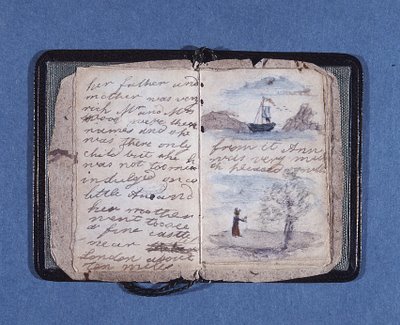
One of the earliest known manuscripts by Charlotte Brontë will be on display at the Bronte Parsonage Museum, and also featured on a BBC programme displaying 'quirky' items from British museums. Richard Wilcox from the Brontë Society Gazette has much more to say about the piece, on his blog- the Brontë Parsonage E-Magazine Blog. There is also a post about Clare Boyland, author of Emma Brown.
The Haworth Arts Festival will feature an outdoor screening of Wuthering Heights (and some... Bulgarian singing and Flamenco dancing!). For more infomation contact www.haworthartsgroup.co.uk or by phoning 01535 642329.
Wuthering Heights gets (very briefly) compared with Moulin Rouge. In fact, the comparison amount to the 'device' of having one lover die, leaving the other alone and doomed to a life of emptiness without that person who remains crystallized in the mind as the romantic ideal..'
The Bronte Project is reviewed again. This time there is a little more information about its plot but also some extremely vague statements that leave some awkward impressions.


